Ant Group has just released Ling 3.0 Flash, a 124B open weights model that score
- Source
- x.com
- Date

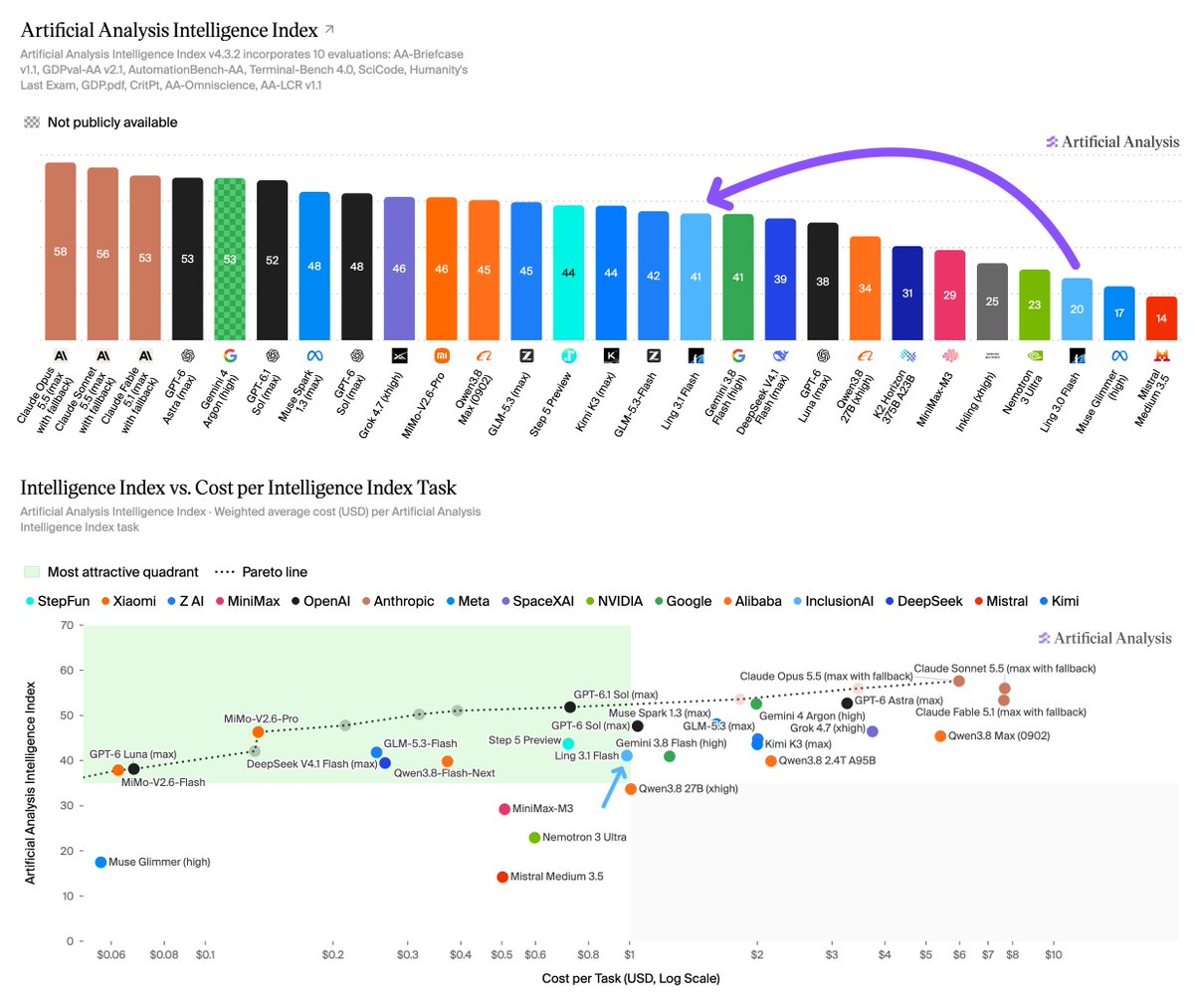
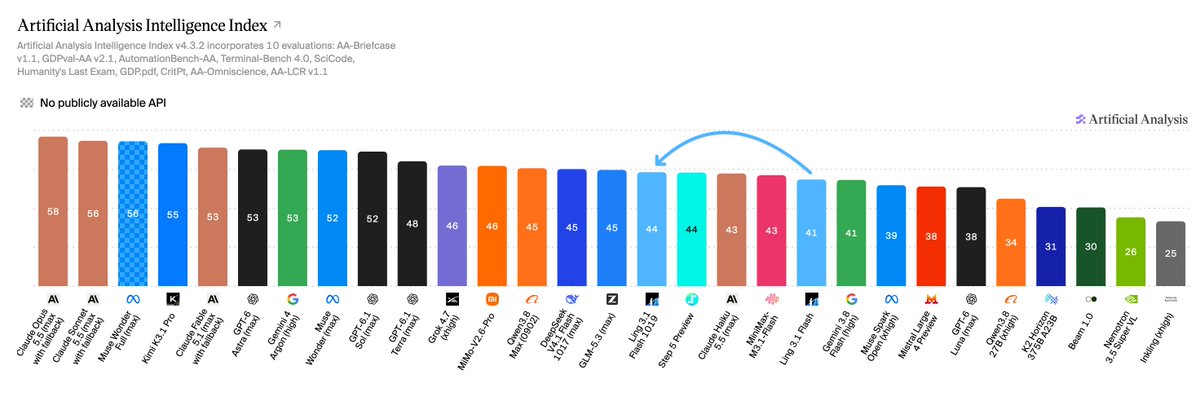
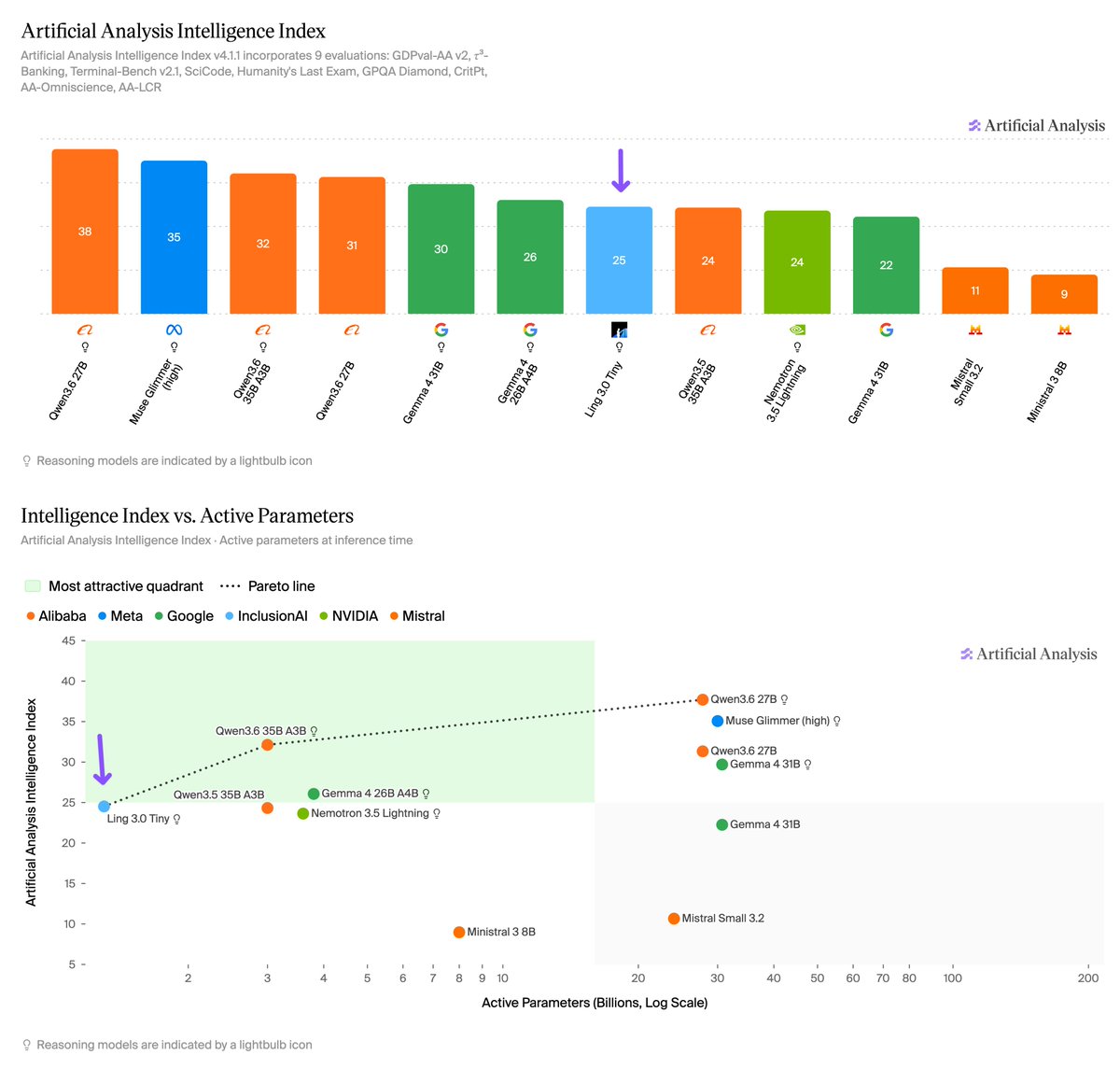
Ant Group has just released Ling 3.0 Flash, a 124B open weights model that scores 38 on the Artificial Analysis Intelligence Index. Ling 3.0 demonstrates a marked improvement over the previous generation and sits on the Pareto frontier for Intelligence versus Total Parameters among open weights models @AntGroup has released Ling 3.0 Flash, an open weights reasoning model with 124B total parameters and 5B active at inference time and a 262K token context window. It scores 38 on the Artificial Analysis Intelligence Index v4.1.1, 24 points above the previous generation Ling 2.6 Flash (Non-reasoning, 14). This matches MiMo-V2.5 (38) and Qwen3.6 27B (38) while using a third of MiMo-V2.5's active parameters. It remains behind the flash-tier open weights leader, DeepSeek V4 Flash 0731 (Reasoning, Max Effort) at 52. Key results: ➤ Ling 3.0 Flash sits on the open weights Pareto frontier for Intelligence vs. Total Parameters. No open weights model with fewer than 124B total parameters scores higher on the Artificial Analysis Intelligence Index, and at a comparable total size gpt-oss-120b (117B) scores 24, 14 points behind. The next model up the frontier is MiniMax-M2.7, which scores 39…

Context
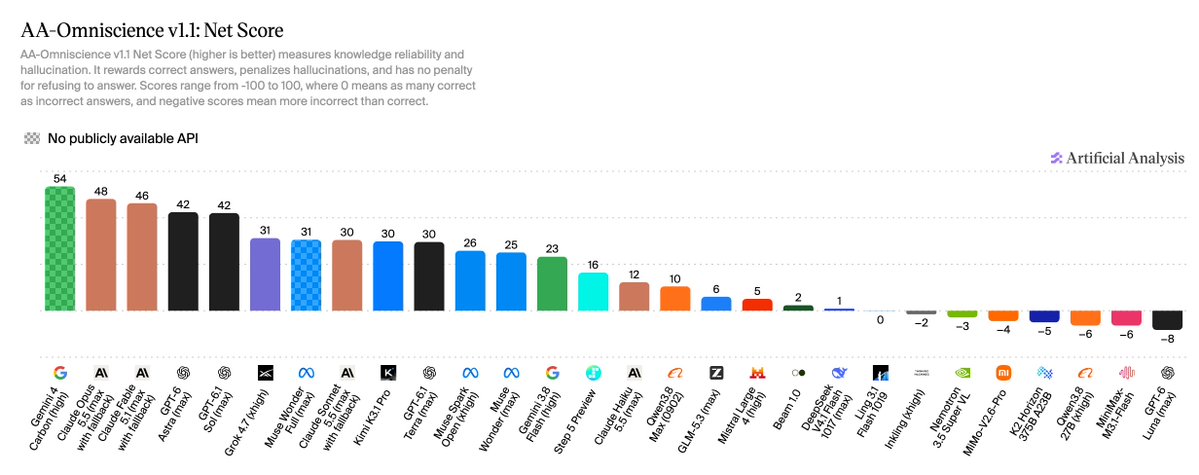
Most of Ling 3.0 Flash's gain on a knowledge-reliability test came from declining questions, not from answering more of them correctly. In its benchmark thread, Artificial Analysis reports that Ant Group's new open-weights model scores -18 on the AA-Omniscience Index, up from -66 for the non-reasoning Ling 2.6 Flash. Over the same comparison, the share of all questions answered correctly moved only from 16% to 18%, while the share the model attempted fell from 99% to 56%.
The scoring rule explains how both can be true. The AA-Omniscience methodology gives +1 for a correct answer, -1 for a wrong one and 0 when the model does not try. A model that stops guessing on questions it would have got wrong sheds penalties without knowing anything new. Artificial Analysis tracks this with its rate: of the responses that were not correct, the share that were wrong answers rather than abstentions. For Ling 3.0 Flash it fell from 97% to 44%.
The measured change is restraint rather than recall. Ling 3.0 Flash still answers fewer than one in five of these questions correctly, about the same as its predecessor, but it is much less likely to give a wrong answer where it lacks the knowledge. Artificial Analysis puts it the same way: the model "answers far fewer questions but is far less likely to hallucinate when it does answer."
- hallucination — When a model states something false with full confidence — inventing facts, citations, or APIs that don't exist.
- open weights — A model whose trained parameters are published for anyone to download and run — unlike API-only models you can access but never possess.
- reasoning model — A model trained to think — generating extended internal reasoning before answering — trading time and tokens for accuracy on hard problems.
- token — The chunk of text a model reads and writes in — roughly three-quarters of a word — and the unit AI usage is billed in.
Checking sign-in…
Loading comments…