Stanford Study: Self-Consistency Can't Fix Truthfulness
- Source
- x.com
- Date

LLMs are better at predicting what other models will say than what’s actually true. When they’re wrong, they’re wrong together; so polling can’t recover the truth. Check out this paper at ICML! 🇰🇷 https://t.co/IMTA2pZqTK
Context
Polling multiple models, or the same model multiple times, and treating the majority answer as more trustworthy borrows from 'wisdom of crowds' reasoning that works when judges reach their answers independently. A Stanford paper, Consensus is Not Verification, accepted at ICML 2026, and Stanford SAIL's post about it state the finding plainly: language models are better at predicting what other models will say than at determining what is actually true, so when they are wrong, they tend to be wrong together.
The paper reports that this correlated-error pattern held even under heavy scaling: spending as much as 25 times the cost of a single sample on polling-style aggregation produced no consistent accuracy gains, because model errors are correlated both within and across model families rather than independent, which is what crowd-wisdom aggregation requires to work.
- inference — Running a trained model to get answers — the phase where AI is actually used, as opposed to trained.

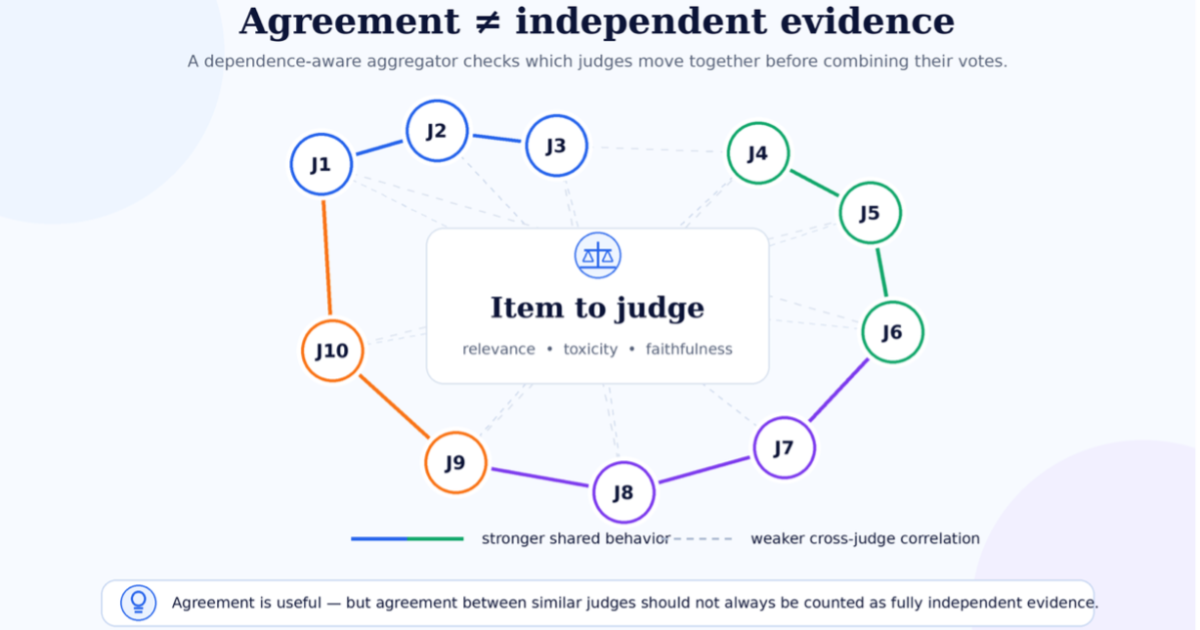 articleWhen LLM judges agree, should we believe them?www.amazon.science
 articleAgreement Overstates Evidence: Error Dependence in LLM Judge ConsensusElias Hossain, Niloofar Yousefi, Ser-Nam Lim
 articleChain-of-Models: Cross-Model Auditing for Bias-Robust LLM JudgesQian Wang, Zhanzhi Lou, Zhenheng Tang, Nuo Chen, Bingsheng He
Checking sign-in…
Loading comments…