OpenAI Releases GPT-6 Sol and Luna at Half the API Price
- Source
- x.com
- Date
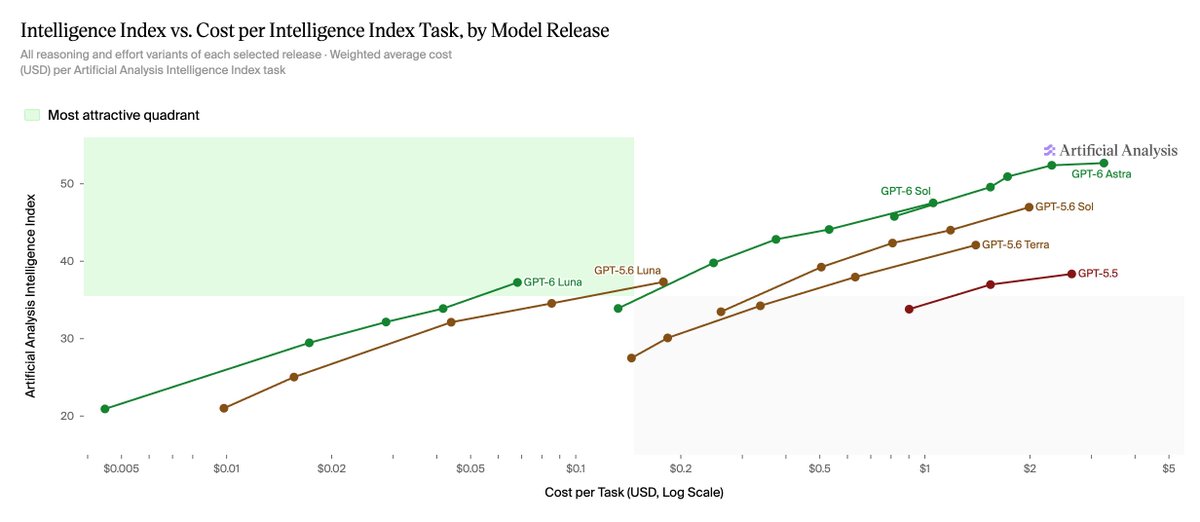
OpenAI says Sol and Luna carry GPT-6 Astra's capabilities into cheaper tiers, with API pricing half of GPT-5.6's promotional rates and rollout across Codex and ChatGPT Work. OpenAI's developer account claims near-parity with Claude Fable 5 on long-horizon coding at far lower cost. Artificial Analysis found cost per task roughly halved against GPT-5.6 with flat intelligence scores, but the two models split on its Coding Agent Index: Sol improved while Luna regressed. That split matters for routing, since Luna is pitched for high-volume agent work where coding quality may still count. OpenAI paired the launch with caching changes: higher default prompt-cache hit rates, a caching dashboard and diagnostics API that show what broke reuse, and explicit cache breakpoints so agents keep discounts while adjusting tools or reasoning effort. Simon Willison's pricing table shows the launch landing the same day as Opus 5.5, pushing frontier per-token prices down across vendors at once.

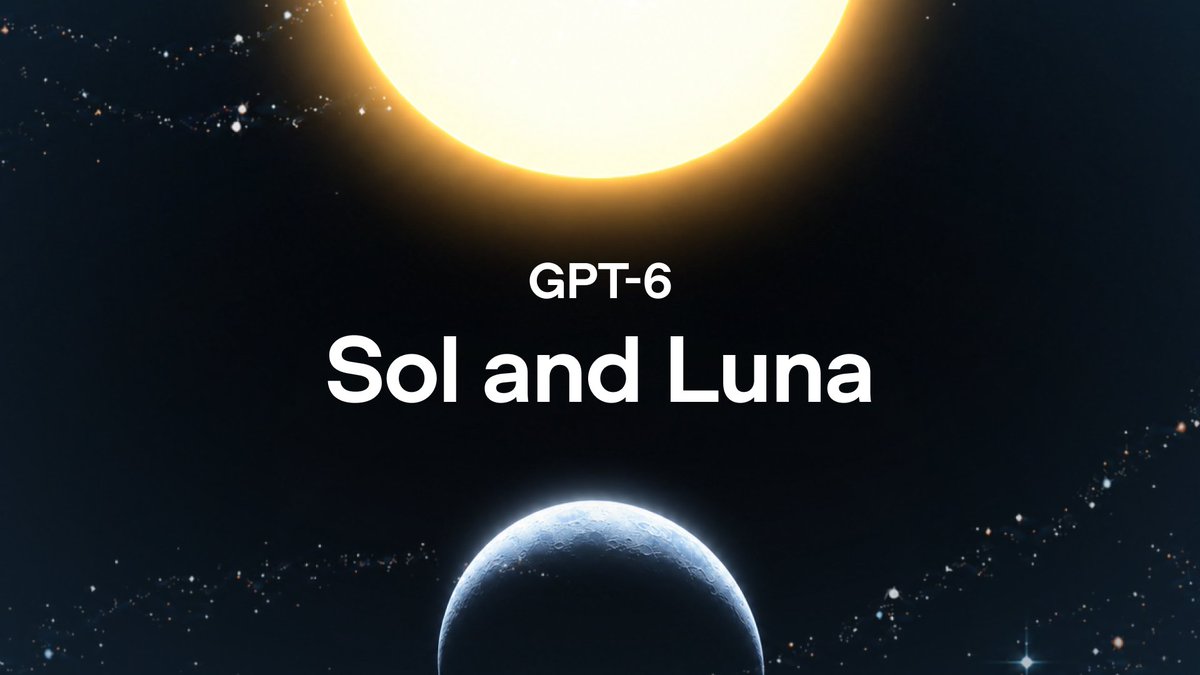
Please welcome GPT-6 Sol and GPT-6 Luna to the GPT-6 universe. GPT-6 Sol and Luna build on the advances behind GPT-6 Astra, bringing much of its strengths into faster and more affordable models to support work at scale. We’ve also made caching and inference more efficient, and we’re passing the savings directly to you: 50% lower API prices for Sol and Luna compared with GPT‑5.6 promotional pricing.

Context
OpenAI released two new models, GPT-6 Sol and GPT-6 Luna, which it describes as bringing much of the strength of its top GPT-6 Astra model into faster, cheaper versions for high-volume work (OpenAI on X). OpenAI says it made caching and more efficient and is passing the savings on: API prices for both are 50% lower than the promotional prices of the GPT-5.6 models they follow.
The word promotional matters. Simon Willison notes that GPT-5.6 had a 25% price increase scheduled for November, so the new models cost half of GPT-5.6's discounted rate, and less than half of what GPT-5.6 was due to cost (simonwillison.net). In dollars, Sol goes from $4 to $2 per million input and from $20 to $10 per million output tokens. Luna goes from $0.20 to $0.10 for input and from $1.20 to $0.50 for output, slightly more than half off.
The announcement post gives no numbers, and its attached launch video could not be reviewed, so on this evidence the claim that the models carry much of Astra's strength is OpenAI's own and unquantified. Artificial Analysis, which ran its own tests on launch day, found both models scoring level with their GPT-5.6 predecessors overall, with gains on some tests and losses on others, and cost per task cut roughly in half by the lower prices (its results). On those measurements the release changes what the work costs more than what the models can do.
- inference — Running a trained model to get answers — the phase where AI is actually used, as opposed to trained.
- token — The chunk of text a model reads and writes in — roughly three-quarters of a word — and the unit AI usage is billed in.
- benchmark — A standard public test set for comparing AI models — the shared scoreboards behind every "model X beats model Y" claim.

Checking sign-in…
Loading comments…