Training A Scalable Forecasting Agent
- Source
- thinkingmachines.ai
- Author
- Thinking Machines editorial sitemap
- Date
Context
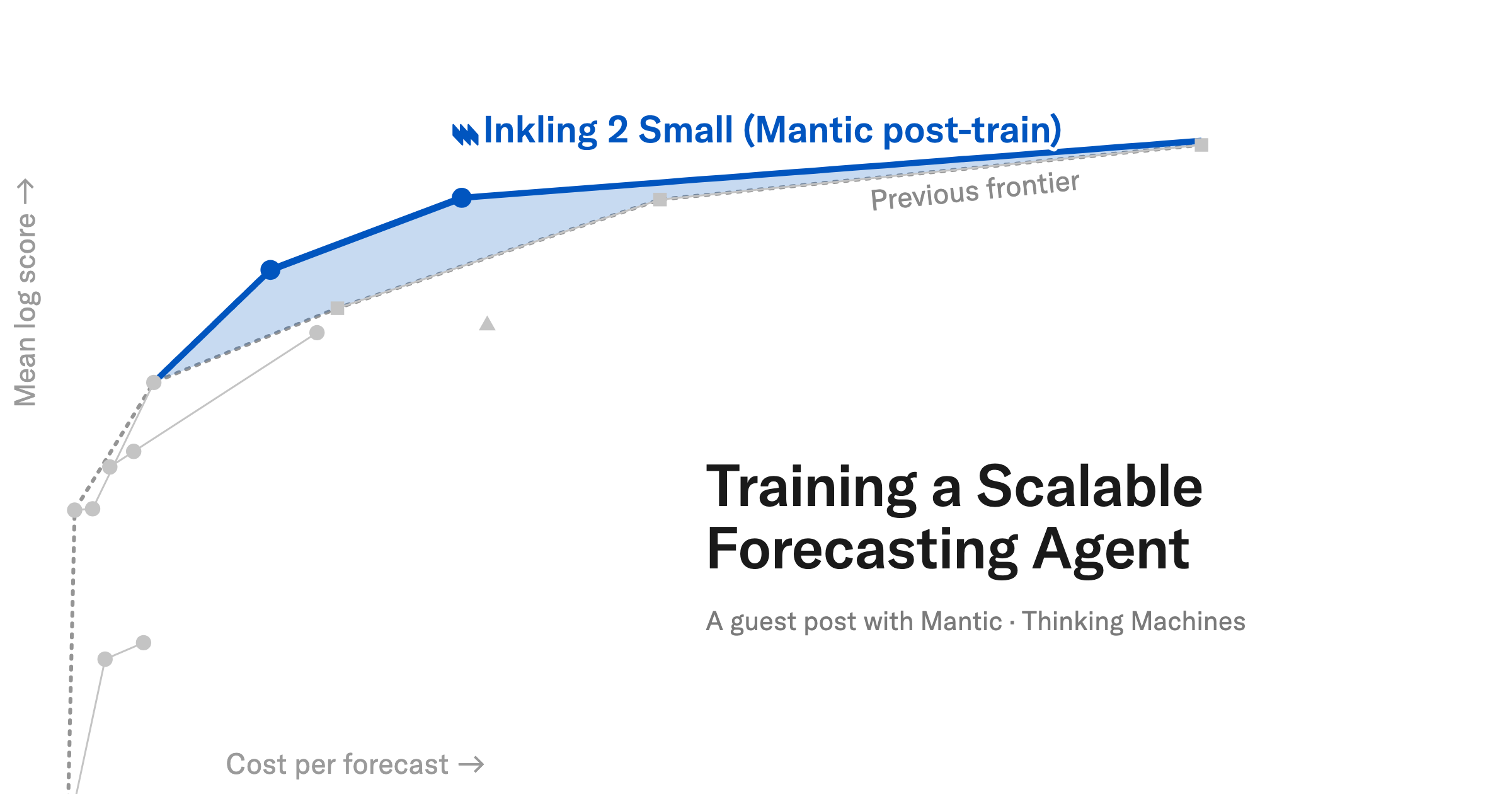
Mantic, a company that builds AI forecasting systems, reports that it has trained a small model to forecast about as accurately as Fable 5.2 (medium) at one fifteenth of the cost per forecast. The work appears as a guest post on the Thinking Machines site, written with Thinking Machines: the starting model is that lab's Inkling 2 Small, and training ran on Tinker, its service for models. Cost is the point of the exercise. Mantic counts roughly 1,000 interesting global questions on the major prediction markets and argues that useful forecasts run orders of magnitude beyond that, which only cheap forecasts can cover. Its demonstration is 100,000 forecasts of 2027 revenue and earnings per share for S&P 500 companies under 50 economic and geopolitical scenarios.
The accuracy comparison uses the mean log score, the logarithm of the probability a forecast placed on what actually happened, so a confident miss costs far more than a hedged one. Mantic ran it on 200 held-out numerical questions from Metaculus, Polymarket, Kalshi and its own platform, all with prediction dates after 15 September 2026, which the post gives as Inkling 2 Small's , so the model cannot have absorbed the answers during . The result is Mantic's own evaluation, shown as a chart; the text gives neither dollar costs nor absolute scores.
Getting there took more than fine-tuning on past answers. In an earlier guest post, Mantic trained a model to predict from research that other agents had gathered; this time a single agent does both, receiving a question, tools that search news, Wikipedia and economic data as they stood on the question's date, and a code runner, then submitting a probability distribution. Public questions proved too scarce to train on: of about 848,000 numerical questions resolved on Metaculus, Polymarket and Kalshi in 2026, about 3,900 survived the removal of duplicates, off-topic and low-quality questions, so Mantic used language models to write 45,000 questions from the news and checked that gains on them carried over to public questions. Live data services were too slow, since under their rate limits the training run would have taken around nine years, so Mantic keeps its own copies, including a 1.32 TB point-in-time copy of Wikipedia's full revision history. Rewards were noisy, because on any one question an overconfident guess can get lucky, so the reward mixes the real outcome's score with agreement with a reference forecast from an ensemble of frontier models, accepting some bias toward those models' errors.
The post's worked example shows what changed in the agent's behavior. Asked for the Bank of Korea's August 2026 producer price index for coal and petroleum products, the base model made 25 tool calls and four code calls, drew one straight line against the oil price and submitted a median of 225. The trained agent made 49 tool calls and nine code calls, found that refinery price caps were frozen and a fuel-tax cut ran to the end of July, estimated that only about 0.38% of each 1% oil move reaches the index in the same month, checked that against the 2022 oil crash and submitted a median of 272. The post does not say how that question resolved; it presents the case as typical of a shift, measured across training, toward forecasts in data and modeling them in code.
- Mantic post-trained Inkling 2 Small on Tinker into a forecasting agent that does research and prediction in one rollout. The authors report accuracy roughly matching Fable 5.2 (medium) at about 15x lower cost per forecast.
- Public prediction markets supplied too few usable training questions after deduplication and filtering, so the team generated 45,000 quantitative questions from news with LLMs and checked that gains carried over to held-out questions from real prediction sites.
- Calling third-party data APIs live during RL would have made the run take about nine years under rate limits. The team instead mirrors point-in-time data in its own databases, including a 1.32 TB indexed copy of Wikipedia's full revision history.
- Because a single resolved outcome can reward an overconfident guess, the reward mixes the outcome log score with the expected log score under a reference forecast from an ensemble of frontier models. The stated tradeoff is a bias toward those models' errors.
- In a Bank of Korea price-index example, the fine-tuned agent made 49 tool calls and nine code calls versus 25 and four for the base model, found frozen refinery price caps and a fuel-tax cut, and modeled oil pass-through month by month instead of fitting one straight line.
- fine-tuning — Taking a trained model and training it a bit more on your own examples so it gets better at one specific job.
- knowledge cutoff — The date after which a model saw no training data — everything later has to reach it through search, tools, or the context window.
- pretraining — The first, biggest phase of building a model: training it on enormous amounts of text so it learns language, facts, and reasoning in general.
- grounding — Tying a model's answers to checkable sources — retrieved documents, live data, tool results — instead of letting it answer from memory alone.



Checking sign-in…
Loading comments…