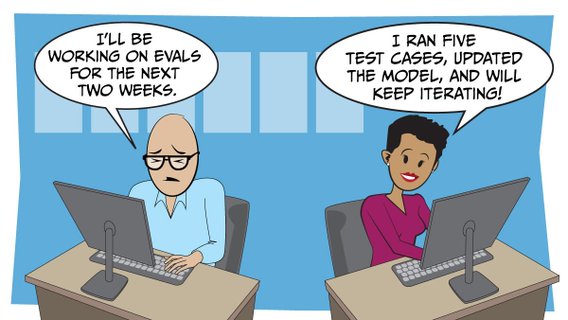
Gives a working definition of evals that does not require a single metric or perfect accuracy, and says when lighter rigor is justified. Helps teams stop treating evals as all-or-nothing.
Key takeaways · AI-distilled
Shankar and Hamel Husain define evalA repeatable test for AI quality — a set of tasks plus scoring — used the way software teams use test suites, because model output is too variable to judge by eyeballing.Full definition → as the systematic measurement of ApplicationSoftware arranged so that a person can use it; in this course, the software around a model that accepts your request, prepares the context and shows the reply.Full definition → quality: no particular metric, method or single number is required, and an estimate counts, as long as checking is continuous and deliberate rather than ad hoc.
Teams building coding agents inherit heavy upstream evaluation: model providers optimize and publicly report coding, math, ToolAn operation that the software around a model makes available for the model to request, with a name, expected inputs and a kind of result.Full definition →-use and long-Context and context windowContext is the information available for a generation; the context window is the capacity available to hold it.Full definition → performance in posttraining, so someone else has already done much of the eval work for that task.
Shankar names two situations where lighter eval processes work: the task is well represented in posttraining, or the team has the domain expertise and taste to steer by continuous dogfooding and error analysis.
In her experience complex document processing needs rigorous evals: a document fitting in the context window does not mean the model completes the task, so her team decomposes the task into smaller pieces and designs an eval for each.
She argues anti-eval sentiment hurts newcomers most: teams whose tasks are not well covered by posttraining and who lack error-analysis experience lose the tools that show what works, what does not, and how to make progress.
Terms in this piece · Glossary
eval — A repeatable test for AI quality — a set of tasks plus scoring — used the way software teams use test suites, because model output is too variable to judge by eyeballing.
Application — Software arranged so that a person can use it; in this course, the software around a model that accepts your request, prepares the context and shows the reply.
Tool — An operation that the software around a model makes available for the model to request, with a name, expected inputs and a kind of result.
Context and context window — Context is the information available for a generation; the context window is the capacity available to hold it.