Ant Ling releases open-weight LingSante-3.1-flash medical MoE model
- Source
- x.com
- Date

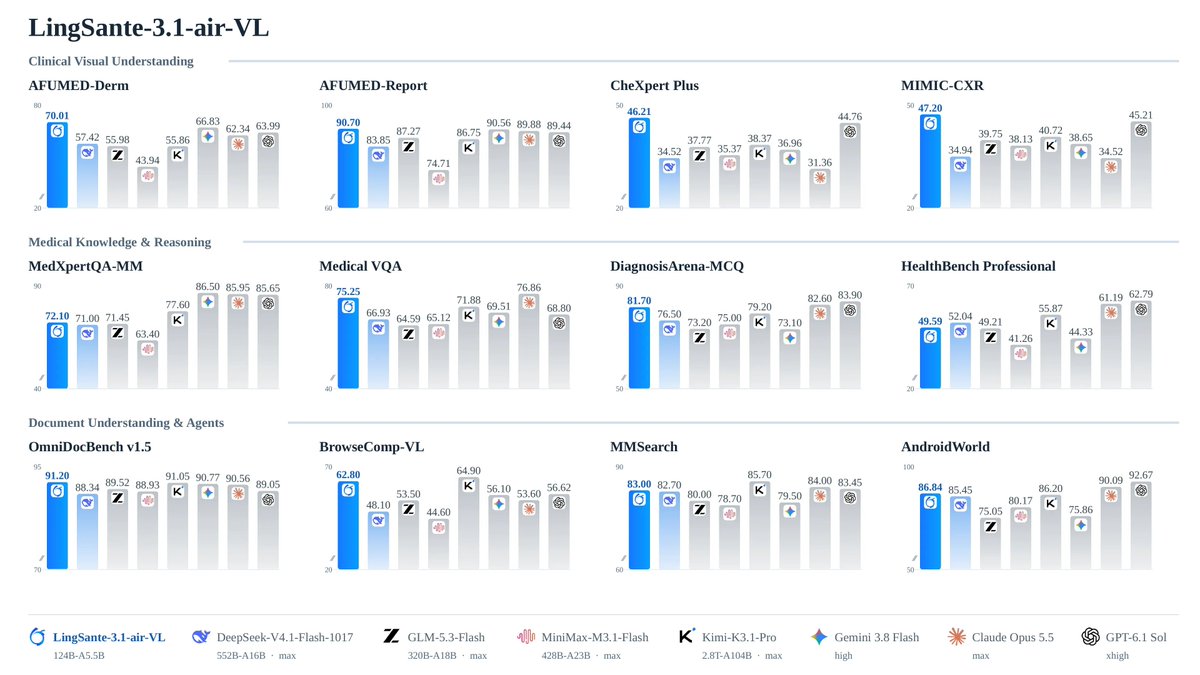
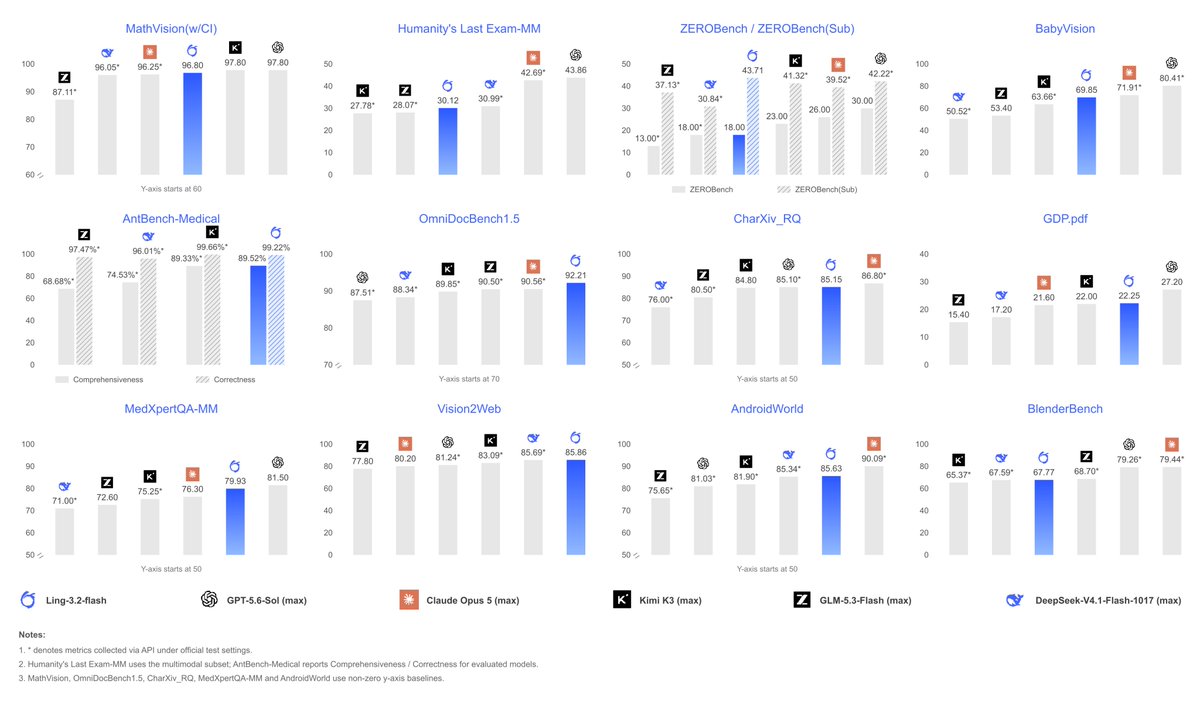
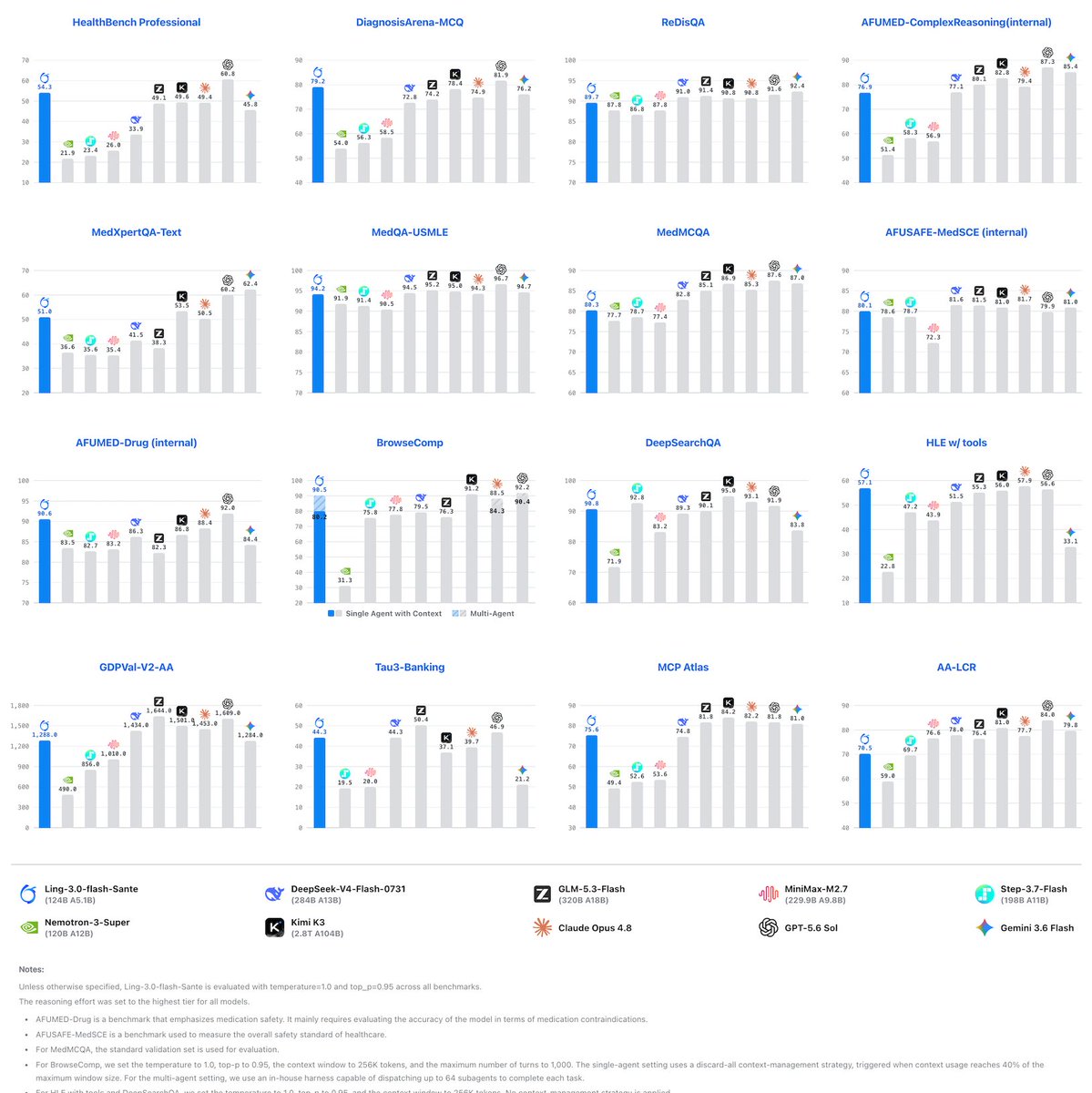
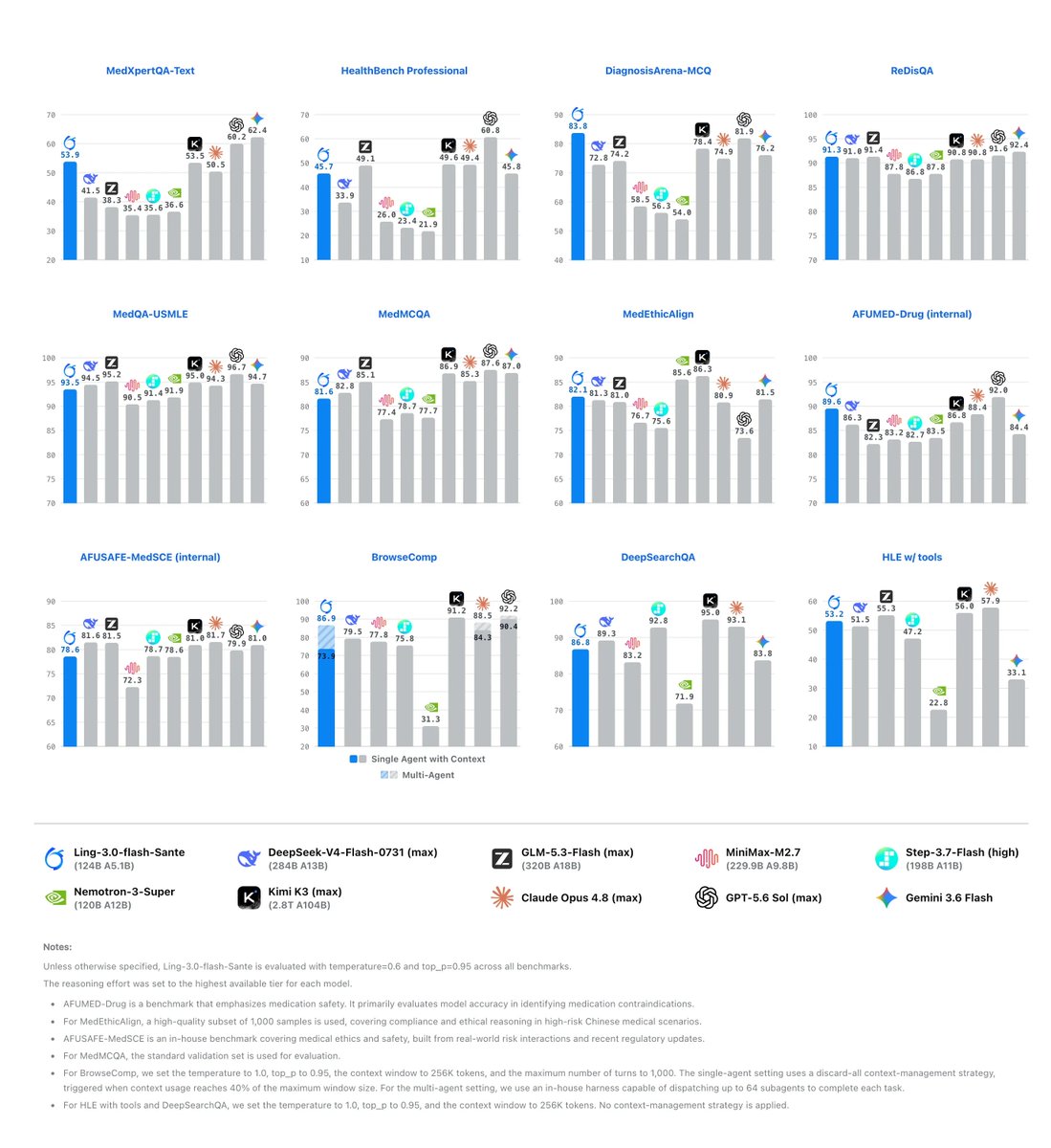
Today, we release LingSante-3.1-flash, an open-weight MoE model with 560B total parameters and 25B activations per token. It unifies diverse medical capabilities while retaining general capabilities, including complex medical reasoning, long-horizon workflow execution, and professional behavior alignment. LingSante-3.1-flash moves beyond medical QA toward real-world healthcare problem. The model leads on HealthBench Professional (65.72), HLE (text-only, with tools: 72.22) and BrowseComp (with context: 94.10), outperforming GPT-6 Astra, Claude Opus 5.5 and Gemini 4 Argon on all three. LingSante-3.1-flash also performs well on professional long-horizon medical workflows, such as PhysicianBench (57) and EHR-Complex (74.40). Together, these results establish LingSante-3.1-flash as the leading open-weight models for healthcare. The weights are available. Explore LingSante and build with it. More below ↓

Context
Ant Group's Ling team (inclusionAI) used its launch post for LingSante-3.1-flash to put numbers on a release that was first covered from Hugging Face, where the scores sat only in chart images. The post says the open-weight medical model leads on three benchmarks: HealthBench Professional at 65.72, HLE (text-only questions, answered with tools) at 72.22, and BrowseComp with at 94.10, ahead of GPT-6 Astra, Claude Opus 5.5 and Gemini 4 Argon on all three. The full comparison table on the model card carries the same figures, and the leads are real in Ant's own numbers but some are thin. On HealthBench Professional the next score is GPT-6 Astra's 64.18. On HLE with tools it is Kimi-K3.1-Pro's 70.00, and on BrowseComp it is Kimi-K3.1-Pro's 92.10 and Tencent Hy4's 92.00. All of these are Ant's measurements, with each comparison model run at its highest available reasoning-effort setting.
The post and the card can look as if they disagree. The card's text says the model ranks second overall on benchmarks of medical professional behavior, behind only GPT-6 Astra, while the post says it leads HealthBench Professional ahead of GPT-6 Astra. The two statements need not conflict, because they describe different things. On the single HealthBench Professional score, LingSante-3.1-flash is first, 65.72 to 64.18. The card's ranking covers a group of professional-behavior benchmarks that it does not list, and on at least one other medical benchmark in the same chart group, MentalHealthBench, GPT-6 Astra scores 57.50 to LingSante's 54.64.
The table also shows where the model trails, which the post leaves out. Without tools, HLE drops to 44.07, against 53.94 for GPT-6 Astra and 58.11 for Claude Opus 5.5, so the 72.22 depends on the search and tool setup; the card notes that figure is a single-agent run with a 1-million-token context, and a run reached 74.87. On the long-horizon workflow tests the post highlights, PhysicianBench is 57, a point behind Gemini 4 Argon's 58, and EHR-Complex is 74.40, only just ahead of GPT-6 Astra's 74.20. Coding is clearly weaker: 26.5 on Terminal-Bench 4.0, where GPT-6 Astra, Claude Opus 5.5 and Gemini 4 Argon score between 57.1 and 59.6, and 65.25 on Pro against Claude Opus 5.5's 89.90. Several medical benchmarks in the table, including AFUMED-LCR, MedEthicAlign and TeleMedAgentBench, are marked internal, so outsiders cannot rerun them. The post ends with "More below", but no follow-up posts were collected for this summary.
- Context and context window — Context is the information available for a generation; the context window is the capacity available to hold it.
- multi-agent — Using several AI agents on one problem — splitting work in parallel, checking each other, or filling different roles like planner and reviewer.
- SWE-bench — The standard benchmark for AI coding agents: real GitHub issues from real repositories, scored by whether the agent's patch passes the project's own tests.
- mixture-of-experts — A model built from many specialist sub-networks where only a few activate per token, giving big-model capability at small-model running cost.
Checking sign-in…
Loading comments…