Ant Ling Open-Sources LingSante-3.1-air-VL Medical Multimodal Model
- Source
- x.com
- Date

Meet LingSante-3.1-air-VL, an open-source multimodal medical model with 124B total and 5.5B active parameters. It combines medical image understanding, report generation and medical reasoning with multimodal search and tool use. In our evaluation, it leads the compared models on AFUMED-Derm, AFUMED-Report, MIMIC-CXR and medical VQA (averaged across benchmarks), ahead of GPT-6.1 Sol, Gemini 3.8 Flash on all four. It also demonstrates strong general-purpose capabilities, scoring higher than GPT-6.1 Sol on BrowseComp-VL and Gemini 3.8 Flash on AndroidWorld, alongside competitive performance on MMSearch. Explore LingSante-3.1-air-VL and build with it.

Context
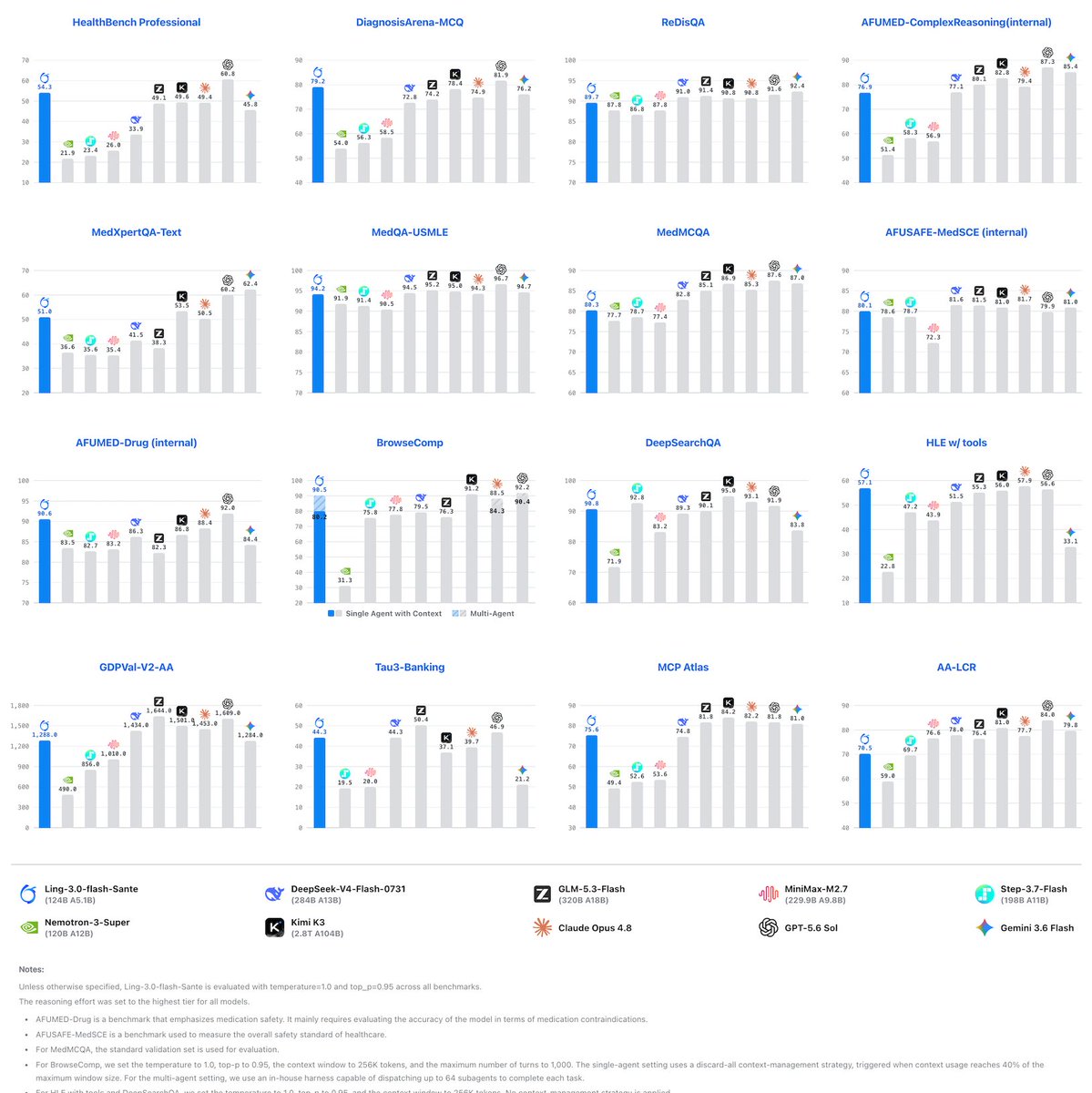
LingSante-3.1-air-VL is a smaller, image-reading companion to the LingSante-3.1-flash text model that Ant Group's Ling team (inclusionAI) released earlier the same day. It takes text and images, has 124 billion parameters of which 5.5 billion are active for each token, and supports a 256,000-token . The model card lists an MIT license, a base of Ling-3.0-flash-VL, and four focus areas: drafting imaging reports; assessing photos of skin, meals and medical reports; searching medical literature for evidence; and operating apps, for example to book a hospital appointment. The card says it is the first large medical model Ant's healthcare team has released as open source, and that it runs on four 141GB-class GPUs.
Its clearest strength in Ant's own results is generating imaging reports. On the three public report-generation sets it scores highest of the eight models compared: 46.21 on CheXpert Plus and 47.20 on MIMIC-CXR, against GPT-6.1 Sol's 44.76 and 45.21, and 64.34 on IU X-RAY, where the next best is Kimi-K3.1-Pro at 56.88. Each of those scores is the unweighted mean of three report-scoring metrics, CRIMSON, RaTEScore and RadGraph. It also leads on two of Ant's in-house sets, AFUMED-Derm for skin conditions at 70.01 against Gemini 3.8 Flash's 66.83, and AFUMED-Report at 90.70 against Gemini's 90.56, a margin of 0.14 points on a test outsiders cannot rerun.
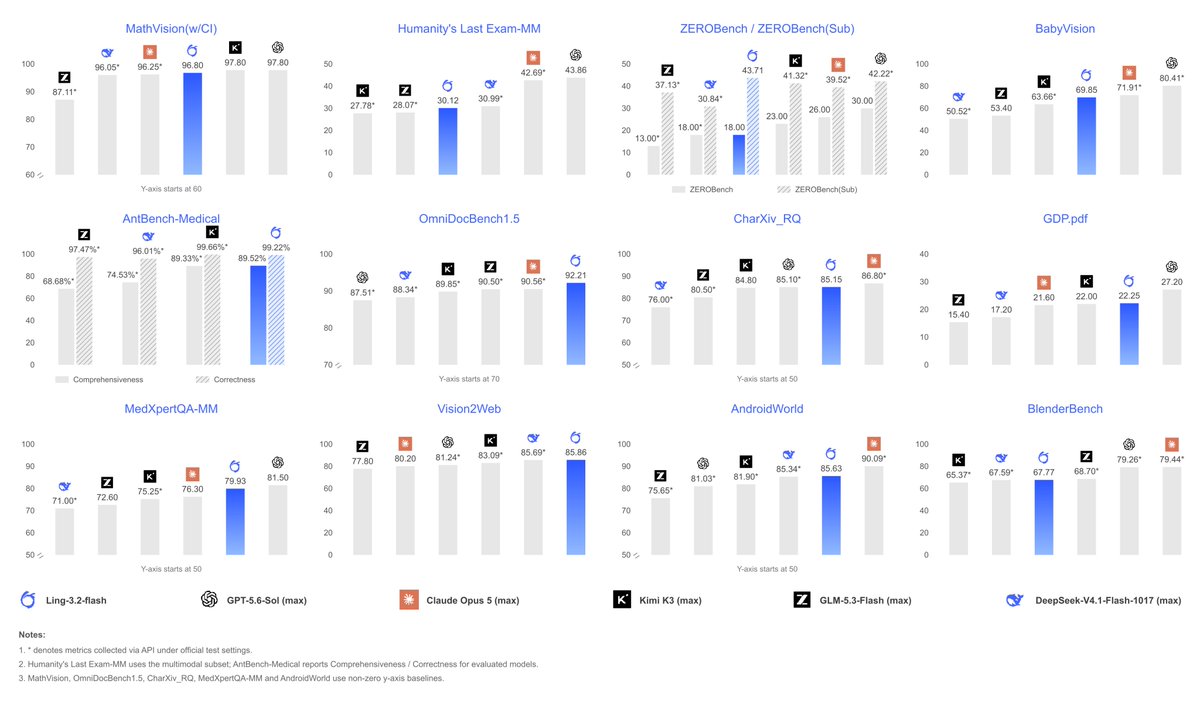
The launch post overstates one result. It says the model leads the compared models on four benchmarks, including medical visual question answering averaged across benchmarks. The chart shows that average at 75.25, ahead of GPT-6.1 Sol at 68.80 and Gemini 3.8 Flash at 69.51, which are the two models the post names, but behind Claude Opus 5.5 at 76.86. The general claims are chosen the same way: each is true against the model it names, but not against the whole . It beats GPT-6.1 Sol on BrowseComp-VL, 62.80 to 56.62, but Kimi-K3.1-Pro scores 64.90, and it beats Gemini 3.8 Flash on the phone-control test AndroidWorld, 86.84 to 75.86, while GPT-6.1 Sol and Claude Opus 5.5 score 92.67 and 90.09.
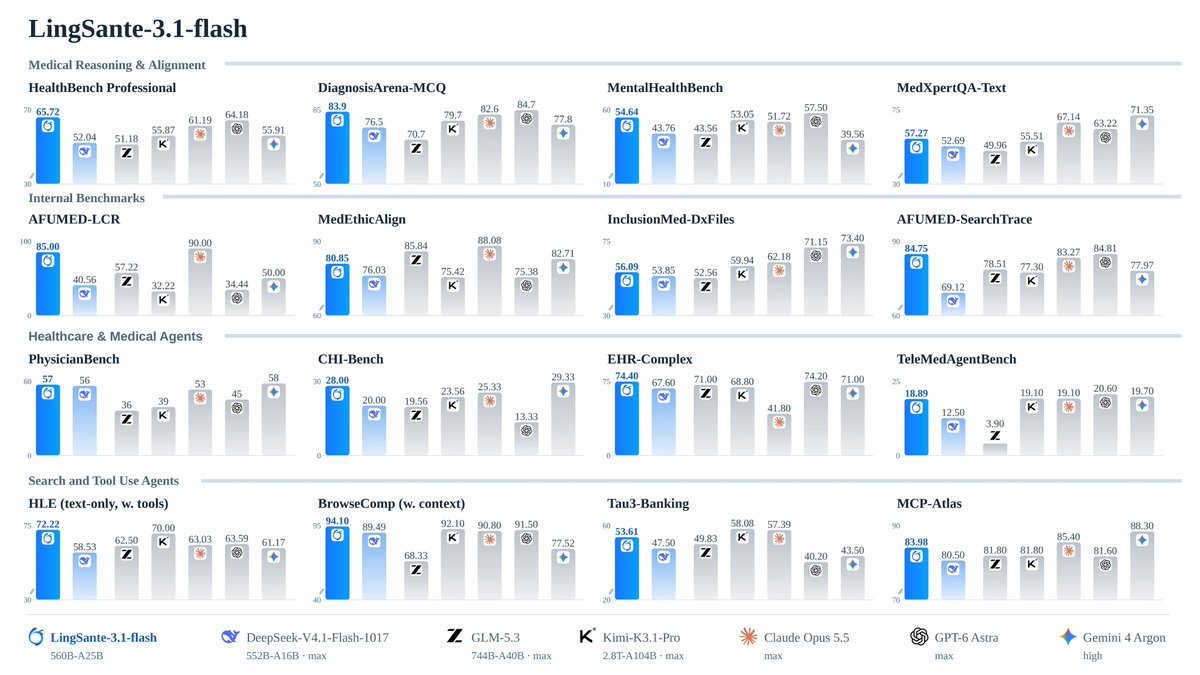
On broader medical reasoning the small model is well behind the strongest compared models: 49.59 on HealthBench Professional against GPT-6.1 Sol's 62.79, and 72.10 on MedXpertQA-MM against Gemini 3.8 Flash's 86.50. The card says it is a research model, not a medical device, and that skin, diet and report outputs need review by qualified professionals.
- Context and context window — Context is the information available for a generation; the context window is the capacity available to hold it.
- multimodal — A model that works with more than text — reading images, audio, or video, and sometimes generating them too.
- Field — One named piece of a record, such as name or approved_on; a record is one entity's set of values, one per field.
- Retrieval — Selecting evidence relevant to the current request.
Checking sign-in…
Loading comments…