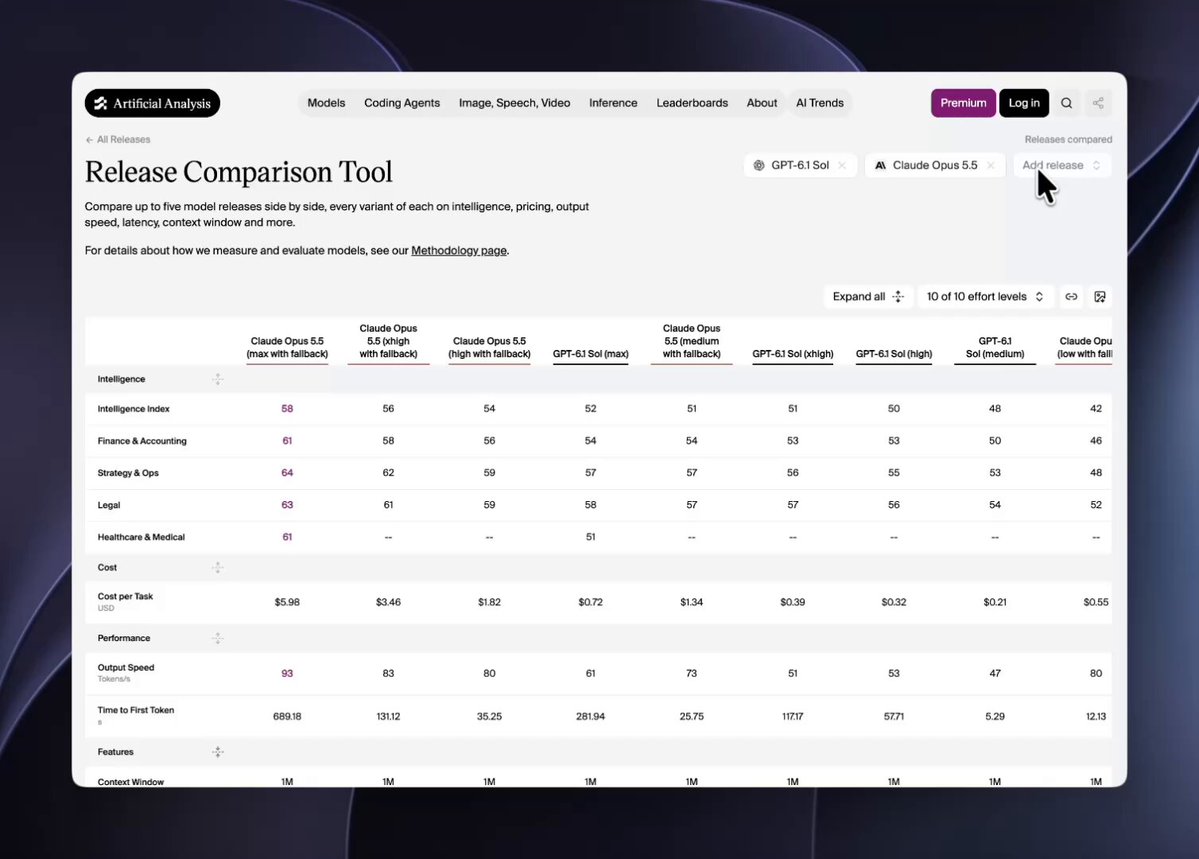
Build and run your own benchmark today:
- Source
- artificialanalysis.ai
- Publisher
- Artificial Analysis
- Author
- ArtificialAnlys
- Date

Context
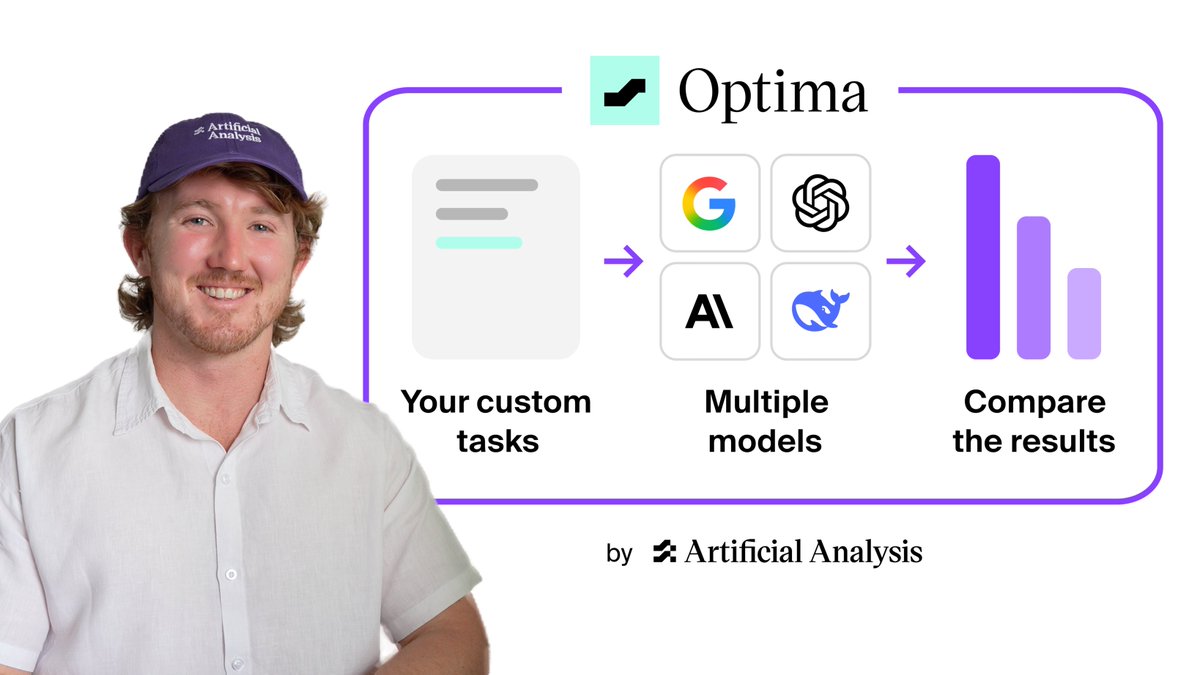
Artificial Analysis, which publishes independent model benchmarks, launched Optima in August as a way for teams to benchmark models on their own work. Its product page argues that standardized benchmarks measure general capability but cannot say which model suits a specific use. A team can start in three ways: describe the work and attach a few examples, import an existing or traces from platforms, or install an Optima skill that lets a gather from the team's environment. A build agent then drafts the test tasks and grading rubrics with the user, who can refine them before anything runs.
Grading reuses the company's own methods. With rubric grading, a judge model checks each response against criteria that carry the expected answer. With pairwise grading, the user picks preferred responses from a sample, and Optima uses those preferences to rank models across the whole test set. The launch thread says this is the same pairwise approach used for its GDPval-AA and AA-Briefcase benchmarks. A team's own agent can compete in the same run over HTTP. Every result reports cost per task and time per task next to the score.
Those two extra columns are the point. In the launch video's sales-deck example, the top-scoring model was not the obvious pick, because the trade-off chart showed another model scoring nearly as well at a fraction of the cost. Artificial Analysis says Optima can find an equally capable alternative at 10x lower cost or time per task. That is the company's claim, and the launch materials do not report a measured result behind it. Building and running a benchmark is billed at the models' raw token cost, and grading is billed per rubric criterion or pairwise match. A good answer still depends on tasks and rubrics that reflect the work the team actually needs done.
- Evaluation dataset — A repeatable set of representative cases used to measure system behavior.
- Agent observability — The ability to inspect an agent's actions, state, outputs, and resource use.
- Agent mode — A mode in which one agent can inspect, edit, run commands, and iterate toward an outcome.
- Context and context window — Context is the information available for a generation; the context window is the capacity available to hold it.