Grok Voice Transcribe 2.0 Leads Streaming ASR Accuracy
- Source
- x.com
- Date

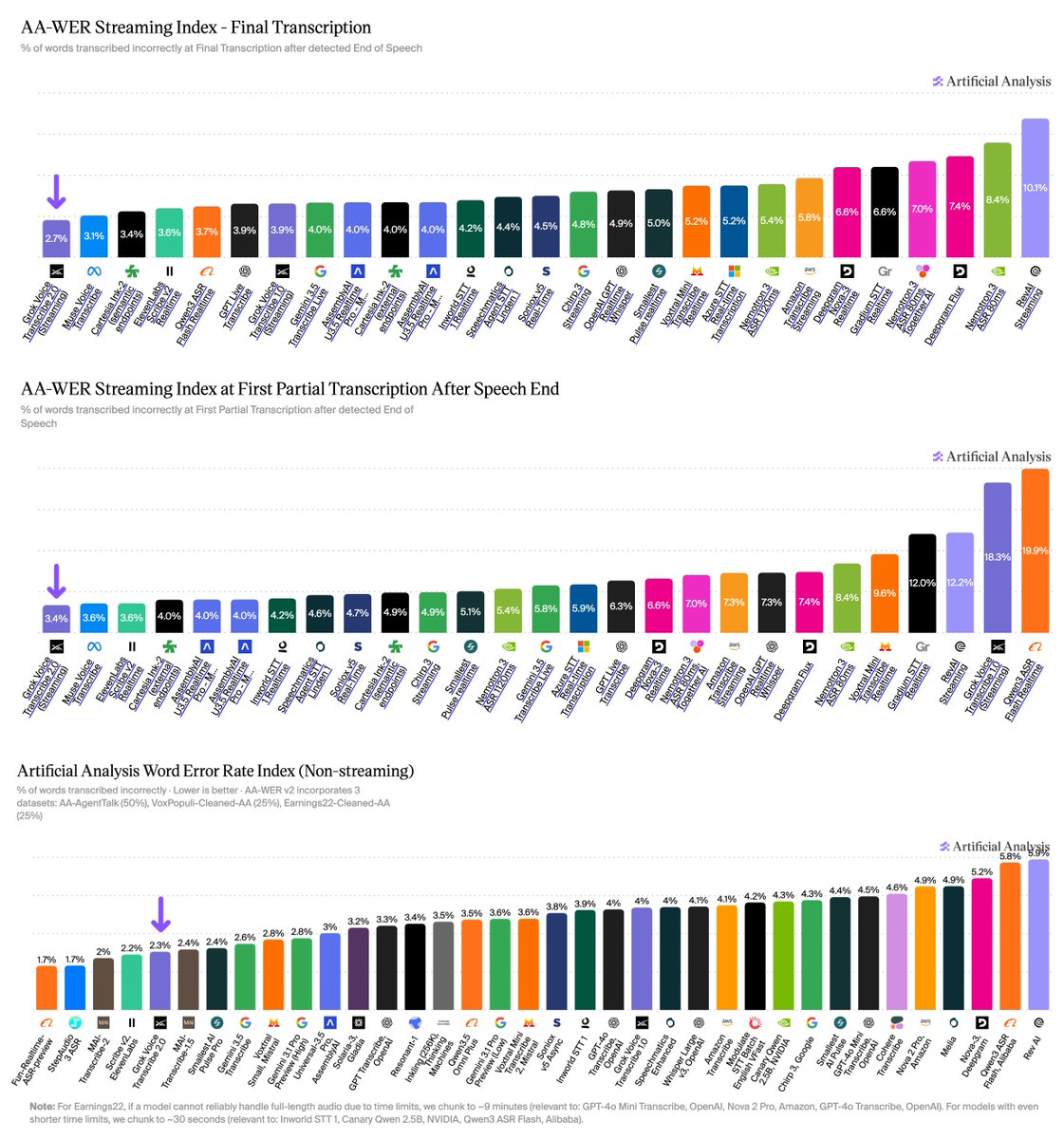
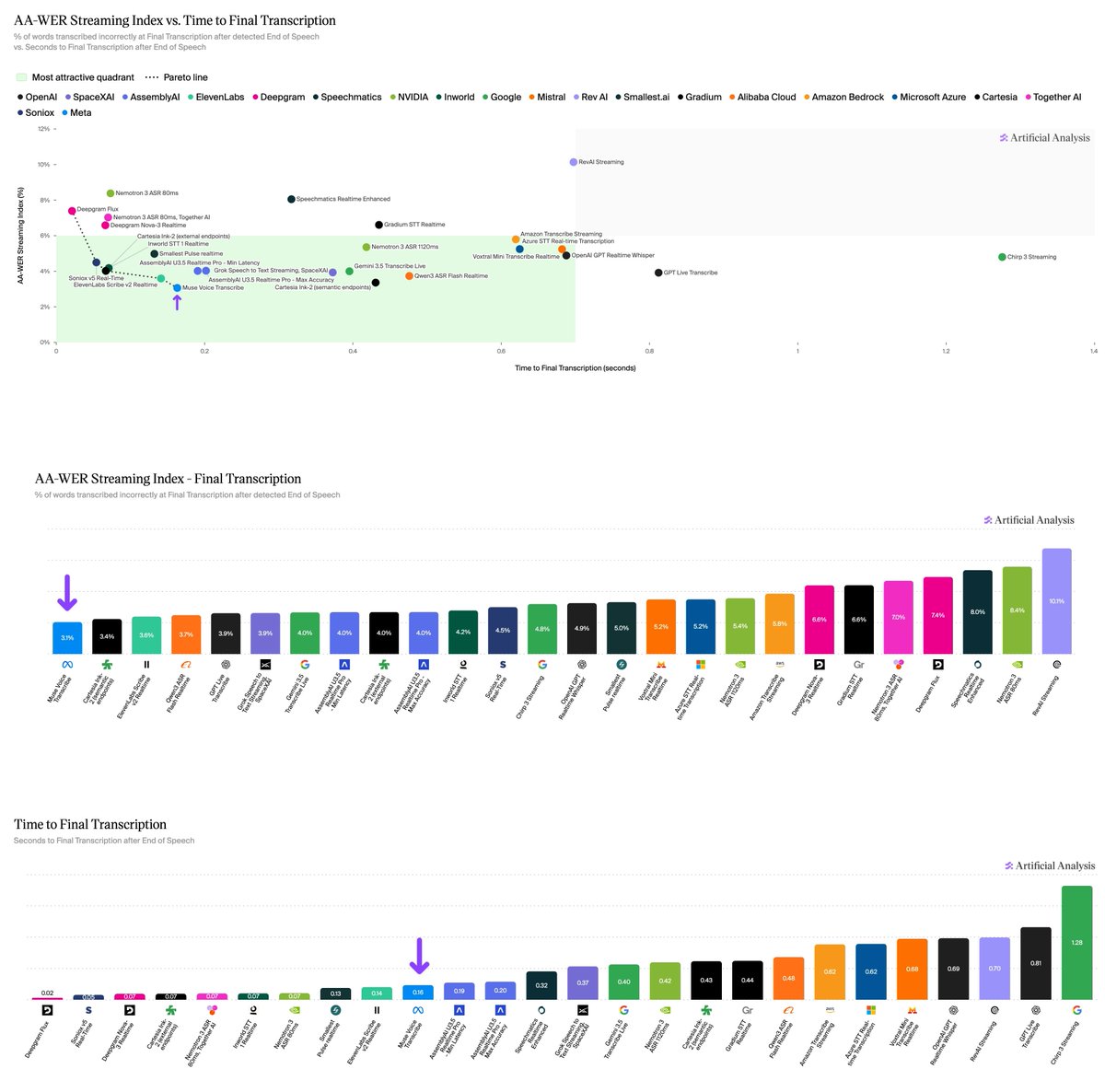
SpaceXAI has released Grok Voice Transcribe 2.0, taking the #1 spot for Final Transcript accuracy and First Partial Transcript accuracy on AA-WER Streaming with 2.7% WER at 0.49s after end of speech Grok Voice Transcribe 2.0 is @spacexai's new Speech to Text model, succeeding Grok Voice Transcribe 1.0 (previously Grok Speech to Text). It improves streaming Final Transcript WER from 3.9% to 2.7% and non-streaming AA-WER from 4.0% to 2.3%. It is available through the SpaceXAI API for both streaming and non-streaming transcription, at the same price as its predecessor. Key takeaways ➤ Final Transcript: Grok Voice Transcribe 2.0 achieves 2.7% WER at 0.49s after end of speech. It is more accurate but slower than Muse Voice Transcribe at 3.1% and 0.16s, and ElevenLabs Scribe v2 Realtime at 3.6% and 0.14s. It is also more accurate, though slightly slower, than Cartesia Ink-2 (semantic endpoints) at 3.4% and 0.43s ➤ First Partial Transcript: The model achieves 3.4% WER at 0.49s, just ahead of Muse Voice Transcribe and ElevenLabs Scribe v2 Realtime on accuracy, both at 3.6%, though slower than both at 0.13s. It is more accurate but slower than Cartesia Ink-2 (semantic endpoints) at 4.9%…
Context
Grok Voice Transcribe 2.0, SpaceXAI's new speech-to-text model, is the most accurate model on Artificial Analysis's transcription test, but it delivers its final text more slowly than its closest competitors. According to Artificial Analysis's results, its final transcript has a 2.7% word error rate, roughly the share of words it gets wrong, and arrives 0.49 seconds after the speaker stops talking. Muse Voice Transcribe scores 3.1% at 0.16 seconds and ElevenLabs Scribe v2 Realtime scores 3.6% at 0.14 seconds, so both return their final text about three times sooner while making somewhat more errors.
The same trade appears in the first partial transcript, an early provisional version of the text. Grok's 3.4% error rate there edges Muse Voice Transcribe and Scribe v2 Realtime, both at 3.6%, but those two return it in 0.13 seconds against Grok's 0.49. Of the rivals named for the final transcript, the one closest to Grok's speed is Cartesia's Ink-2 with semantic endpoints, which reaches 3.4% at 0.43 seconds, so Grok is more accurate there and only slightly slower. In a live voice product, that delay after the speaker stops is time the user spends waiting before anything can respond.
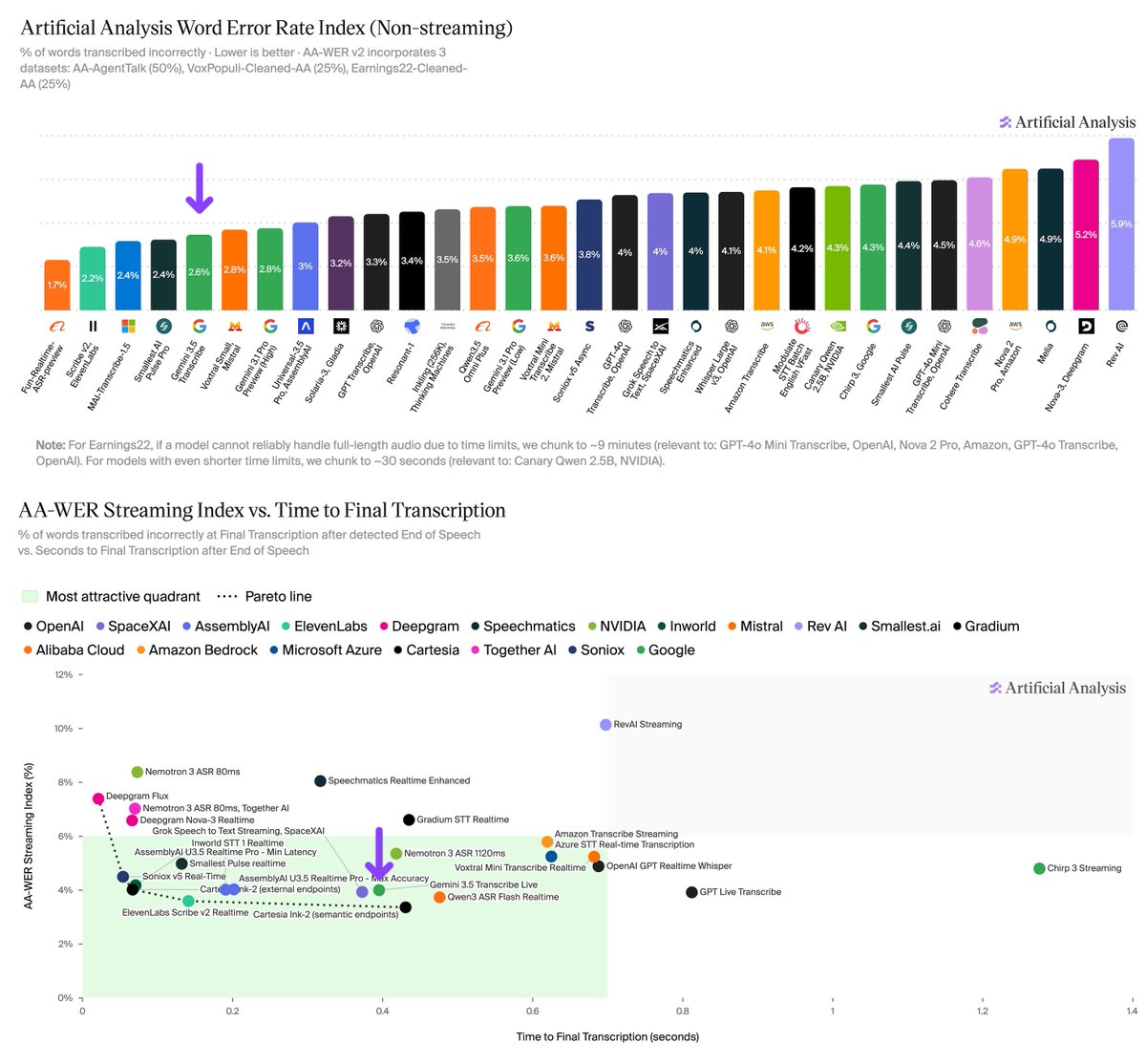
Against its predecessor, Grok Voice Transcribe 1.0, the accuracy gain comes at an unchanged price: the streaming final-transcript error rate falls from 3.9% to 2.7%, and the non-streaming error rate falls from 4.0% to 2.3%. On the non-streaming test it ranks fifth of 59 models, behind Alibaba's Fun-Realtime-ASR-preview and StepFun's StepAudio 3 ASR at 1.7%, Microsoft AI's MAI-Transcribe-2 at 2.0% and ElevenLabs Scribe v2 at 2.2%. Streaming costs $3.33 per 1,000 minutes, a little above Muse Voice Transcribe at $3 and about half the $6.50 charged for Scribe v2 Realtime and Deepgram Flux. The results make Grok Voice Transcribe 2.0 the stronger choice where getting the words right matters more than about a third of a second of response time, while products built around the fastest possible turn-taking still have quicker models that make slightly more errors.
- streaming — Sending a model's response token by token as it is generated, so the reader sees text immediately instead of waiting for the whole answer.
Checking sign-in…
Loading comments…