Gemini 3.5 Transcribe measured: accuracy, latency and price
- Source
- x.com
- Date

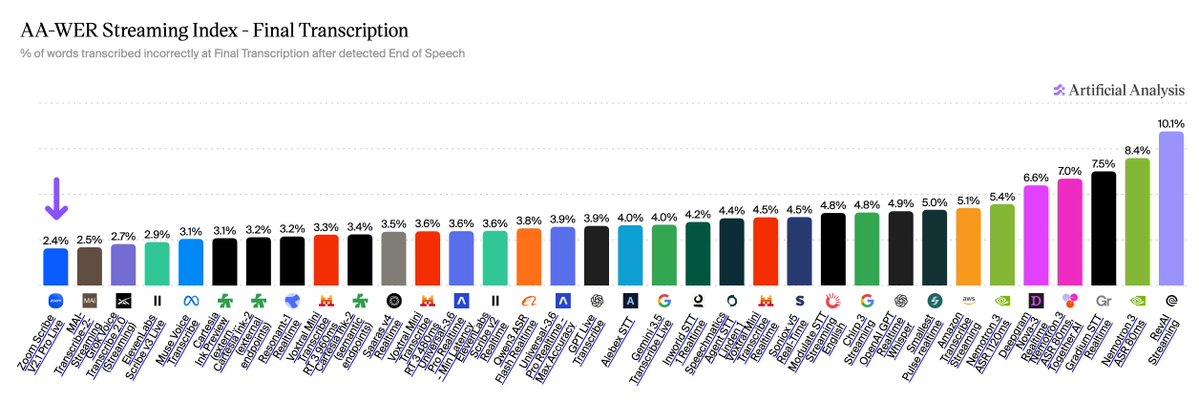
Google has released Gemini 3.5 Transcribe, ranking #5 on AA-WER at 2.6%, alongside Gemini 3.5 Transcribe Live, achieving 4.0% AA-WER Streaming at 0.40s after speech end @GoogleAI's Gemini 3.5 Transcribe release comprises two API offerings: Gemini 3.5 Transcribe Live for continuous streaming through the Live API, and Gemini 3.5 Transcribe for pre-recorded audio through the Interactions API. Both support 85+ languages, custom vocabulary and automatic text formatting, while the pre-recorded API adds timestamped multi-speaker identification for up to three speakers, with support beyond three currently experimental. Key takeaways ➤ Non-streaming transcription: Gemini 3.5 Transcribe achieves 2.6% AA-WER, ranking #5 overall, and processes audio at approximately 84× realtime. ➤ First Final Transcription: Gemini 3.5 Transcribe Live achieves 4.0% WER, with its first final-denoted transcript arriving 0.40s after VAD-detected end of speech. ➤ First Partial Transcription: Gemini 3.5 Transcribe Live achieves 5.8% WER, with its first transcript-bearing event arriving 0.25s after detected end of speech. ➤ Price: Gemini 3.5 Transcribe costs approximately $5 per 1,000 minutes and Transcribe Live…

Context
Artificial Analysis, which benchmarks AI models independently through their public APIs, measured both halves of Google's new speech-to-text release. Gemini 3.5 Transcribe, for pre-recorded audio, got words wrong 2.6% of the time on its AA-WER test, fifth best on the leaderboard, and processed audio about 84 times faster than real time. Gemini 3.5 Transcribe Live, for continuous , delivered its first final transcript 0.40 seconds after the speaker stopped, with a 4.0% error rate. Its first partial transcript came sooner, at 0.25 seconds, but with 5.8% errors. The streaming figures come from AA-WER Streaming, a version of the test that streams the audio to the model as it plays; within it, waiting 0.15 seconds longer for the final transcript rather than the first partial one lowers the error rate from 5.8% to 4.0%.
Word error rate, as Artificial Analysis defines it, counts substituted, inserted and deleted words against a reference transcript and divides by the reference's length. AA-WER weights three test sets: half comes from a proprietary, held-out collection of about 250 minutes of voice-agent speech, and a quarter each from European parliamentary proceedings and corporate earnings calls. The clock starts when a voice-activity detector decides the speaker has finished, so 0.40 seconds is how long a user waits after speaking, not how long it takes to transcribe a whole utterance.
The prices are Artificial Analysis's estimates, not billed figures. It calculates about $5 per 1,000 minutes for Transcribe and $9 for Live by assuming 25 audio and 175 text per minute and applying Google's per-token rates of $2 and $12 per million for Transcribe and $3.50 and $21 for Live. Google's own launch post is covered separately; these measurements are the outside check on it.
- streaming — Sending a model's response token by token as it is generated, so the reader sees text immediately instead of waiting for the whole answer.
- Latency — The time between asking for a result and having it, including the model's generation time, tool calls, retries and any queueing.
- throughput — How much model output a provider can generate over time, commonly measured in output tokens per second.
- Token — A piece of text, such as a word, part of a word or a punctuation mark, that a language model represents as numbers and handles as a unit.
Checking sign-in…
Loading comments…