For more details and full results see:
- Source
- x.com
- Date
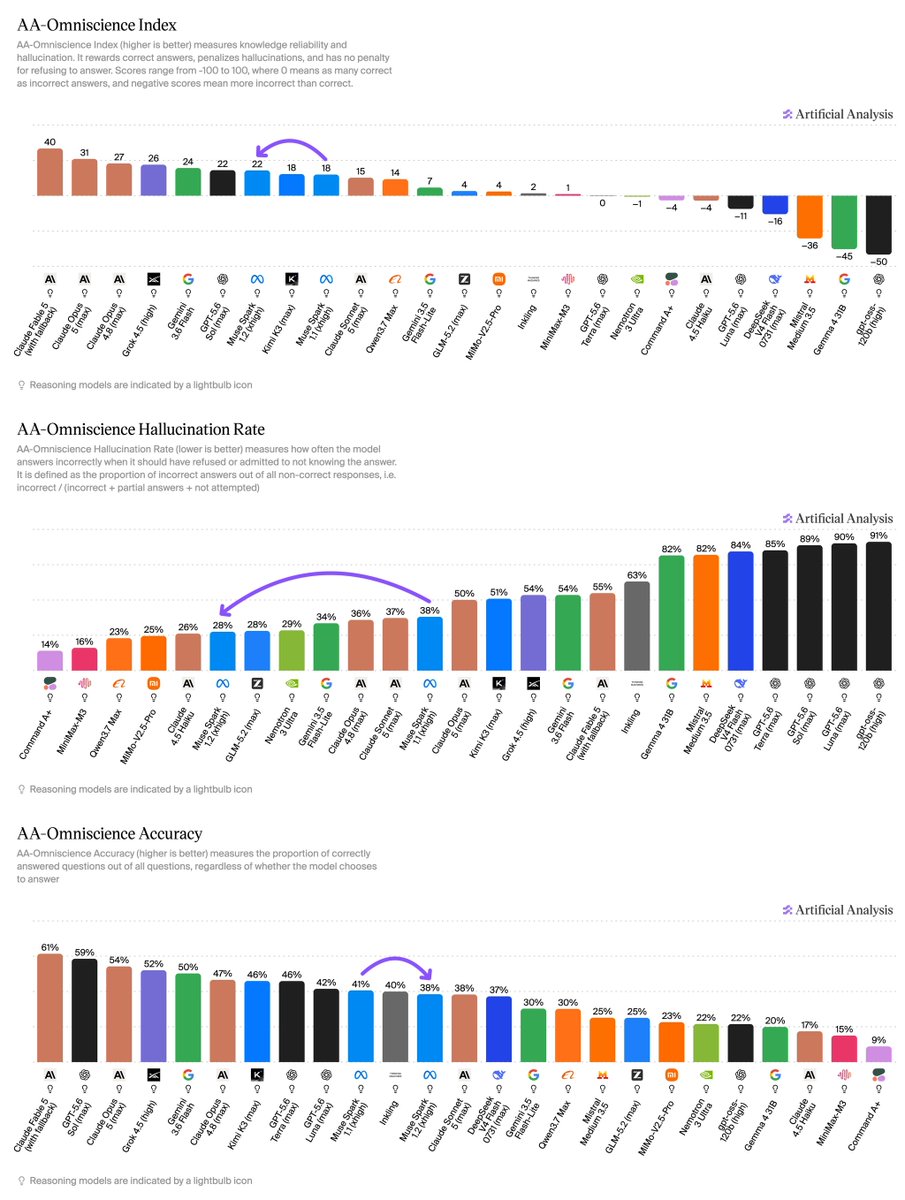
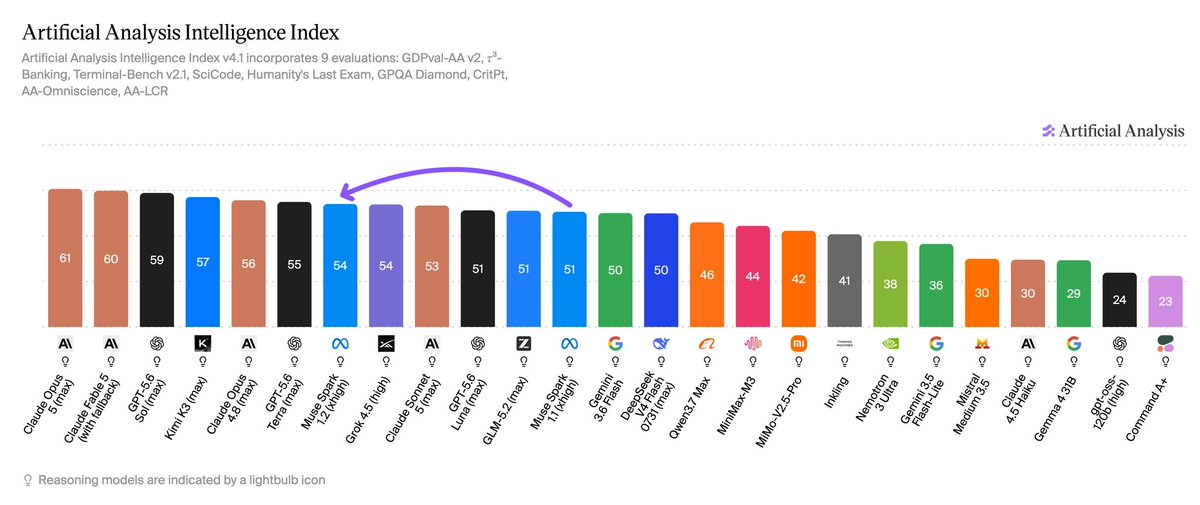
Meta has released Muse Spark 1.2. It's their third release in four months and scores 54 on the Artificial Analysis Intelligence Index, significantly improving agentic knowledge work capabilities over prior releases and putting Meta next to SpaceXAI in a tie for third place amongst US labs Muse Spark 1.2 (xhigh) lands at 54, up 3 points from Muse Spark 1.1 (51) and 11 points from Muse Spark 1.0 (43, April). It enters effectively tied with GPT-5.5 (xhigh, 55) and Grok 4.5 (high, 54), narrowly behind current frontier models Claude Opus 5 (max, 61), Claude Fable 5 (max w/ fallback, 60), GPT-5.6 Sol (max, 59), and Kimi K3 (max, 57) Congratulations to @AIatMeta, @finkd, and @alexandr_wang on the release! Key Takeaways: ➤ Muse Spark 1.2 gets closer to the frontier on agentic knowledge work. At Muse Spark 1.1's launch, we noted agentic knowledge work as its clearest gap; Muse Spark 1.2's gains help to close this. Its GDPval-AA v2 Elo rose 260 points to 1631, #5 among all models we have benchmarked and ahead of Claude Opus 4.8 (max, 1588). Terminal-Bench 2.1 gained 2 points (78% to 80%), and Tau3-Bench Banking rose 2 points (25% to 27%) ➤ Among the most cost-efficient models at its intelligence level. Muse Spark 1.2 costs $0.40 per Intelligence Index task at Meta's unchanged $1.25/$4.25 per 1M token pricing, with only Grok 4.5 (high, $0.37) and GPT-5.6 Sol (medium, $0.39) cheaper in its intelligence cluster - GPT-5.6 Terra (max, $0.51), Kimi K3 (max, $0.86), and GPT-5.5 (xhigh, $1.18) all cost more per task. The cost increase over Muse Spark 1.1 ($0.29 per task) is driven by increased token usage per Intelligence Index task ➤ AA-Omniscience abstention rate increases. The score rose from 18 to 22 as the hallucination rate fell 10 points (38% to 28%) and the attempt rate dropped from 82% to 67%. This heavy abstention (not answering questions when unsure) now drives both the low hallucination rate and a lower accuracy (41% to 38%) ➤ Scientific Reasoning results remain largely unchanged. CritPt notably gained 3 points (15% to 18%), while SciCode fell 2 points (58% to 56%), and Humanity's Last Exam fell 1 point (45% to 44%) Other model details: ➤ Context window: 1M tokens, unchanged from Muse Spark 1.1 ➤ Pricing: unchanged from Muse Spark 1.1: $1.25/$4.25 per 1M input/output tokens, with cache hits discounted to $0.15 per 1M ➤ Availability: Meta's first-party API at launch
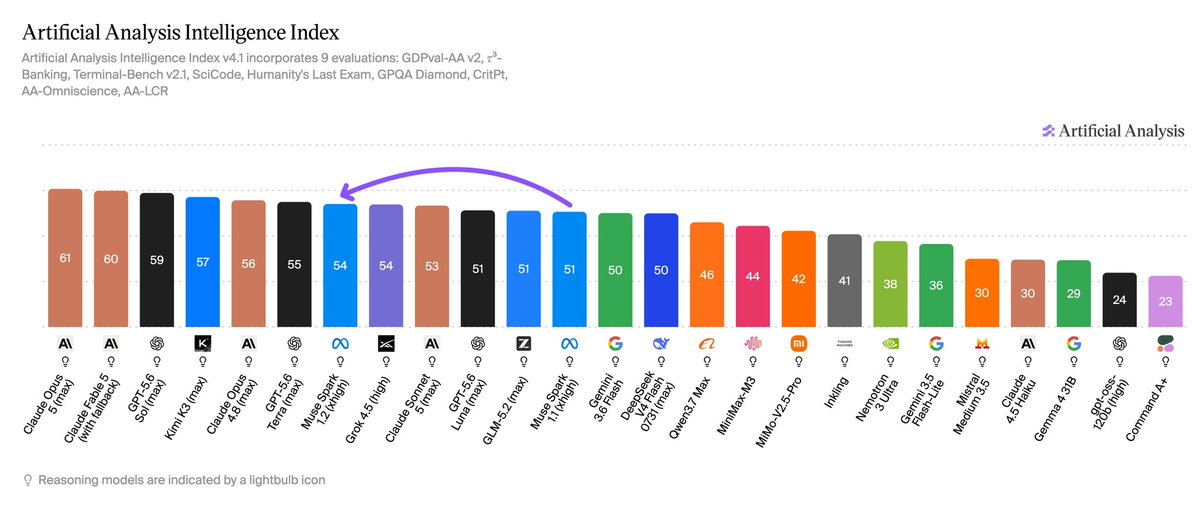
For more details and full results see: https://t.co/K9obshjRif
Context
Meta's Muse Spark 1.2 improved most where its predecessor was weakest: agentic knowledge work, in which a model uses tools over many steps to produce finished work files. In its launch thread, Artificial Analysis scored the model 54 on its Intelligence Index, a composite of evaluations, up from 51 for Muse Spark 1.1 and 43 for the first Muse Spark in April. That put it effectively level with OpenAI's GPT-5.5 at 55 and behind Anthropic's Claude Opus 5 at 61. Artificial Analysis had named agentic knowledge work as Muse Spark 1.1's clearest gap, and the new model's rating on GDPval-AA v2 rose 260 points to 1631, fifth among all the models the firm had tested.
GDPval-AA is the firm's version of OpenAI's GDPval task set, which covers 44 occupations in sectors that contribute to US GDP. According to its methodology, each model works in a code with tools such as web search and must submit files. A judge drawn from a panel of three frontier language models compares two models' submissions for the same task without knowing which model made which, and the results are fitted into an Elo rating. Version 2 of the test set the scale so that human expert performance sits at 1000. The rating therefore reflects how often AI judges preferred the model's work in head-to-head comparisons, not the share of tasks it completed. Two other agentic tests, -Bench 2.1 and a banking customer-support test, each rose 2 points.
The model's lower rate needs a different reading. AA-Omniscience is a factual-knowledge test that subtracts points for wrong answers and treats declining to answer as neutral. Muse Spark 1.2's score there rose from 18 to 22 and its hallucination rate fell from 38% to 28%, but it attempted only 67% of questions, down from 82%, and its accuracy slipped from 41% to 38%. Artificial Analysis attributes both the low hallucination rate and the lower accuracy to that heavier abstention. The model made fewer false claims because it answered less often, not because it knew more.
These numbers belong to the index as it stood on August 5, 2026. Artificial Analysis rebuilt the index as version 5.0 in October, removing GDPval-AA, SciCode, Humanity's Last Exam and a long- reasoning test and adding new evaluations. The firm's Muse Spark 1.2 page now marks the model as deprecated, shows no Intelligence Index score for it, and points to Meta's newer Muse Spark 1.3, which Artificial Analysis covered in September. The 54 is comparable only with scores published under the same index version, such as the rivals named in the thread.
- Sandbox — An enforced restriction that confines a process to specified files, network destinations and other resources, applied by the operating system, a container or a virtual machine.
- Terminal — A program that shows text and accepts typed text.
- Hallucination — Generated content that is false or unsupported, even when it sounds plausible.
- Context and context window — Context is the information available for a generation; the context window is the capacity available to hold it.
Checking sign-in…
Loading comments…