Independent Analysis Of Leading Gpus Amd Nvidia
- Source
- artificialanalysis.ai
- Author
- Artificial Analysis articles
- Date
Context
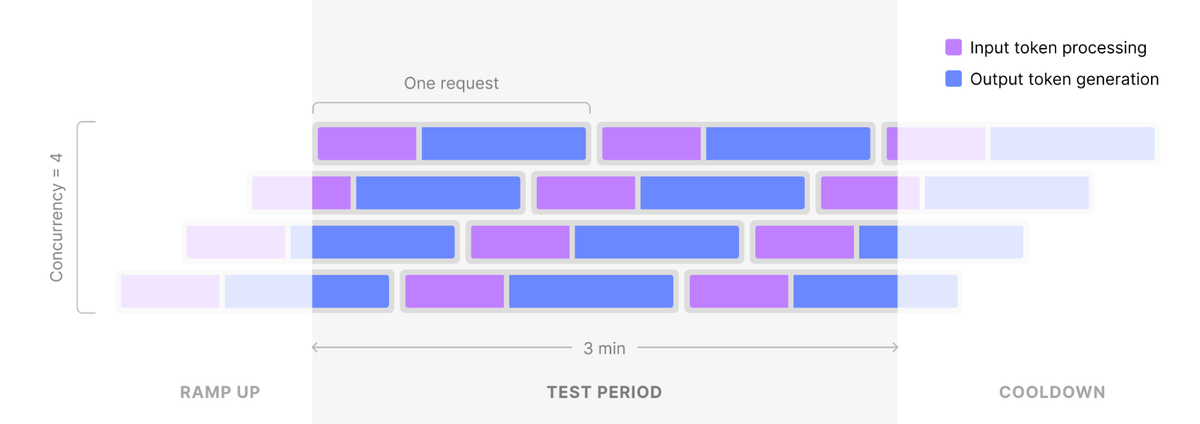
This June 2025 from Artificial Analysis compares eight-GPU servers built on AMD's MI300X and NVIDIA's H100 and H200, serving DeepSeek R1 and Meta's Llama 4 Maverick (artificialanalysis.ai). The key variable is concurrency, the number of requests a server handles at once. More simultaneous requests raise total output, called system throughput, but each individual user gets more slowly. The test steps concurrency up in three-minute phases, each request using 1,000 input and 1,000 output tokens, until throughput stops growing.
Below roughly 250 concurrent queries, the NVIDIA systems were marginally faster per query, with lower latency and slightly higher throughput. At 16 concurrent queries on DeepSeek R1, for example, the H200 delivered about 45 output tokens per second per query against about 35 for the MI300X. Under heavy load the order flipped: the MI300X reached 25-35% higher peak system throughput and kept answering nearly every query up to its peak, while the H200's response rate degraded. Because cost per token is a system's cost divided by its throughput, the authors conclude NVIDIA is slightly cheaper per token at low concurrency and the MI300X cheaper at high concurrency. They found no statistically significant accuracy difference between platforms.
The practical reading is that NVIDIA suits latency-sensitive uses such as chatbots and real-time services, while the MI300X suits large batch workloads. Two details matter when weighing this. AMD engaged Artificial Analysis for the study and provided the test system, though the firm says it followed its own published methodology. And each model was compared against only one NVIDIA chip, the H200 for DeepSeek R1 and the H100 for Llama 4 Maverick, using different software versions and settings on each side.
- On DeepSeek R1 at 16 concurrent queries, the 8xH200 system reached about 45 output tokens/s per query and ~600 tokens/s total, versus about 35 and ~500 for the 8xMI300X system.
- On Llama 4 Maverick at 16 concurrent queries, the H100 system delivered about 90 tokens/s per query and ~2,150 tokens/s total, while MI300X delivered about 70 and ~2,100, so total throughput was close.
- NVIDIA's edge holds below roughly 250 concurrent queries; output speeds were comparable at medium concurrency, and MI300X reached 25-35% higher peak system throughput than the NVIDIA systems.
- MI300X kept near-perfect response rates (queries returning any output within the 3-minute test window) up to its peak throughput, while H200 systems saw degradation, which Artificial Analysis counts in its latency comparison.
- Artificial Analysis derives cost per token by dividing a cost metric by system throughput, which gives NVIDIA a slightly lower implied cost at low concurrency and MI300X a lower cost at high concurrency.



Checking sign-in…
Loading comments…