LFM2.5-VL-3B reads screens and grounds objects inside 3GB
- Source
- x.com
- Date

Today, we release LFM2.5-VL-3B, a lightweight vision-language model that reads screens, documents, and the physical world. It handles digital screens across mobile, web, and desktop, grounds objects to coordinates, reads text and charts, and calls tools from either text or image input. Built on LFM2.5-2.6B base, with a SigLIP2 400M NaFlex vision encoder > Pre-trained on ~34T tokens > Vocab size: 128K Comparable or better scores compared to models up to 2.6x its size: > ScreenSpot-v2 80.7, ahead of Gemma-4-E4B at 51.2 > RealWorldQA 73.1, ahead of InternVL-3.5-4B at 67.7 > TextVQA 84.3, ahead of Qwen3.5-4B at 81.2 > RefCOCO-avg 87.9, up from 57.1 on LFM2-VL-3B > ToolSandbox 59.5, up from 26.4 on LFM2-VL-3B 🧵

LFM2.5-VL-3B decodes 228 tokens/s on an Apple M5 Max and 116 tokens/s on an AMD Ryzen AI Max+ 395, while staying in about 3 GB of memory. It even runs on a phone, decoding 20 tokens/s on a Galaxy S26 Ultra, so a capable vision model runs privately on your own device. LFM2.5-VL-3B ships with day-one support across the inference ecosystem: > llama.cpp, MLX, vLLM, SGLang, ONNX (2/5)

Measured on a single NVIDIA H100 SXM5 with vLLM 0.26: > 34 ms to first token on a multi-image, where the Gemma models take around 200 ms > ~11K output tokens per second at high concurrency, roughly 2x the 4B-class models we tested > Nearly 1B output tokens per day on a single H100 (3/5)
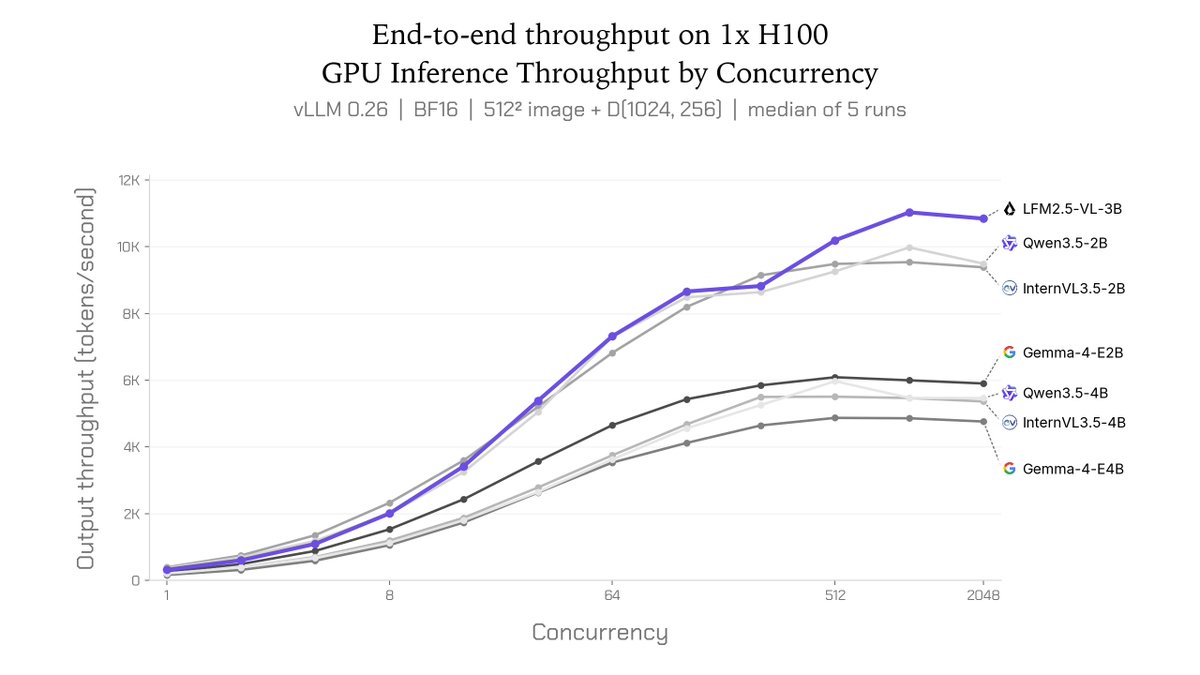
We built LFM2.5-VL-3B on the LFM2.5 base and scaled the vision side. > Vision pretraining scaled 4x in tokens, on curated and synthetic image-caption, OCR, grounding, and instruction-following data > Vocabulary doubled to 128K by extending the existing tokenizer in place rather than retraining from scratch > SFT with knowledge distillation from a larger teacher model, plus Antidoom training > Multi-reward reinforcement learning (4/5)
Context
Liquid AI's LFM2.5-VL-3B can turn visual input into information software can act on: text from documents, coordinates locating objects, or structured requests to call tools. Locating an item on a screen gives an application a position to use for an interaction, beyond a verbal description of what the screen contains. Release thread.
The company reports roughly 3 GB of memory use in its published device tests. Those tests used a compressed model, one 512×512 image and a specified text workload. This supports a concrete deployment possibility: visual interpretation on local hardware with limited memory, with the footprint tied to the tested configuration.
- LLM — A large language model — the neural network behind tools like Claude and ChatGPT, trained on huge amounts of text to predict what comes next.
- grounding — Tying a model's answers to checkable sources — retrieved documents, live data, tool results — instead of letting it answer from memory alone.
 postLiquid AI ships LFM2.5-24B-A2B open weights for local agents
 postToday we release Open d1: two open-weight multimodal models in our d1 decision…
 postLiquid AI's d1 decision model adds vision at a fraction of frontier cost
 articled1 is now available on @vercel AI gateway!We worked with the amazing vercel…
Checking sign-in…
Loading comments…