LFM2.5-2.6B: an open-weight agentic model that plans and calls tools on-device
- Source
- x.com
- Date

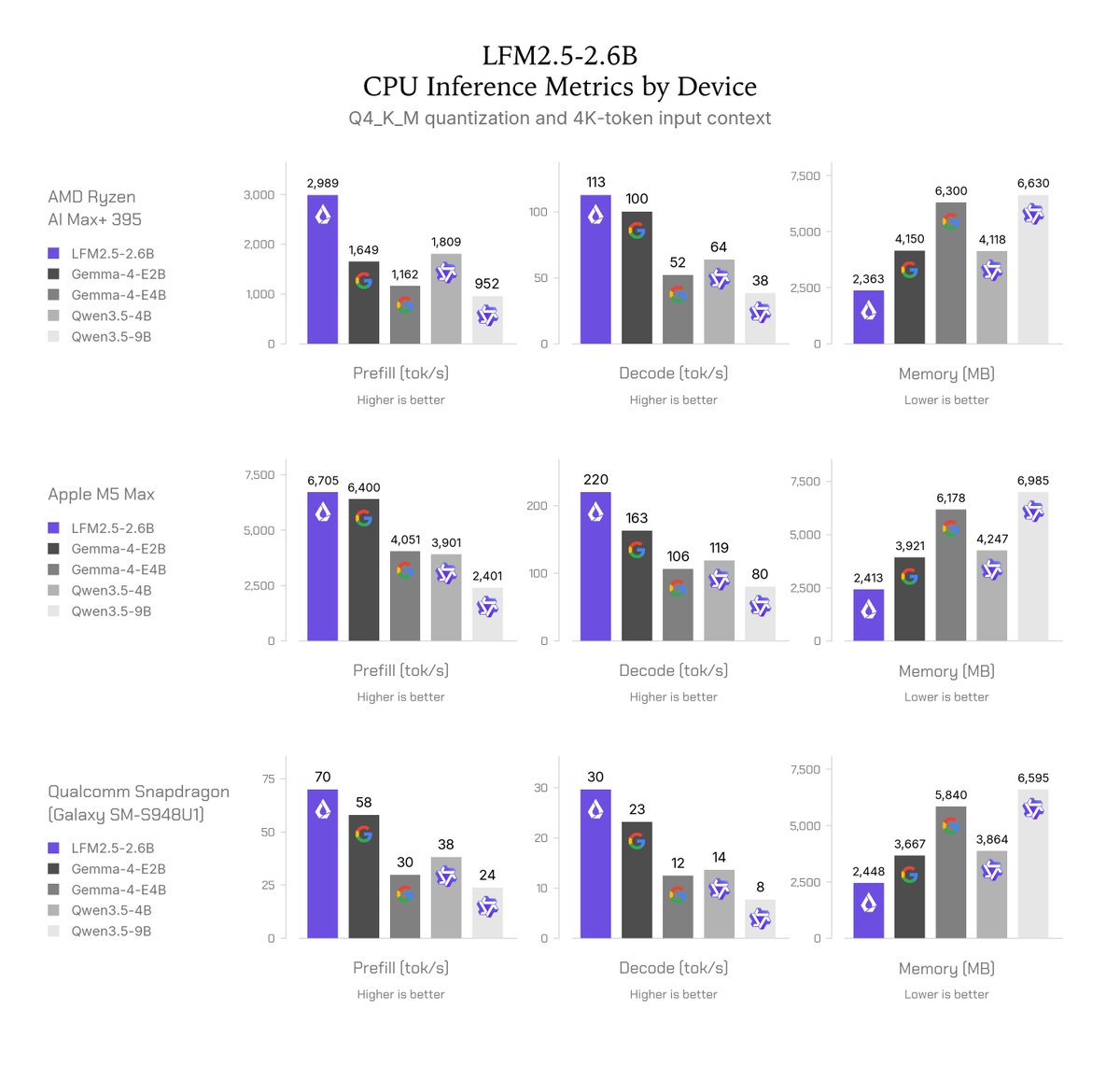
Today we release LFM2.5-2.6B, an agentic model that runs entirely on-device. It plans, calls tools, and works through multi-step tasks on phones, laptops, PCs, and robots. Data never leaves the device, and the marginal cost of each run is essentially zero. > Pre-trained on ~34T tokens > LFM2.5 flagship hybrid architecture > Context length: 128K > Vocab size: 128K > balanced intelligence per watt > customizable on a single GPU for any specialized task > LFM2 open-weight license Comparable or better scores compared to models up to nearly 4x its size: > ToolSandbox 77.83, ahead of Qwen3.5-9B at 76.44 > Multi-IF 80.07, ahead of Gemma-4-E4B-it at 77.35 > IFStruct 85.49, ahead of Qwen3.5-9B at 78.50 🧵

LFM2.5-2.6B is carefully designed for device and ultra-fast server-side deployments with unmatched decode speed, prefill latency, and memory footprint ships with day-one support across the inference ecosystem: > llama.cpp, MLX, vLLM, SGLang, ONNX > Hardware: AMD, Qualcomm, Apple, NVIDIA, Intel Two steps to set up your own local agent: 1) serve LFM2.5-2.6B behind an OpenAI-compatible endpoint 2) point your agent harness at it
We trained it inside the real agent harnesses people use. > Four stages of post-training: SFT, expert specialization, multi-domain on-policy distillation, and agentic RL > The last stage of post-training is multi-turn agentic RL through Pi, Hermes Agent, and OpenClaw > Each rollout runs in its own sandbox, optimized with GRPO against an outcome reward: an LLM-as-a-judge rubric, programmatic checks, and a hard safety gate. The model arrives having already seen their tools, their system prompts, and their interaction patterns.

It suits high-volume agentic work on edge devices, where speed, privacy, and local deployment matter. For coding-heavy workloads or more complex agentic tasks, a larger model may still be the better fit. LFM2.5-2.6B and LFM2.5-2.6B-Base are available now on Hugging Face: > Blog: https://t.co/Qr22eVQacI > LFM2.5-2.6B: https://t.co/2eXeVf9fTI > LFM2.5-2.6B-Base: https://t.co/4zOCXW1WBr > Docs: https://t.co/SyQJEpJd6h
Context
Liquid AI trained LFM2.5-2.6B for local applications that need to plan a task and call software tools over several steps. Part of its training took place inside existing frameworks, exposing it to their instructions, available tools and interaction patterns. Release account.
In that stage, each attempt ran in a separate and was evaluated using outcome checks, including programmatic checks and model-based judging. This trains against the surrounding workflow an agent must operate in, connecting model responses to task outcomes. The company positions the model for frequent on-device work, while identifying complex coding and harder agent tasks as cases where a larger model may remain preferable.
- AI agent — An AI system that doesn't just answer once but works toward a goal in a loop — taking actions, reading the results, and deciding what to do next.
- sandbox — An isolated environment where AI-generated code or agent actions run without being able to touch anything real.
- open weights — A model whose trained parameters are published for anyone to download and run — unlike API-only models you can access but never possess.
- context window — The maximum amount of text a model can consider at once — its working memory for the current conversation or task.
 postLiquid AI ships LFM2.5-24B-A2B open weights for local agents
 postToday we release Open d1: two open-weight multimodal models in our d1 decision…
 postLiquid AI's d1 decision model adds vision at a fraction of frontier cost
 articled1 is now available on @vercel AI gateway!We worked with the amazing vercel…
Checking sign-in…
Loading comments…