Adobe Agentic Sites (Audience of One)
- Source
- latent.space
- Author
- Richard MacManus
- Date
Context
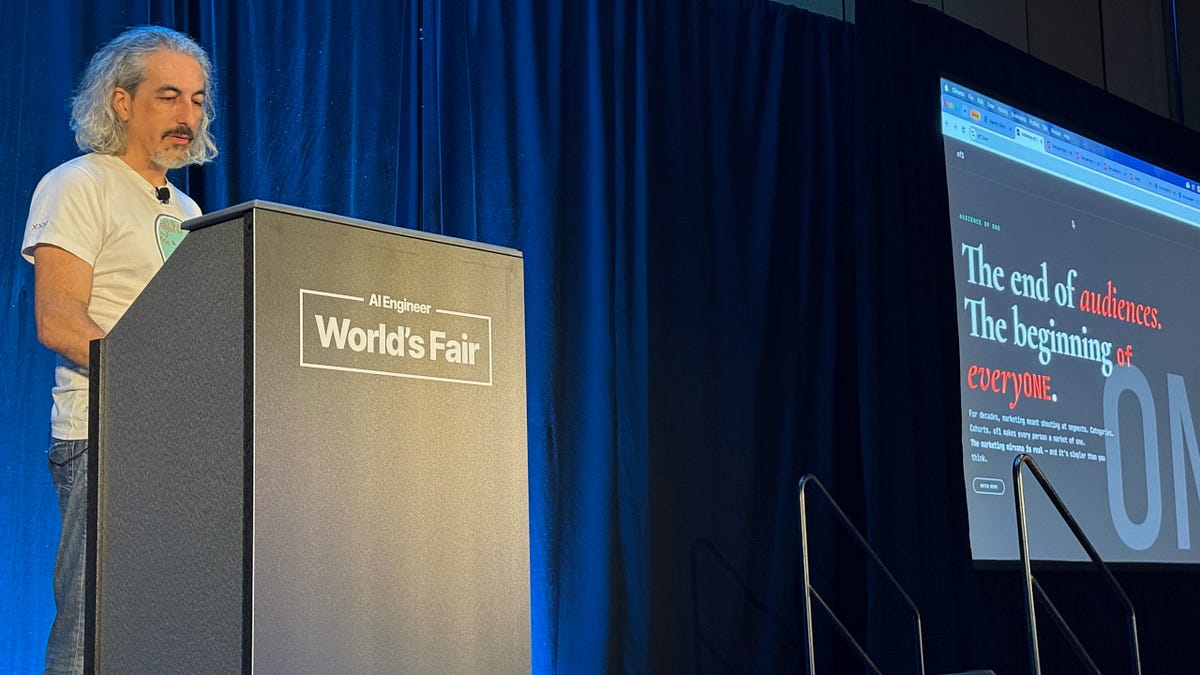
Adobe's experimental agentic website assembles a page around a visitor's apparent interests. Browsing behavior and search queries help identify intent; the system retrieves relevant company content and uses an AI model to compose the page. In the reported demonstration and interview, an interest in camping reshaped a coffee-machine website around making coffee outdoors.
That changes personalization from choosing among prepared pages to composing an experience from existing material. At the time of the interview, Adobe was seeking customers willing to experiment and had not broadly deployed the approach on customer production sites. The demonstrated capability was page composition; whether it improves purchasing outcomes remained open.
- The company's existing published content is the corpus. The system retrieves from that material and rearranges it rather than asking a model to invent a page, which is what keeps a generated page factual and on-brand.
- Signals in, page out: browsing behavior and search queries get bucketed into an intent — exploring, researching, or ready to buy — and a model composes the page for that bucket. A camping-minded visitor got a coffee-machine site reorganized around brewing outdoors.
- Speed is a model-selection criterion here, not just an ops target. Adobe scores candidate models on latency alongside accuracy, because a page a visitor is waiting on has a very different budget than a batch job.
- Agentic commerce is not one interaction pattern. An can silently reorder toilet paper, but a jacket buyer still wants to look first — so a site has to support several levels of delegation, from WebMCP tools to an agent-to-agent backend that skips the visual site.
- This is a concept, not a product: Adobe has not deployed agentic sites on production customer sites and is hunting for willing experimenters. Sanchez's own framing is that AI makes things easy to build and hard to choose.
- LLM — A large language model — the neural network behind tools like Claude and ChatGPT, trained on huge amounts of text to predict what comes next.
- grounding — Tying a model's answers to checkable sources — retrieved documents, live data, tool results — instead of letting it answer from memory alone.
- AI agent — An AI system that doesn't just answer once but works toward a goal in a loop — taking actions, reading the results, and deciding what to do next.
“Adobe Principal Scientist Carlos Sanchez is exploring a more radical possibility: what if the website itself could be assembled around the needs of each visitor?”
Richard MacManus
“In one example, a visitor interested in camping received a version of a coffee-machine site whose copy, product selection and supporting content had been reorganized around making coffee outdoors.”
Richard MacManus
“In his session, Sanchez said that Adobe evaluates models not only for accuracy, but also for speed: “We don’t want the site generation to take more than one or two seconds.” Sanchez says the economics are already becoming plausible. He estimated the current inference cost at “one to two cents per page.””
Richard MacManus
“A personal agent might autonomously reorder toilet paper, while a person buying a jacket may still want to inspect the product and make the final choice through a visual interface. That means websites will need to support different levels of delegation and involvement, rather than treating “agentic commerce” as a single interaction pattern.”
Richard MacManus
“Rather than being a fixed collection of pages that every visitor navigates, a “website” could become a governed content and interaction system that assembles an appropriate interface on demand.”
Richard MacManus





Checking sign-in…
Loading comments…