AINews (Latent Space)
- Source
- latent.space
- Author
- Latent Space
- Date
Context
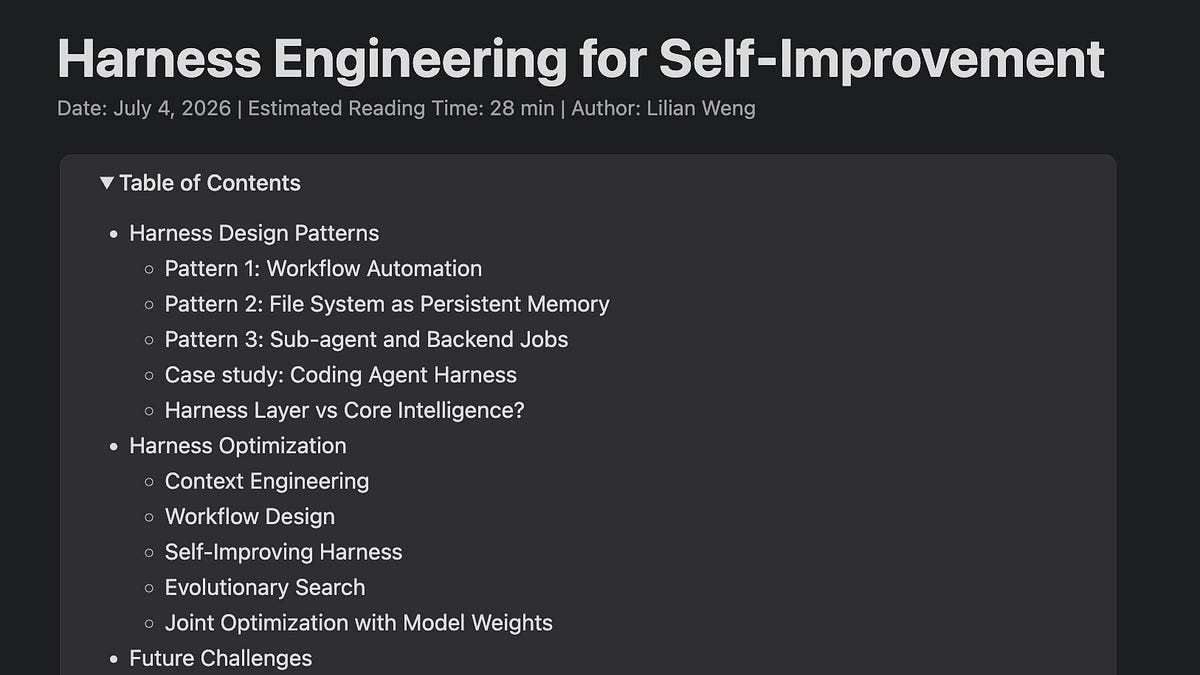
An agent can improve the software directing its work without changing the underlying model. In her essay on harness engineering, Lilian Weng describes the surrounding system, or harness, as the code managing tools, context, stored work and evaluation.
One research pattern lets an agent inspect failures, propose bounded changes to that system and keep changes that pass validation. This makes the execution process itself an improvement target. Weng argues that permissions and security controls must remain outside the editable loop, and that stronger models will still need goals and context. Her underlying research overview describes a direction for self-improvement, rather than establishing unrestricted autonomous progress.
- Liquid AI's Antidoom attacks 'doom loops', where a small reasoning model repeats tokens until it burns through its context. Its FTPO method relabels the token that triggers the loop and shifts probability to alternatives: loop rate fell from 10.2% to 1.4% on a 2.6B model.
- Meta's Muse Image is a generation loop, not a single pass: it plans, searches the web, calls tools, runs code, and self-refines before rendering, and quality improves with more . Meta says the self-refinement emerged during RL rather than being scripted.
- NVIDIA's Puzzle compresses a hybrid model to 75B parameters with 9B active while holding reasoning and coding quality — roughly doubling server throughput and taking concurrent million-token-context requests on an H100 from 1 to 8.
- Lilian Weng reframes recursive self-improvement around the harness — the scaffolding of goals, context, and tools around a model — rather than a model rewriting its own weights. Even as harness tricks get absorbed into models, someone still has to specify goals and context.
- Verification is emerging as its own scaling axis: a training-free verifier reads continuous scores directly off the logits of scoring tokens, reporting results across Terminal-Bench V2, , and MedAgentBench.
- test-time compute — Spending more computation when the model answers — thinking longer, trying multiple attempts — to buy accuracy without training a bigger model.
- mixture-of-experts — A model built from many specialist sub-networks where only a few activate per token, giving big-model capability at small-model running cost.
- calibration — How well a model's confidence matches reality — a calibrated model saying "90% sure" is right about 90% of the time.
- SWE-bench — The standard benchmark for AI coding agents: real GitHub issues from real repositories, scored by whether the agent's patch passes the project's own tests.
“The biggest product launch by engagement was Claude Cowork coming to mobile and web , positioning Claude as a task-running background teammate rather than a foreground chat UI.”
“This is a good example of the field’s recent pattern: removing specific failure modes rather than only scaling parameters.”
“The big message is that models can satisfy many individual rubric items yet still fail to produce acceptable end-to-end deliverables.”


Checking sign-in…
Loading comments…