Breakthrough Results in Sphere Packing, Coding Theory, and Group Theory
- Source
- x.com
- Publisher
- OpenAI
- Date

An internal version of our next major model produced 10 new results on long-standing open problems in mathematics and theoretical computer science, using roughly $2,000 worth of tokens at GPT-5.6 Sol API rates.

The results span sphere packing, coding theory, group theory, quantum complexity, lattice cryptography, extremal combinatorics, and more. Among them: establishing the existence of non-sofic groups and exponential improvements to bounds on high dimensional sphere packing.
Context
OpenAI says an unreleased internal version of its next major produced 10 new results on long-standing open problems in mathematics and theoretical computer science. The evidence available here supports that only as OpenAI's claim: the announcement thread names the fields and two of the results, but the proofs and any technical write-up were not part of the material read.
The thread lists results in sphere packing, coding theory, group theory, quantum complexity, lattice cryptography and extremal combinatorics, and highlights two. One establishes that non-sofic groups exist. Sofic groups are a broad class of groups that can be approximated by finite permutations, and whether every group belongs to that class has been an open question, so an existence proof would answer it in the negative. The other is an exponential improvement to bounds on sphere packing in high dimensions, the problem of how densely identical balls can fill space. The thread does not say which bound improved, whether the density known to be achievable or the ceiling on what is possible.
OpenAI puts the cost at roughly $2,000 worth of priced at GPT-5.6 Sol's rates, not at any price for the internal model itself. That figure describes model usage only. The thread does not say how many attempts were made, how much people guided the work, or whether outside mathematicians have checked the results. Collection was also incomplete: the thread read was cut short by a reading budget, and the attached video yielded no text. Until the proofs can be read and checked by others, these are announced results, not established theorems.
- Model — A computational system that uses learned patterns to produce an output from information supplied to it.
- Token — A piece of text, such as a word, part of a word or a punctuation mark, that a language model represents as numbers and handles as a unit.
- API — Application programming interface: the agreed set of operations, inputs and outputs through which one piece of software uses another.
 articleGPT-6.2 designs lab-tested protein binders using reasoning and code
 articleOpenAI's Agent Pipeline Validated 948 Linux Kernel Root Exploits
 articleOpenAI and Cisco open-source Shirudo, agent-written eBPF shields for live Linux
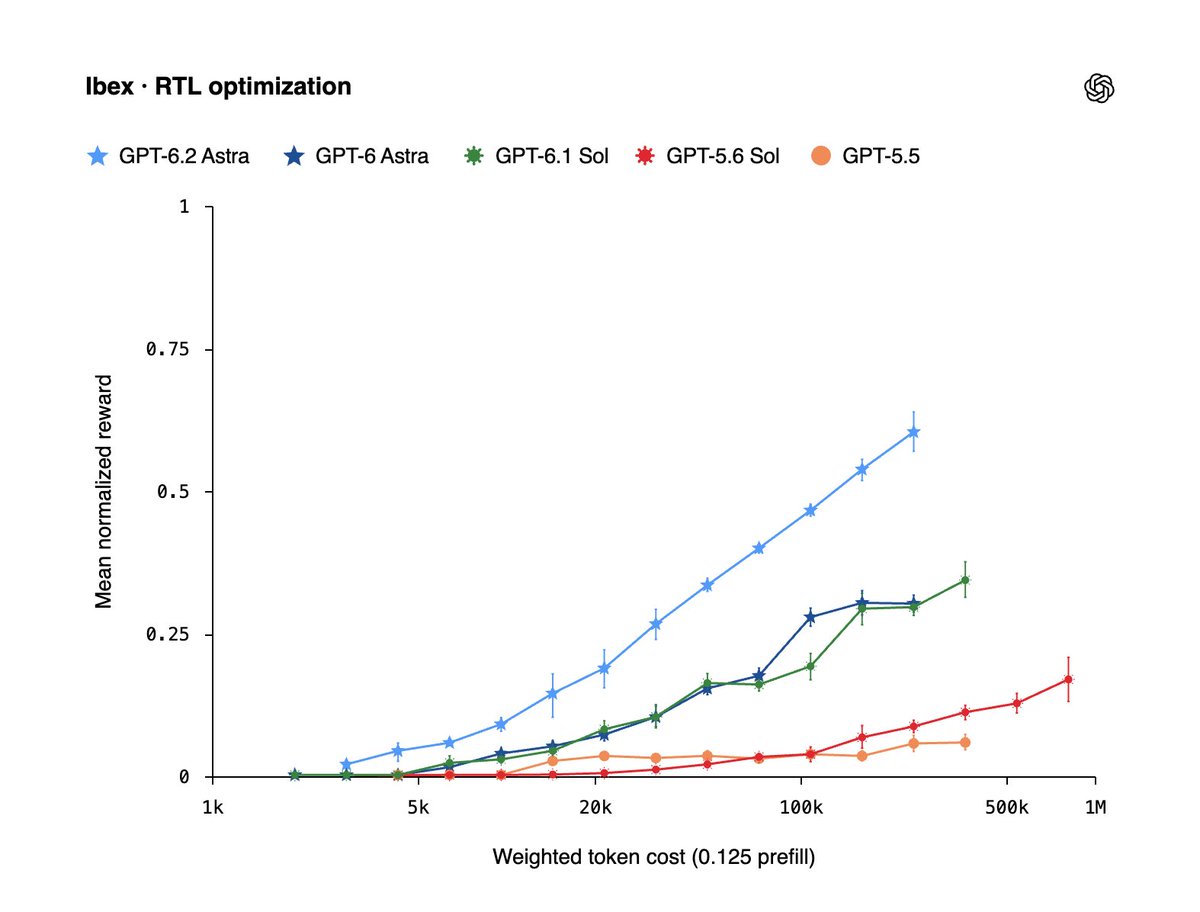 postOpenAI models cut up to 14% PPA on AMD GPU IP, verified on Jalapeño silicon