GPT-6.2 designs lab-tested protein binders using reasoning and code
- Source
- openai.com
- Author
- OpenAITop Viber
- Date
Context
OpenAI says its GPT-6 family can design both a new protein's three-dimensional shape and the sequence of chemical building blocks that folds into that shape, using only reasoning and general-purpose coding tools instead of the specialized biology models that normally generate such designs, and that proteins made from GPT-6.2's designs bound their intended targets in laboratory tests run with its research partner Onava. The question worth asking of that claim is how much of the design job the did on its own, and OpenAI's November 24 write-up answers it: two stages of a longer pipeline, with specialized models supplying the rest. Proteins are chains of building blocks called amino acids, and the order of those blocks largely sets the shape the chain folds into, which sets what the protein can do. Anyone who wants a protein to grip one particular target has to settle two linked questions, which shape would do the job and which sequence would produce that shape. The preprint behind the post, titled GPT-6 as a Universal for Protein Biology: Beyond Specialized Models, was too large to retrieve for this explanation, so the results below are OpenAI's own account of its own work except where another source is named.
The standard route hands each stage to a single-purpose model. RFdiffusion draws a backbone, the the chain takes through space. ProteinMPNN or SolubleMPNN proposes amino acid sequences for a given backbone. Structure predictors such as ESMFold2, Boltz-2 and OpenDDE predict how each candidate would fold, which is how a long list of designs is cut down to the few worth making. In the first lab experiment GPT-6.2 took over the backbone step alone: given the structures of five target proteins and a marked spot on each where a small binding protein, called a minibinder, should attach, it wrote code to produce candidate shapes, and specialized models then supplied the sequences and helped choose what to test. Of 322 minibinders made and tested, 35, or 10.9%, bound the target they were designed for. OpenAI notes that the original RFdiffusion study reported higher hit rates, and that such rates depend heavily on how strictly designs are filtered before testing and on how binding is defined. RFdiffusion's own Nature figure legend shows how much that matters: it credits one of its two orders of magnitude of improvement over earlier design campaigns to RFdiffusion itself and the second to filtering with AF2, estimating that those earlier campaigns would have come in between 0% and 5.5% had the same filter been applied. Three of the five targets, IL-7Rα, PD-L1 and TrkA, appear in both studies, but 10.9% is evidence that GPT-6.2's shapes can be turned into proteins that bind, not a ranking against RFdiffusion.
The stronger evidence is the second experiment, where GPT-6.2 wrote the sequences itself. Given structural models of existing minibinders with the original sequences withheld, its designs bound in 75 of 88 cases for the target MDM2, 26 of 42 for VEGF-A and 8 of 59 for PD-1. It also proposed sequences for three minibinder shapes it had generated earlier and that have never been published, and 14 of the 107 proteins made from those sequences bound. For one of those unpublished PD-L1 shapes it produced two sequences that both showed binding and that differed from each other at 44 of 90 positions, which is hard to explain as recall of something seen in . The antibody work follows the same pattern. Asked to write new versions of the three loops a small antibody uses to grip its target, 128 of 182 designs bound IL-4Rα, and when about half the amino acids in each of three loops of five therapeutic antibodies were changed, 179 of 272 fragments still bound the original target, PD-1 or PD-L1. Specialized models again picked which candidates reached the bench. That coordinating arrangement is where other labs have put the general model: Amazon reported an antibody-design workflow in September in which an agent recommends binding regions and generative models propose the candidates (earlier coverage).
OpenAI is explicit about what this does not show. The campaign leaned on specialized structure predictors to filter candidates, so the results establish intrinsic capability at backbone generation and sequence redesign and do not yet establish that the models can produce a de novo minibinder end to end without that help. Several of the strongest numbers also come from an unreleased internal model rather than a shipped one. On 30 motif-scaffolding problems from MotifBench, a standardized set that asks a design to reproduce a required arrangement of amino acids to within 1Å and the surrounding backbone to within 2Å, a preliminary analysis put that internal model at 43.7% against 27.8% for RFdiffusion, counting a design as a success when at least one ProteinMPNN sequence was predicted by ESMFold to preserve the motif and match the submitted shape. Predicting a whole protein's structure from its sequence alone remains the clear weakness, with the internal model averaging a TM-score of 0.38 where the specialized ESMFold2 averaged 0.93 and 1.0 is a perfect match. And binding is the first property a designed protein needs rather than the last. Specificity, stability, biological activity and safety are untested, and these are the authors' own measurements in a preprint, not an independent replication.
- In lab tests with Onava, 35 of 322 minibinders designed by GPT-6.2 bound their intended target, a 10.9% hit rate across five targets. OpenAI notes RFdiffusion's original study reported higher rates and that rates depend heavily on how strictly designs are filtered.
- The campaign still leaned on specialized models: SolubleMPNN and ProteinMPNN supplied sequences while Boltz-2, OpenDDE and ESMFold2 filtered candidates, so OpenAI says the work does not establish end-to-end zero-shot minibinder design.
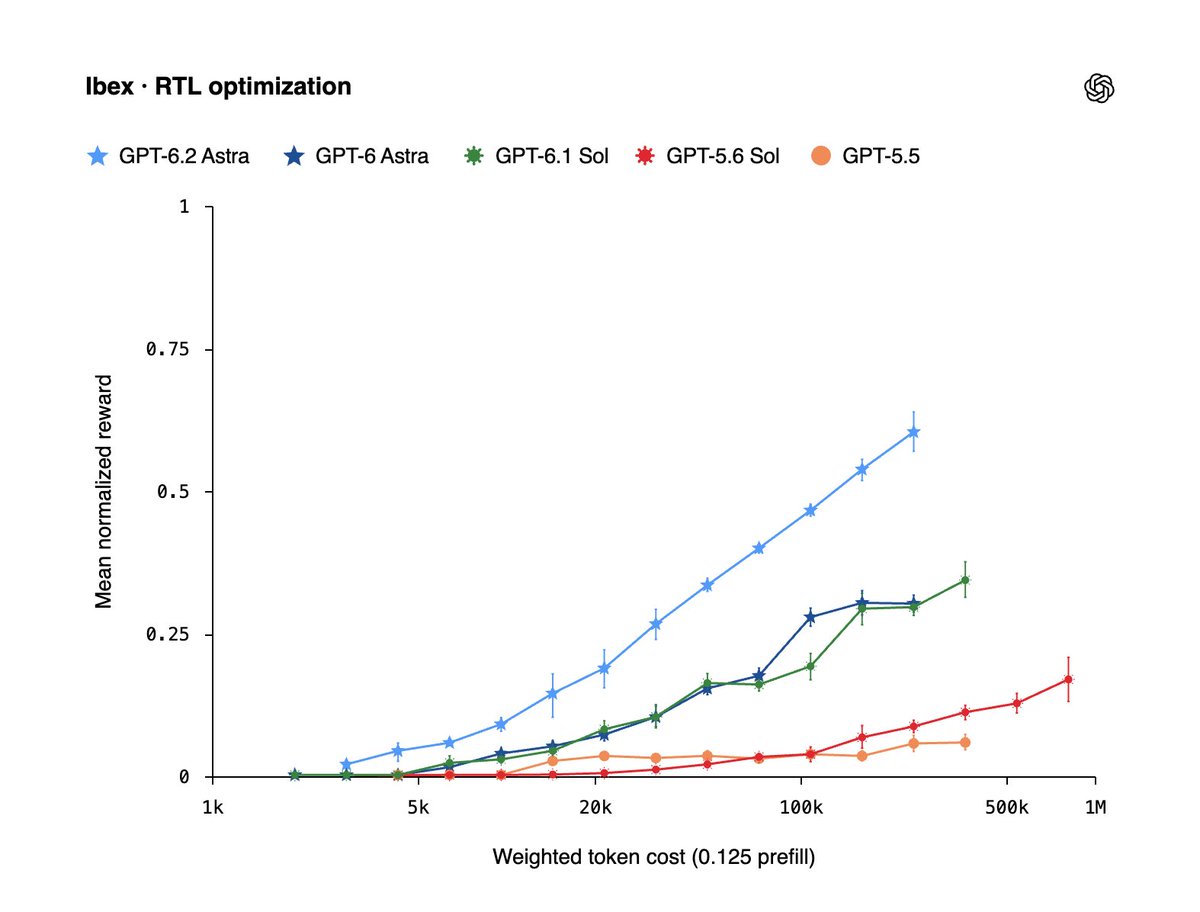
- Whole-structure prediction stays the clear weakness. Average TM-score rose from 0.16 for GPT-5.6 to 0.26 for GPT-6.2 and 0.38 for OpenAI's latest internal model, against 0.93 for the specialized ESMFold2.
- Docking went the other way: GPT-6.2 matched the observed pose in 93% of scored PoseBusters predictions versus 50% for DiffDock-L, and on the Scarpino set, told which two atoms were bonded, it reached 92% against DiffDock's 60%.
- Redesign held up better than designing from scratch. Of 182 new loop sequences for six IL-4Ra VHHs, 128 (70%) still bound, and 179 of 272 fragments (66%) based on five therapeutic antibodies bound the original PD-1 or PD-L1 target.
- Model — A computational system that uses learned patterns to produce an output from information supplied to it.
- Pre-trained model — A model trained broadly before it is adapted or prompted for a particular application.
- Path — A description of a file or folder location, written using directory names and separators.
- Training — The process that adjusts a model using examples and a measure of how well it performs.



Checking sign-in…
Loading comments…