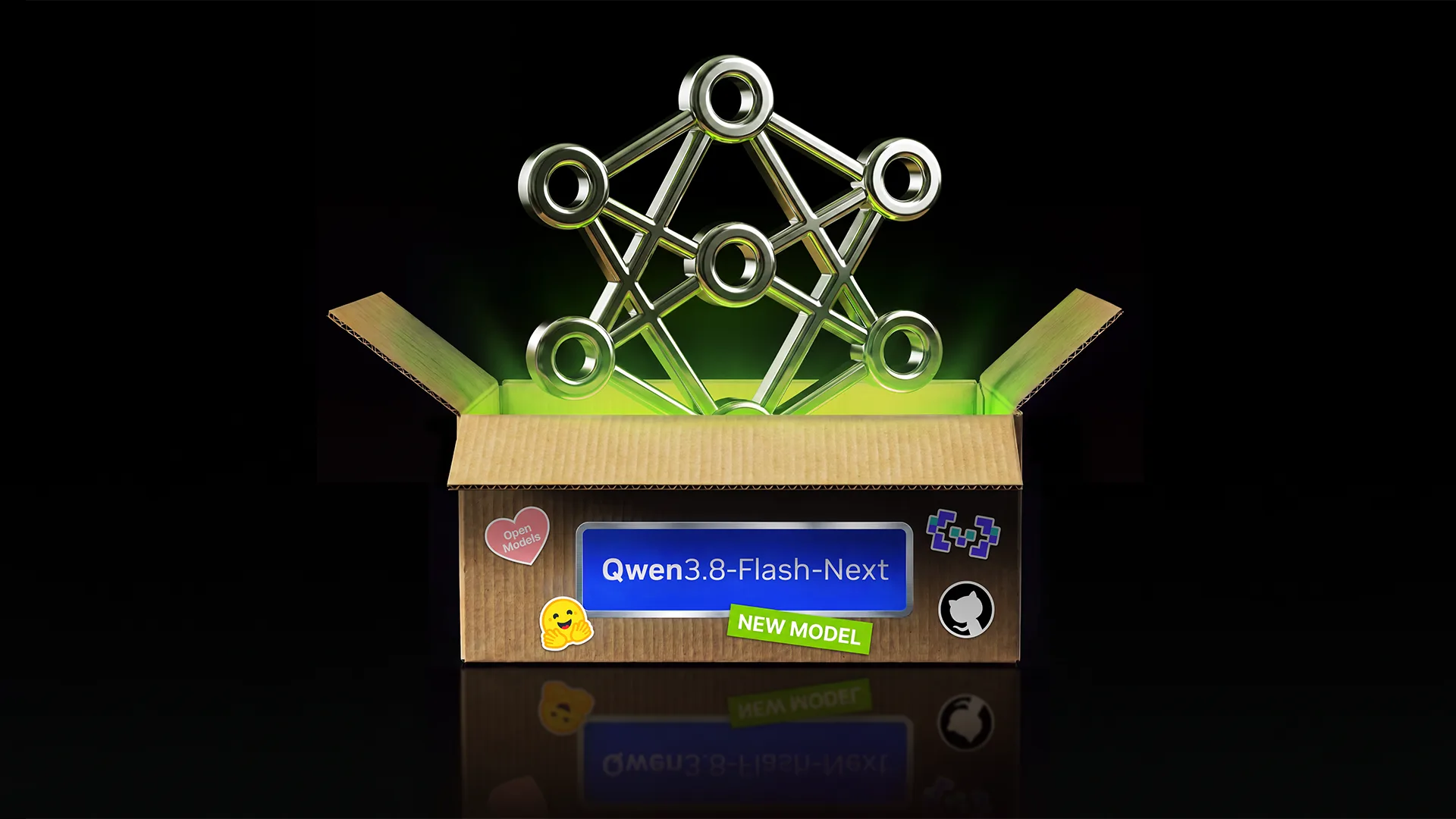
NeMo AutoModel ships day-0 fine-tuning for Qwen3.8-Flash-Next
- Source
- github.com
- Publisher
- NVIDIA
- Author
- Qwen
- Date
Context
NVIDIA's fine-tuning framework NeMo AutoModel had a tested recipe for supervised fine-tuning of Qwen3.8-Flash-Next ready at launch, and Qwen thanked NVIDIA for the day-0 support. The documentation makes clear this is a cluster job. The baseline run used 64 H100 GPUs across eight nodes, and the recipe asks users to allocate the same. Training was validated on 4,096-token sequences, although the model natively handles 262,144, and only the language path is supported: vision and video training, the model's multi-token-prediction head and some parallelism modes are not.
Much of the engineering goes into a component ordinary models lack. Qwen3.8-Flash-Next, which Qwen released as an open-weight preview of its Qwen4 architecture, activates 6 billion of its 125 billion backbone parameters for each token and adds a separate 51.2-billion-parameter Engram table. Engram comes from a DeepSeek and Peking University paper arguing that transformers waste computation reconstructing knowledge that could be looked up directly; its table stores retrieved by hashing short runs of tokens. In this model, the second decoder layer adds values found through eight two-token and eight three-token hashes. NeMo splits the table's rows across every GPU: each GPU sends hashed row IDs to the GPU that owns those rows and gets the values back, and during training only the owner stores and updates a row's gradient.
NVIDIA's evidence that the port is correct is a comparison with the SGLang reference implementation. On fixed inputs, token embeddings, hash IDs and table values matched exactly, and a full-model run produced the same top-1 and top-5 next-token predictions as SGLang. A 100-step run reduced training loss from 3.0734 to 1.8195 without numerical or communication errors. That shows the recipe trains the same model the reference runs; it says nothing yet about how well a fine-tuned model performs on any task.
- embedding — A list of numbers representing a piece of text's meaning, so that similar meanings end up numerically close and can be searched.
- attention — The mechanism that lets a model weigh which earlier words matter for the word it's currently processing — the core operation of a transformer.
- mixture-of-experts — A model built from many specialist sub-networks where only a few activate per token, giving big-model capability at small-model running cost.
- Context and context window — Context is the information available for a generation; the context window is the capacity available to hold it.