A proposal for the future of scientific communication
Source
Paradigma
Author
Paradigma
Date
Key takeaways · AI-distilled
Paradigma says its agent harnessThe scaffolding around a model that turns it into a working agent — the loop, the tools it can call, and the rules for when to stop.Full definition → proved the inverse Fourier transform of 1/Xi is strictly log-concave, so every 2x2 test in Gröchenig's total-positivity criterion for the Riemann Hypothesis passes, without assuming RH.
The authors stress this is not a proof of RH: the 2x2 case says nothing about 3x3 or larger matrices, and they are unsure of novelty, having found no prior proof of this exact statement while allowing a specialist may know one.
The result was checked in Lean in full, without sorry, custom axioms or native_decide, and the code is published at paradigma-inc/xi-log-concavity-lean.
An attribution audit of the run logs credits Paradigma's internal math checkpoint with some correct calculations, such as a convolution kernel and a positivity argument, but says the decisive steps, corrections and numerical certificate came from Codex.
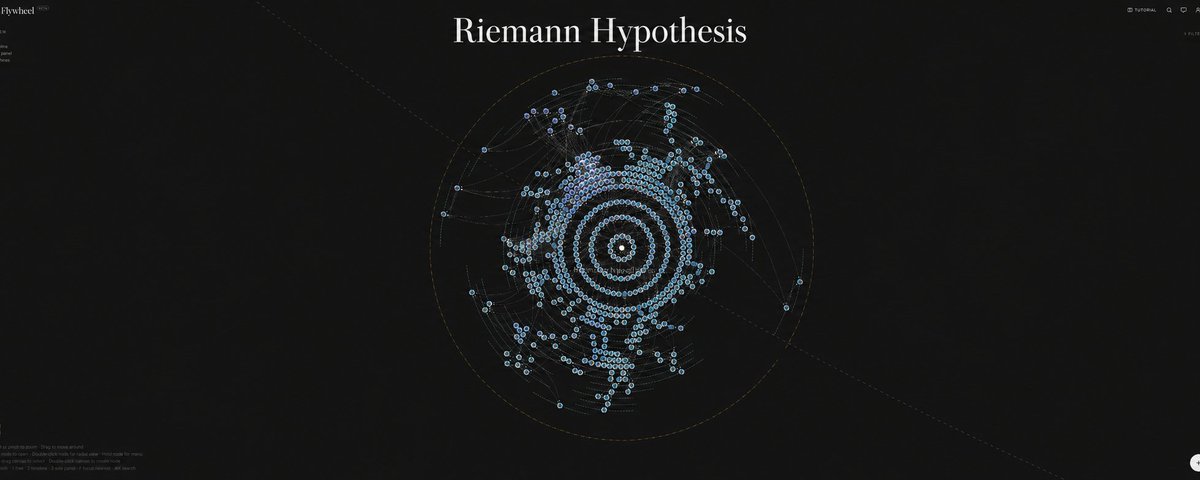
Paradigma argues a Flywheel graph differs from a paper: it records work in progress with dead ends attached, so reviewers, possibly other people's models, can check the actual steps instead of reconstructing them from the author's account.
Terms in this piece · Glossary
AI agent — An AI system that doesn't just answer once but works toward a goal in a loop — taking actions, reading the results, and deciding what to do next.
agent harness — The scaffolding around a model that turns it into a working agent — the loop, the tools it can call, and the rules for when to stop.
Why it matters
Paradigma's Flywheel reframes research sharing as a versioned graph rather than finished papers, and its demo shows an agent harness (Codex plus an internal math model) producing a formally verified partial result toward Gröchenig's RH criterion, with all dead ends left visible for others to branch from.

 articleThe Problem Is the Problem: Towards Scalable Mathematical DiscoveryZeyu Zheng, Shengtong Zhang, Jeremy Avigad, Prasad Tetali, Sean Welleck