Phonic 1.1 tops Artificial Analysis speech-to-speech index
- Source
- x.com
- Date

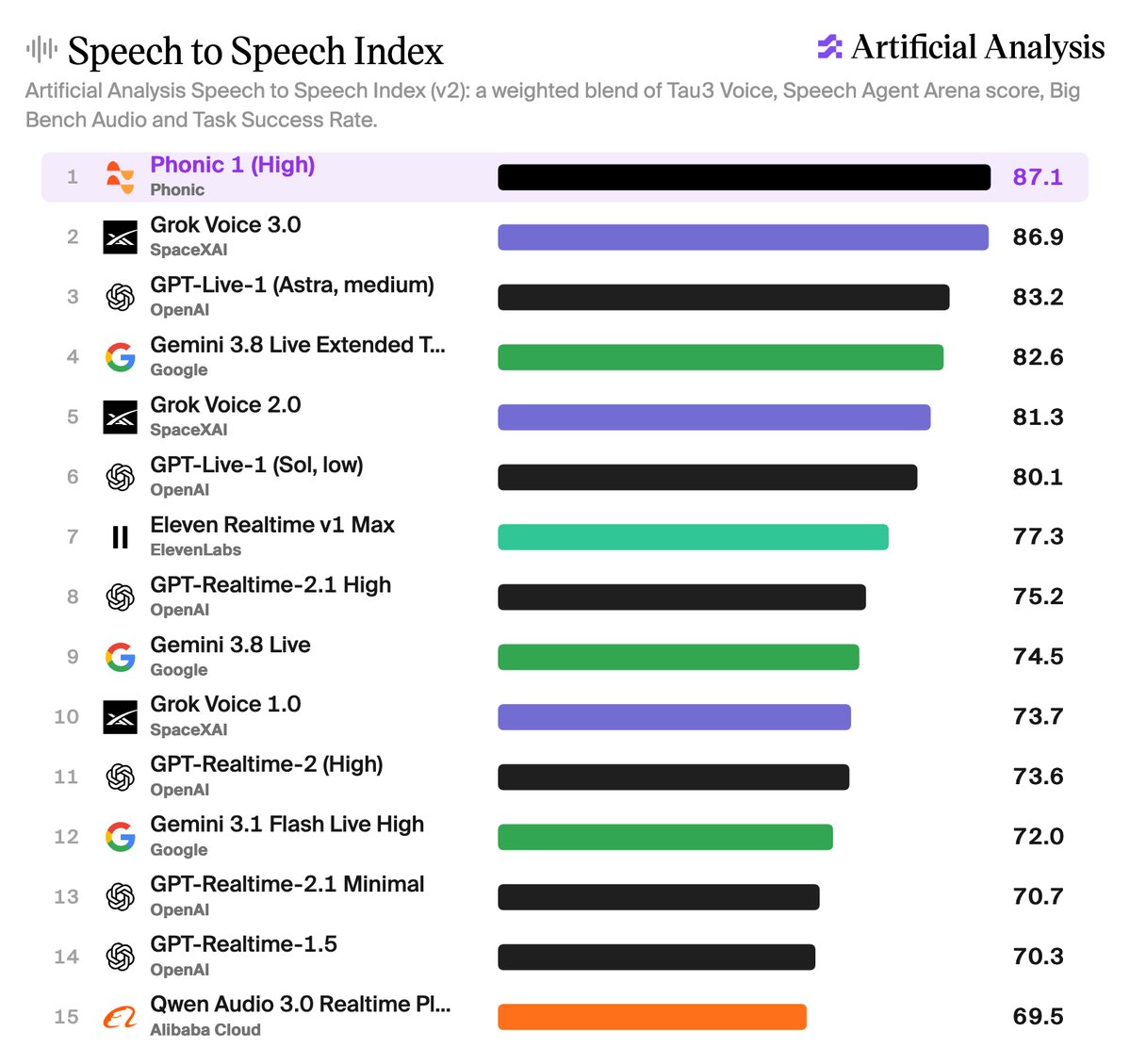
Phonic 1.1 (High) is the new #1 on the Artificial Analysis Speech to Speech Index at 89.1, taking the top spot from Phonic's own Phonic 1 (87.1), released less than a month ago Congratulations to @phonic_co on the release! 🧵

Context
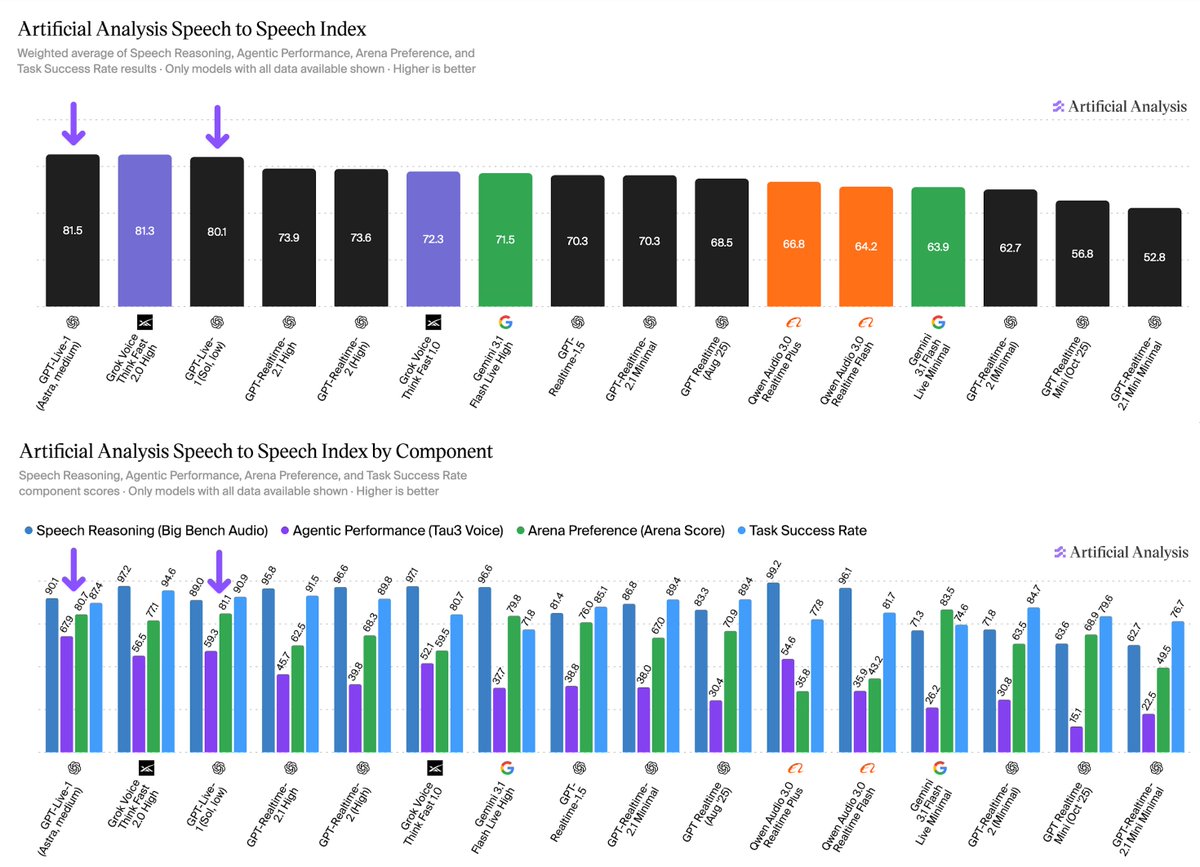
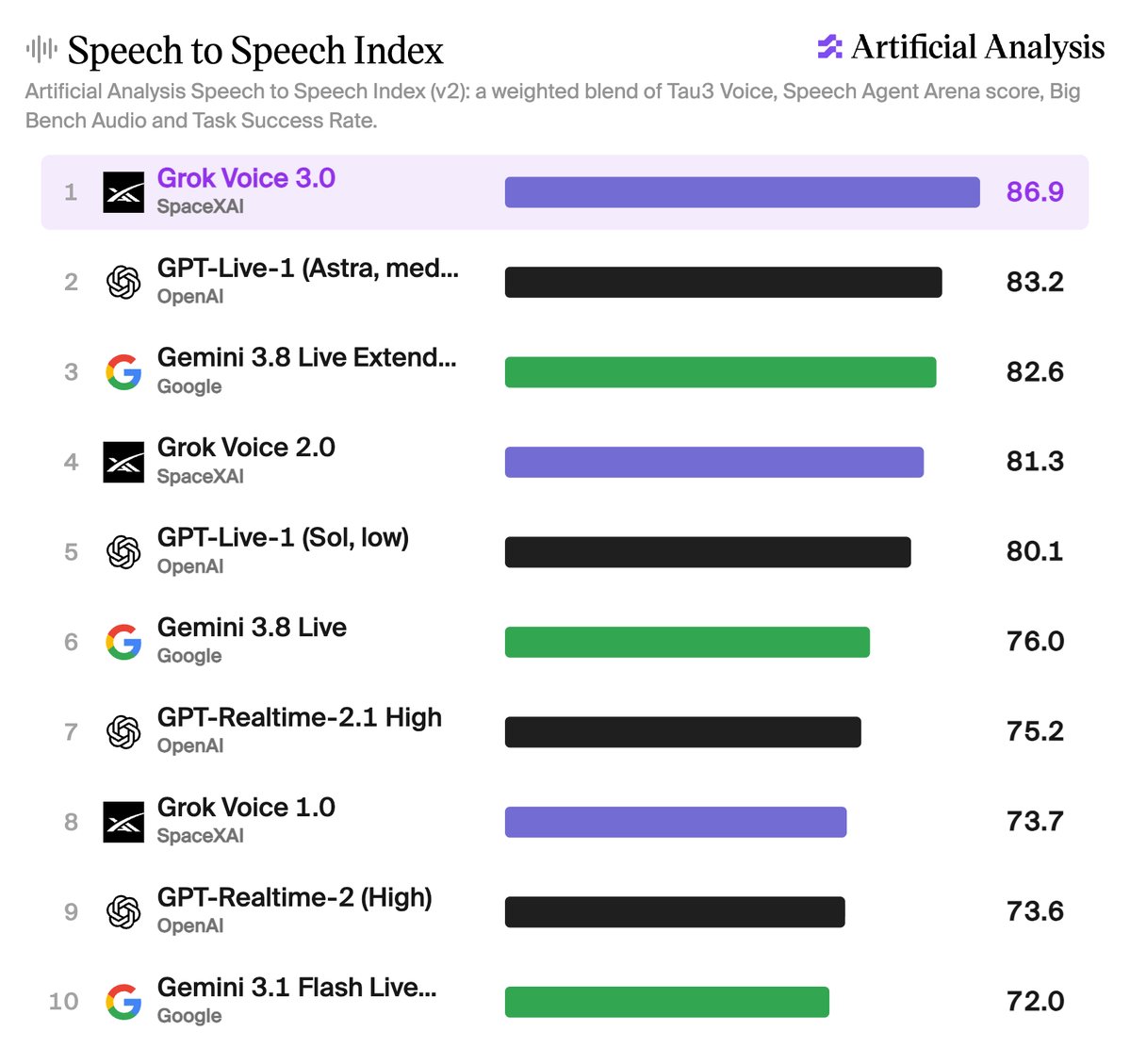
Phonic 1.1's lead on the Artificial Analysis Speech to Speech Index rests mainly on a strength it shares with its predecessor: completing customer service calls that require the model to use software tools. Phonic 1.1 (High) is a new speech-to-speech model from Phonic, meaning it takes spoken audio in and answers in spoken audio. Artificial Analysis gives it an index score of 89.1, two points above Phonic 1 at 87.1, which took first place less than a month earlier. The index gives equal weight to four measures: a spoken reasoning test, an agentic test, a preference rating from blind live calls, and how often those calls end with the correct action taken. The thread does not say how much each measure contributed to the two-point gain.
In Artificial Analysis's words, Phonic's edge is agentic calls. Tau Voice 2.0, its implementation of Sierra's , simulates airline, retail and telecom support calls, and a task passes when the system the model works in ends in the correct . Phonic 1.1 scores 87.1% and Phonic 1 85.6%, a gap Artificial Analysis says is within the margin of error, and both are at least 5 points ahead of every other model. Phonic 1 was reported at 79.9% on Tau Voice in October and is now listed at 85.6% on Tau Voice 2.0. Artificial Analysis charts the two versions separately because their scores are not comparable, so the fair comparison is between the two Phonic models on the new version.
The other measures barely separate Phonic 1.1 from its predecessor or the . On Big Bench Audio, 1,000 spoken reasoning questions covering formal logic, navigation, object counting and truth-telling puzzles, it rose from 98.9% to 99.5%, but the top five models sit within one point of each other, so the test is close to saturation. In the Speech Agent Arena, participants complete the same task with two hidden models and pick the one they preferred. There Phonic 1.1 gained 43 Elo points over Phonic 1, reaching 1053, level with Grok Voice 3.0 from SpaceXAI but seventh of 32 entries. Grok Voice 3.0 is listed just above it, and three Google Gemini models and two hosted voice-agent platforms rank higher. Its 92.9% task success rate in those calls is third, behind Grok Voice 3.0 at 94.8% and Gemini 3.8 Live at 93.2%, and the arena leaderboard shows its 95% confidence interval overlapping both.
The new version is slower to respond. Phonic 1.1 takes 0.80 seconds on average to start speaking, measured across the Big Bench Audio questions, up from 0.61 seconds for Phonic 1. That is level with Grok Voice 3.0 at 0.81 seconds and faster than GPT-Live-1 (Astra, medium) at 1.34 seconds. The price is unchanged at $4.20 per hour of input audio, or $0.07 per minute. That is below Grok Voice 3.0 at $4.80 and about 2.6 times cheaper than OpenAI's GPT-Realtime-2.1 High at $10.75, though Gemini 3.8 Live Extended Thinking (High) costs less at $3.50. Moving from Phonic 1 to Phonic 1.1 buys a gain in caller preference and a fraction of a point on reasoning, at the cost of about a fifth of a second before the model starts talking. The advantage over other companies' models is still on tool-using calls, where Phonic 1 already led.
- Benchmark — A fixed set of tasks with a stated way of scoring them, used to compare models or setups.
- State — Information describing a system at a particular moment, such as its current text, settings or saved records.
- Field — One named piece of a record, such as name or approved_on; a record is one entity's set of values, one per field.
- Session — One conversation or piece of work as a harness keeps it: a record of messages, tool calls and observations that can be saved and resumed.
Checking sign-in…
Loading comments…