For more details and full results, see:
- Source
- x.com
- Publisher
- Artificial Analysis
- Date
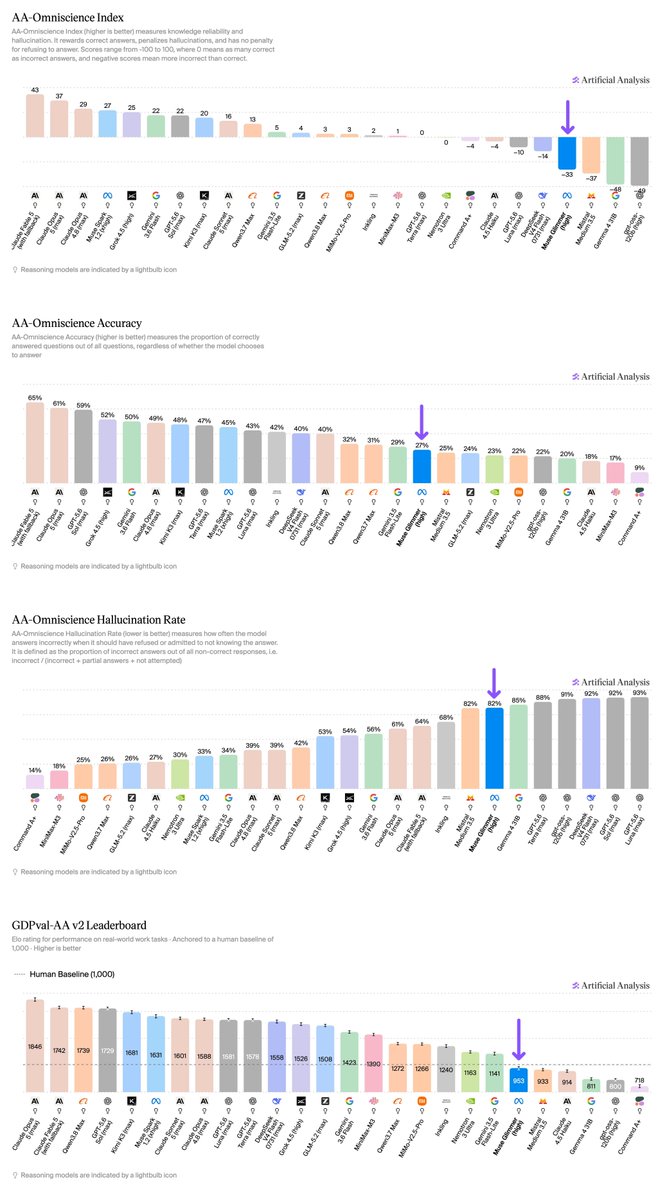
Meta returns to open weights: Muse Glimmer, its first open-weights release since Llama 4, scores 35 on the Artificial Analysis Intelligence Index. It is a 30B-parameter model, and the first from Meta to be released under Apache 2.0 Muse Glimmer (high) arrives 16 months after Llama 4, scoring 21 points above Llama 4 Maverick (14), Meta's last open weights release. It sits alongside Kimi K2.5 (Reasoning, 36) and just behind Qwen3.6 27B (Reasoning, 38) and Ling 3.0 Flash (38), and creates a two-tier Meta lineup together with the proprietary flagship Muse Spark 1.2 (xhigh, 57) @AIatMeta shared access with us ahead of public release for benchmarking. Congratulations to @AIatMeta, @finkd, and @alexandr_wang on the release! Key Takeaways: ➤ Meta's open-weights line is back, under its most permissive license yet. Every prior Meta open release shipped under a Llama License; Muse Glimmer uses Apache 2.0, placing almost no restrictions on commercial use or derivatives ➤ Strong intelligence for its parameter count. At 30B parameters, Muse Glimmer scores 5 points above Gemma 4 31B (Reasoning, 30) at the same size, and effectively matches 1T total parameter Kimi K2.5 (Reasoning, 36) with 33x fewer parameters. Qwen3.6 27B (Reasoning, 38) remains ahead on the Intelligence vs Parameters frontier at a slightly smaller size ➤ Small enough to self-host on a single GPU, even at full context. Muse Glimmer is a 30B dense model (including a ~1.8B vision encoder) with weights at ~60 GB in BF16 and ~18 GB in 4-bit. It features a hybrid-attention mechanism with three sliding-window layers for every global layer, which holds KV cache memory use to ~1.8 GB (minimum) at its pre-extension 128K context. This means the model can run at full context on a single H100 at BF16 precision, or on a higher-spec MacBook or RTX 5090 at 4-bit, with more breathing room if the vision encoder is not required ➤ Agentic knowledge work is its weakness relative to its size class. Muse Glimmer scores 953 Elo on GDPval-AA v2, below the 1,000 human baseline and behind other models at its intelligence level, including the similarly sized Qwen3.6 27B (Reasoning, 1141), and Gemini 3.5 Flash-Lite (1141). Knowledge calibration follows the same pattern: its AA-Omniscience Index of -33 is low for its intelligence level, driven by an 82% hallucination rate (Qwen3.6 27B: 49%) rather than accuracy, where it matches its peers. Agentic tool use is the exception, with Muse Glimmer scoring 24% on Tau3-Banking, ahead of Gemini 3.5 Flash-Lite (18%) and Qwen3.6 27B (17%), among the best in its class Other model details: ➤ Parameters: 30B Dense ➤ Context window: 128K tokens, plus extension ➤ License: Apache 2.0 ➤ Openness Index: 44, indicating relatively high openness/transparency vs. other major open-weights models ➤ Pricing and output speed: at the time of release, Meta is not serving the model on their API; pricing and serving speed are TBC depending on third-party providers

For more details and full results, see: https://t.co/zXTzgbjW5s
Context
Meta's Muse Glimmer, released on August 10, is the company's first open-weights model since Llama 4 and its first under the Apache 2.0 license, which places almost no restrictions on commercial use or derivative models. Every earlier Meta open release used a Llama License. Artificial Analysis, which had access before release, scored it 35 on its Intelligence Index at launch. That was 21 points above Llama 4 Maverick and effectively level with the 1-trillion-parameter Kimi K2.5 (36), which has 33 times as many parameters. The slightly smaller Qwen3.6 27B (38) stayed ahead.
Its practical appeal is that a 30-billion-parameter dense model, one that uses all of its weights for every token, fits on a single machine. The weights take about 60 GB at BF16 precision and about 18 GB at 4-bit. For every layer that looks at the whole , three look only at a sliding window of recent text, and Artificial Analysis says this holds the memory used to store the conversation to a minimum of about 1.8 GB at its standard 128K-token context, before any extension. That lets the model run at full context on one H100 at BF16, or at 4-bit on a higher-spec MacBook or an RTX 5090.
The same analysis found its weak spot in agent-driven professional work. On GDPval-AA v2, where models produce files for real-world tasks across 44 occupations and judges compare pairs of submissions, Glimmer rated 953 Elo. That is below the 1,000 human baseline and behind Qwen3.6 27B and Gemini 3.5 Flash-Lite, both at 1141. On AA-Omniscience, a knowledge test that penalizes wrong answers but not declining to answer, its index of -33 came from an 82% rate (Qwen3.6 27B: 49%), while its accuracy matched its peers. The exception was 𝜏³-Banking, where an agent searches about 700 banking policy documents and makes multi-step account changes through tools, graded on the resulting database state. Glimmer scored 24% there, ahead of Gemini 3.5 Flash-Lite (18%) and Qwen3.6 27B (17%).
Anyone following the link to the full results today will find different numbers. Artificial Analysis's model page now lists Muse Glimmer at 6, below the median of 13 for open-weights models of similar size. That score comes from Intelligence Index v5.0, introduced in October 2026. According to the methodology, v5.0 is built from a different set of nine evaluations weighted equally across knowledge work, coding, science and general knowledge, and it no longer includes GDPval-AA or 𝜏³-Banking, which Artificial Analysis now reports separately. The 35 and the 6 sit on different scales, so the drop is not a re-test of the same thing. The launch comparisons hold for the index version used in August, and the current figure ranks Glimmer against today's . The page also shows that the model, which Meta was not serving at launch, is now available from four API providers at a median of $0.30 per million input tokens and $1.20 per million output tokens.
- Context and context window — Context is the information available for a generation; the context window is the capacity available to hold it.
- Hallucination — Generated content that is false or unsupported, even when it sounds plausible.
- Field — One named piece of a record, such as name or approved_on; a record is one entity's set of values, one per field.
- tool use — A model's ability to call external functions — run code, search the web, edit files — instead of only generating text.