Ant Group has released Ling 3.0 Tiny, which scores 25 on the Artificial Analysis
- Source
- x.com
- Date

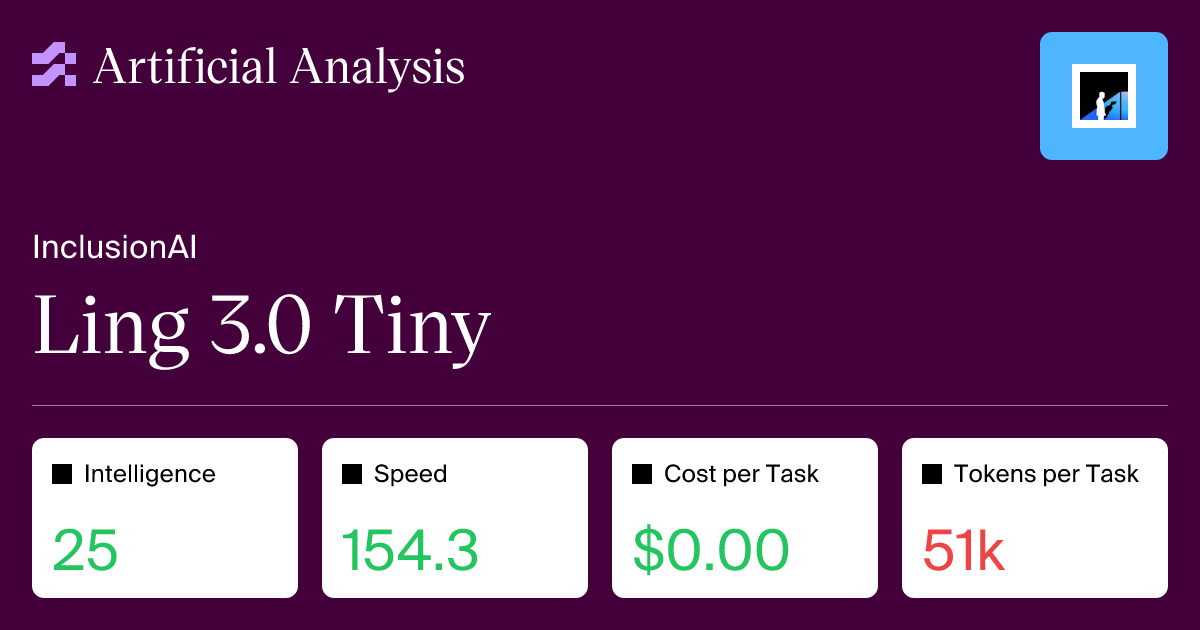
Ant Group has released Ling 3.0 Tiny, which scores 25 on the Artificial Analysis Intelligence Index. With just 7.9B total and 1.3B active parameters, it sits on the Pareto frontier for Intelligence vs. Active Parameters @AntLingAGI has released Ling 3.0 Tiny, an open weights reasoning model with a 262K-token context window. It scores 25 on the Artificial Analysis Intelligence Index, comparable to gpt-oss-120b (high, 24) with 15x fewer total parameters and 4x fewer active parameters. However, this parameter efficiency comes with high token usage: Ling 3.0 Tiny used 213M output tokens to run the Intelligence Index, nearly as many as the larger Ling 3.0 Flash (240M). It follows the recent release of Ling 3.0 Flash, which scores 38 with 124B total and 5.1B active parameters. The weights are available on Hugging Face under an MIT license. Key results: ➤ Ling 3.0 Tiny extends the open weights Pareto frontier for Intelligence vs. Active Parameters. It scores 25 on the Artificial Analysis Intelligence Index, and at 7.9B total and 1.3B active parameters, the model is small enough to run locally in many settings ➤ Ling 3.0 Tiny makes a 59-point improvement in AA-Omniscience over…

Context
Ling 3.0 Tiny is small in parameters but still writes a lot, by Artificial Analysis's measurements. The open-weights , released by Ant Group through its Ant Ling account, is a model: of its 7.9 billion parameters, only 1.3 billion are active for each token. It scores 25 on the Artificial Analysis Intelligence Index, comparable to gpt-oss-120b (high, 24) with 15 times fewer total and 4 times fewer active parameters. That places it on the Pareto frontier for intelligence against active parameters, meaning no open-weights model with as few active parameters scores higher, and Artificial Analysis says it is small enough to run locally in many settings.
The small size does not cut its output. Ling 3.0 Tiny generated 213 million output tokens to run the Intelligence Index, nearly as many as the much larger Ling 3.0 Flash (240 million), which has 124 billion total and 5.1 billion active parameters and scores 38. Artificial Analysis presents that high token usage as the trade-off for its parameter efficiency.
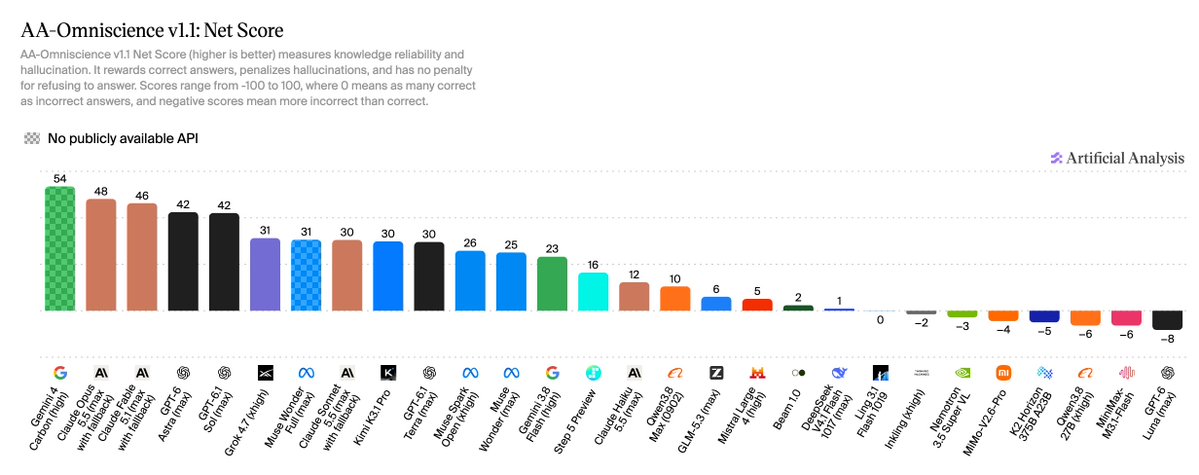
Its knowledge gains come from declining questions rather than answering more of them. On AA-Omniscience it scores -19, 59 points better than Ling-mini-2.0, mainly because its rate fell from 96% to 30% while accuracy stayed at 9%; it attempted only 37% of the questions instead of guessing. Artificial Analysis calls that accuracy relatively low among similarly sized open models. In agent tests it scores 21% on τ³-Banking, ahead of Qwen3.6 27B (17%), but reaches only 772 Elo on GDPval-AA v2, behind NVIDIA's Nemotron 3.5 Lightning (824), which it slightly outscores on the overall index. The weights are on Hugging Face under the MIT license, and the model is served through InclusionAI's first-party API and Novita.
- reasoning model — A model trained to think — generating extended internal reasoning before answering — trading time and tokens for accuracy on hard problems.
- mixture-of-experts — A model built from many specialist sub-networks where only a few activate per token, giving big-model capability at small-model running cost.
- hallucination — When a model states something false with full confidence — inventing facts, citations, or APIs that don't exist.
- context window — The maximum amount of text a model can consider at once — its working memory for the current conversation or task.


Checking sign-in…
Loading comments…