See Artificial Analysis to compare Ling 3.0 Tiny with other small open weights m
- Source
- x.com
- Publisher
- Artificial Analysis
- Date
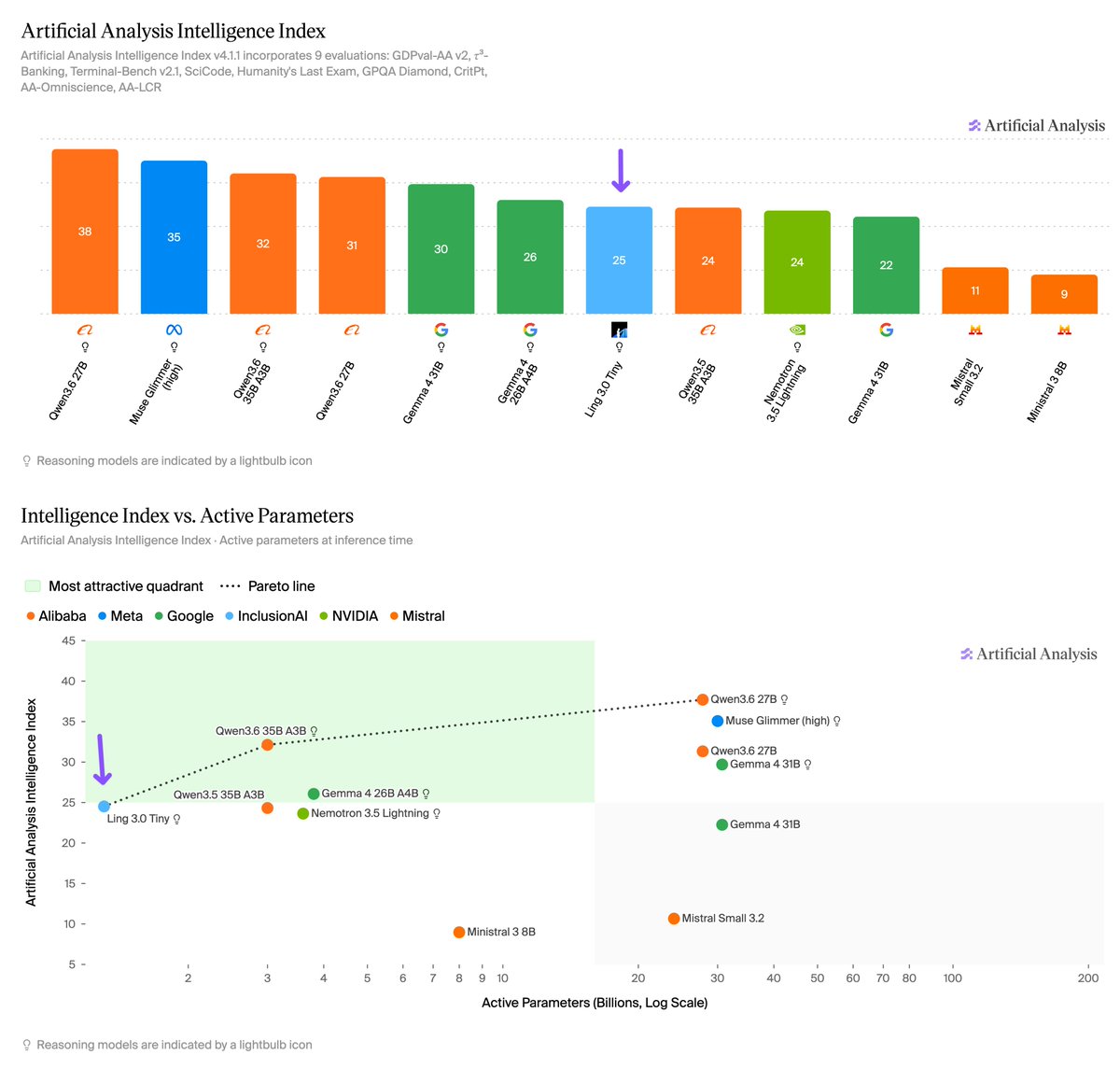
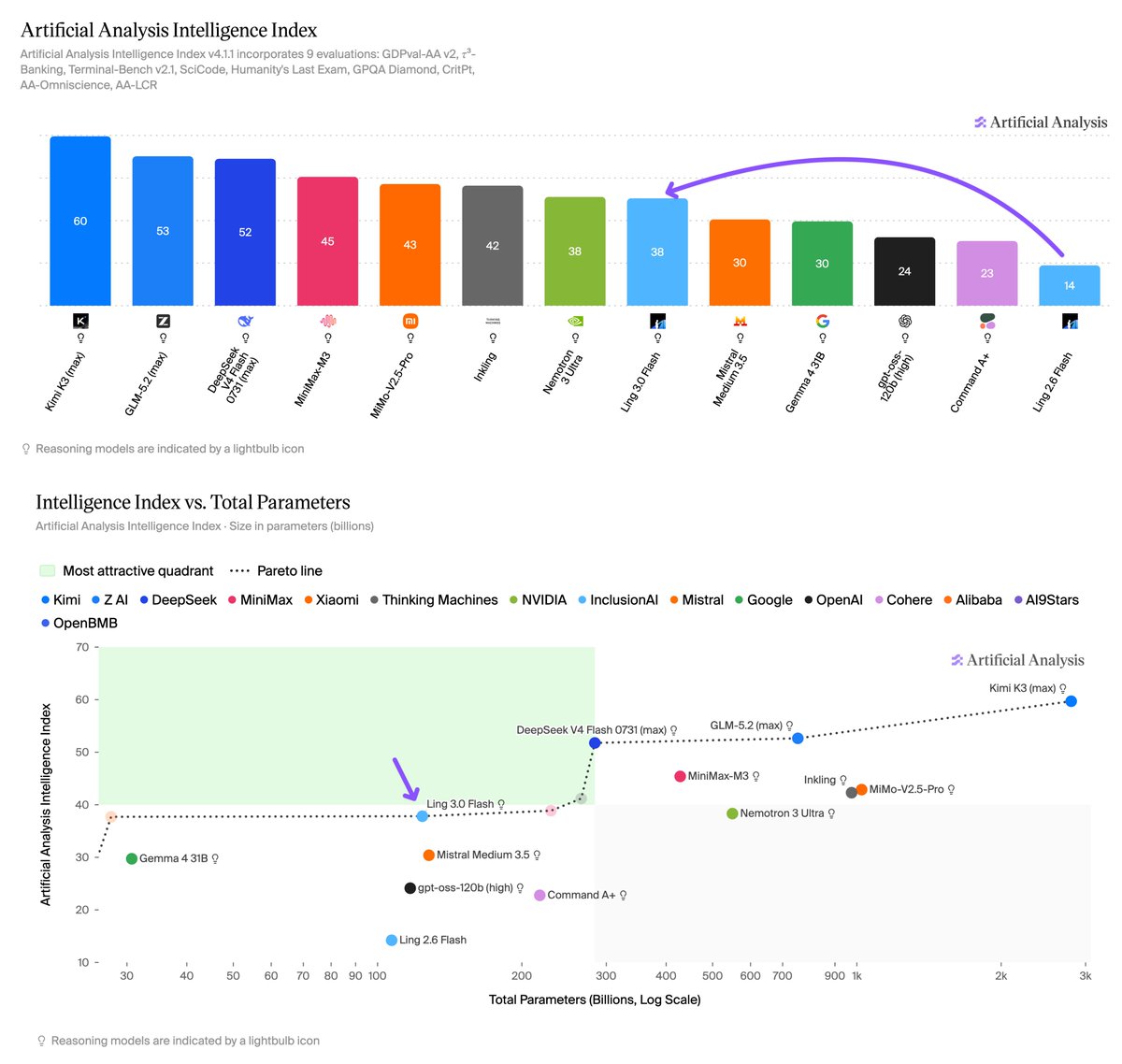
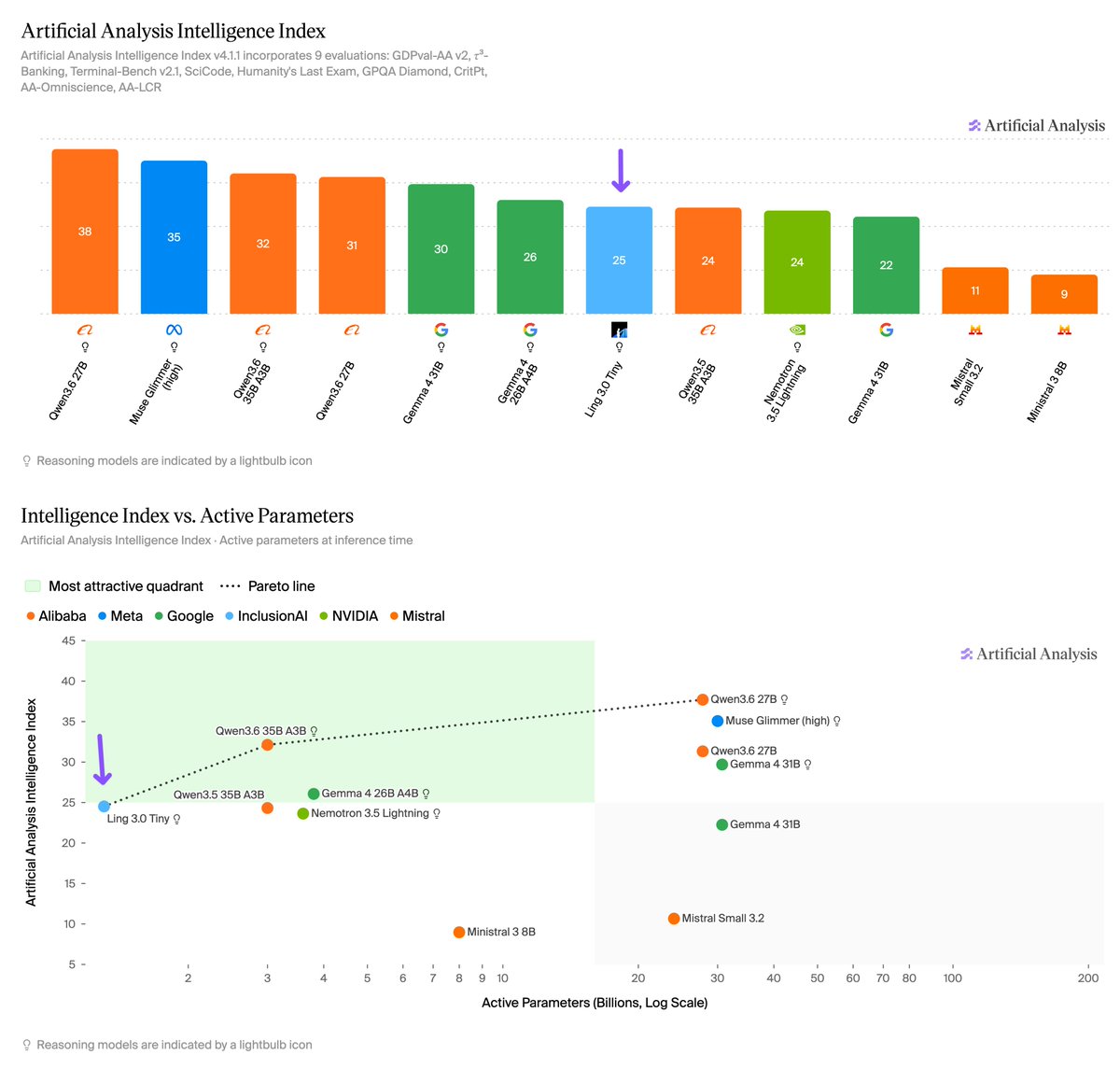
Ant Group has released Ling 3.0 Tiny, which scores 25 on the Artificial Analysis Intelligence Index. With just 7.9B total and 1.3B active parameters, it sits on the Pareto frontier for Intelligence vs. Active Parameters @AntLingAGI has released Ling 3.0 Tiny, an open weights reasoning model with a 262K-token context window. It scores 25 on the Artificial Analysis Intelligence Index, comparable to gpt-oss-120b (high, 24) with 15x fewer total parameters and 4x fewer active parameters. However, this parameter efficiency comes with high token usage: Ling 3.0 Tiny used 213M output tokens to run the Intelligence Index, nearly as many as the larger Ling 3.0 Flash (240M). It follows the recent release of Ling 3.0 Flash, which scores 38 with 124B total and 5.1B active parameters. The weights are available on Hugging Face under an MIT license. Key results: ➤ Ling 3.0 Tiny extends the open weights Pareto frontier for Intelligence vs. Active Parameters. It scores 25 on the Artificial Analysis Intelligence Index, and at 7.9B total and 1.3B active parameters, the model is small enough to run locally in many settings ➤ Ling 3.0 Tiny makes a 59-point improvement in AA-Omniscience over Ling-mini-2.0, primarily driven by improvements in hallucination rate. Ling 3.0 Tiny scores -19 with 9% accuracy and a 30% hallucination rate, similar to Qwen3.6 27B (-20), but its accuracy is relatively low among similarly sized open weights models. Compared to the previous generation, where Ling-mini-2.0 had a 96% hallucination rate, Ling 3.0 Tiny improves on hallucination while maintaining the same accuracy. Instead of guessing when it doesn’t know, it attempted just 37% of questions in the AA-Omniscience evaluation. ➤ Ling 3.0 Tiny is relatively capable in tool use but performs modestly in agentic work tasks. Ling 3.0 Tiny scores 21% on 𝜏³-Banking, ahead of Qwen3.6 27B (17%). On GDPval-AA v2, however, it reaches an Elo rating of 772, behind Nemotron 3.5 Lightning at 824 despite sitting slightly ahead on the overall Intelligence Index. Additional model details: ➤ Size: 7.9B total parameters, 1.3B active (mixture of experts) ➤ Context window: 262K tokens ➤ License: MIT ➤ Providers: InclusionAI first-party API and @novita_labs
See Artificial Analysis to compare Ling 3.0 Tiny with other small open weights models: https://t.co/24VG0Fx7oL
Context
Ling 3.0 Tiny is light per token but not brief. Artificial Analysis reported that the open-weights from Ant Group's Ling team scored 25 on its Intelligence Index, against 24 for gpt-oss-120b (high), with 15 times fewer total parameters and 4 times fewer active ones. Ling 3.0 Tiny has 7.9 billion parameters but uses only 1.3 billion for each token, because it is a model: a router sends each token through a subset of the network instead of all of it. At those sizes, Artificial Analysis says, it is small enough to run locally in many settings.
The catch Artificial Analysis flags is how much the model writes. Ling 3.0 Tiny used 213 million output tokens to run the index, nearly as many as the much larger Ling 3.0 Flash, which used 240 million and has 124 billion total and 5.1 billion active parameters. Fewer active parameters cut the work done for each token, but they do nothing about the number of tokens. Artificial Analysis estimates the time a task takes as output tokens divided by output speed, and its model page lists Ling 3.0 Tiny at 58 , below the 87 median for open-weights models of similar size. A long reasoning trace at that speed means slow answers even from a small model.
Treat the 25 and the 213 million as figures from the August evaluation. The model page now reports Intelligence Index v5.0.1 and shows no index score or output-token count for Ling 3.0 Tiny, so the current page cannot confirm those numbers.
- reasoning model — A model trained to think — generating extended internal reasoning before answering — trading time and tokens for accuracy on hard problems.
- mixture-of-experts — A model built from many specialist sub-networks where only a few activate per token, giving big-model capability at small-model running cost.
- throughput — How much model output a provider can generate over time, commonly measured in output tokens per second.
- Hallucination — Generated content that is false or unsupported, even when it sounds plausible.