Agent Swarms and the New Model Economics
- Source
- cursor.com
- Publisher
- Cursor
- Author
- cursor_ai
- Date

Context
Cursor asked a team of AI agents to build SQLite, a widely used database engine, in Rust from nothing but its 835-page manual. The agents had no access to the source code, the test suites, the SQLite itself or the internet. In the swarm, planner agents split the goal into smaller pieces and hand them off, and worker agents write the code for each piece. Cursor graded the result against sqllogictest, a suite from the SQLite project with millions of queries whose correct answers are known, and never told the agents the suite existed. According to Cursor's write-up, every configuration of the new swarm eventually passed the whole suite. At the four-hour mark the new runs scored 73 to 85 percent, against 11 to 77 percent for the old swarm.
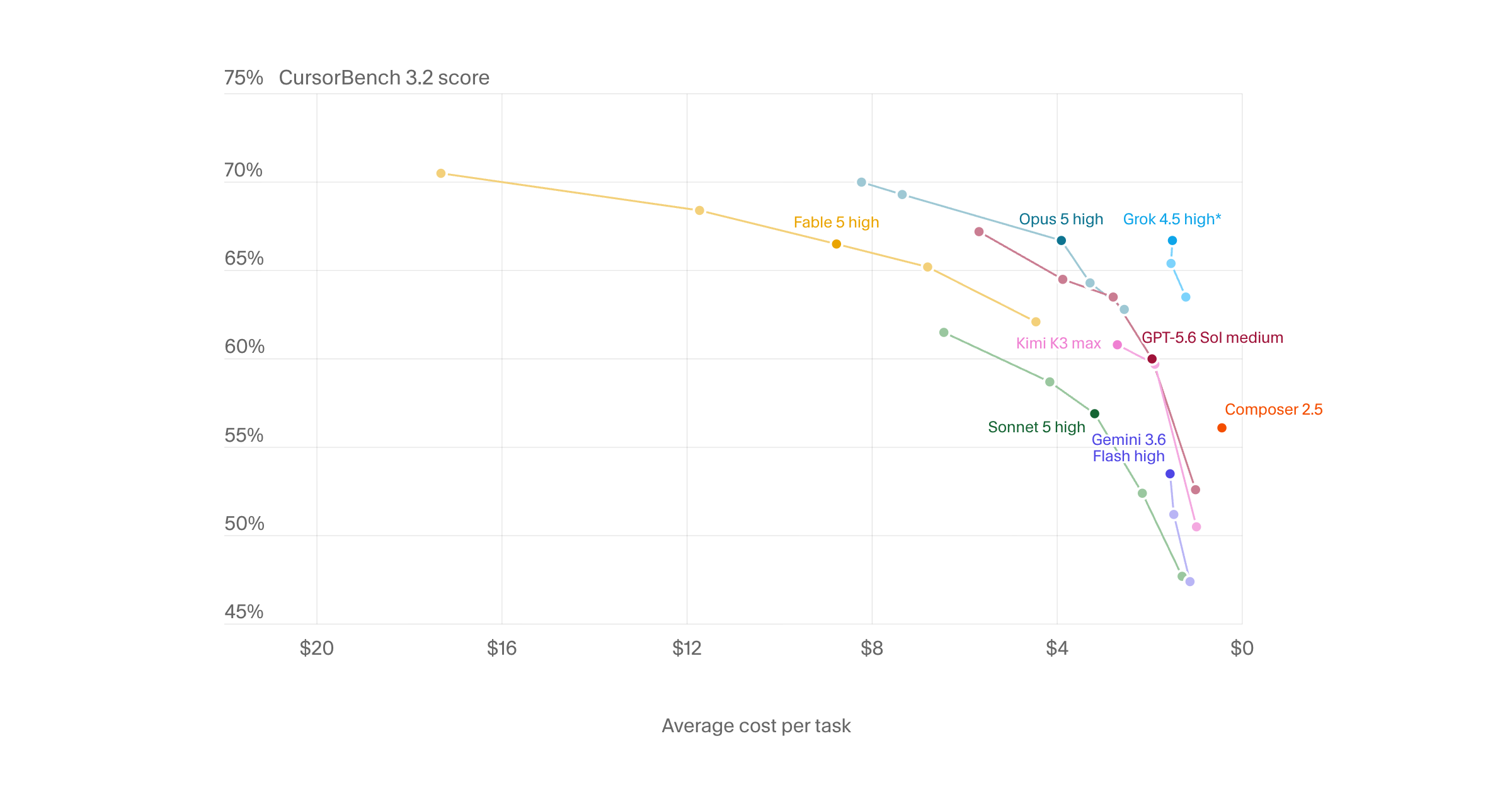
The cost differences come from who does the most typing. Workers used at least 69 percent of the in every run, and more than 90 percent in most. A run that used OpenAI's GPT-5.5 for both roles cost $10,565, and its workers alone cost $9,373. A run with Anthropic's Opus 4.8 as planner and Composer 2.5 as worker cost $1,339, of which the whole worker fleet cost $411. Cursor argues that only a few moments in a large task need frontier intelligence, such as the first breakdown and key design decisions. A stronger planner did not automatically save money. Fable 5 as planner used fewer planning tokens than Opus 4.8, but its workers went through several times as many, and that run cost substantially more overall.
The redesigned coordination system explains the comparison with the old swarm. Cursor built its own system, which peaks at around 1,000 commits per second. It added a neutral agent that resolves merge conflicts, a way for workers to flag oversized files so another agent can split them, and stacked review by agents that see different information. In the old Grok 4.5 run, conflicts passed 70,000 before Cursor paused it, and the new run logged fewer than a thousand in four hours. With Fable 5 as planner, both versions passed the full suite, but the old one needed 64,305 lines of engine code and the new one 9,908.
All of these figures come from Cursor's own runs on one task. Cursor says it checked each run by hand for cheating and uneven coverage. Passing the query suite shows the database returns correct results for those queries, not that it matches SQLite in every respect. Cursor has published the code from its solo Opus 4.8 run as cursor/minisqlite on GitHub but says it has not yet done a deeper manual analysis.
- Program — A set of instructions stored so that a computer can run it.
- Token — A piece of text, such as a word, part of a word or a punctuation mark, that a language model represents as numbers and handles as a unit.
- Git and version control — A system for recording and comparing changes to a codebase.
- multi-agent — Using several AI agents on one problem — splitting work in parallel, checking each other, or filling different roles like planner and reviewer.