CursorBench
- Source
- cursor.com
- Author
- cursor_ai
- Date
Context
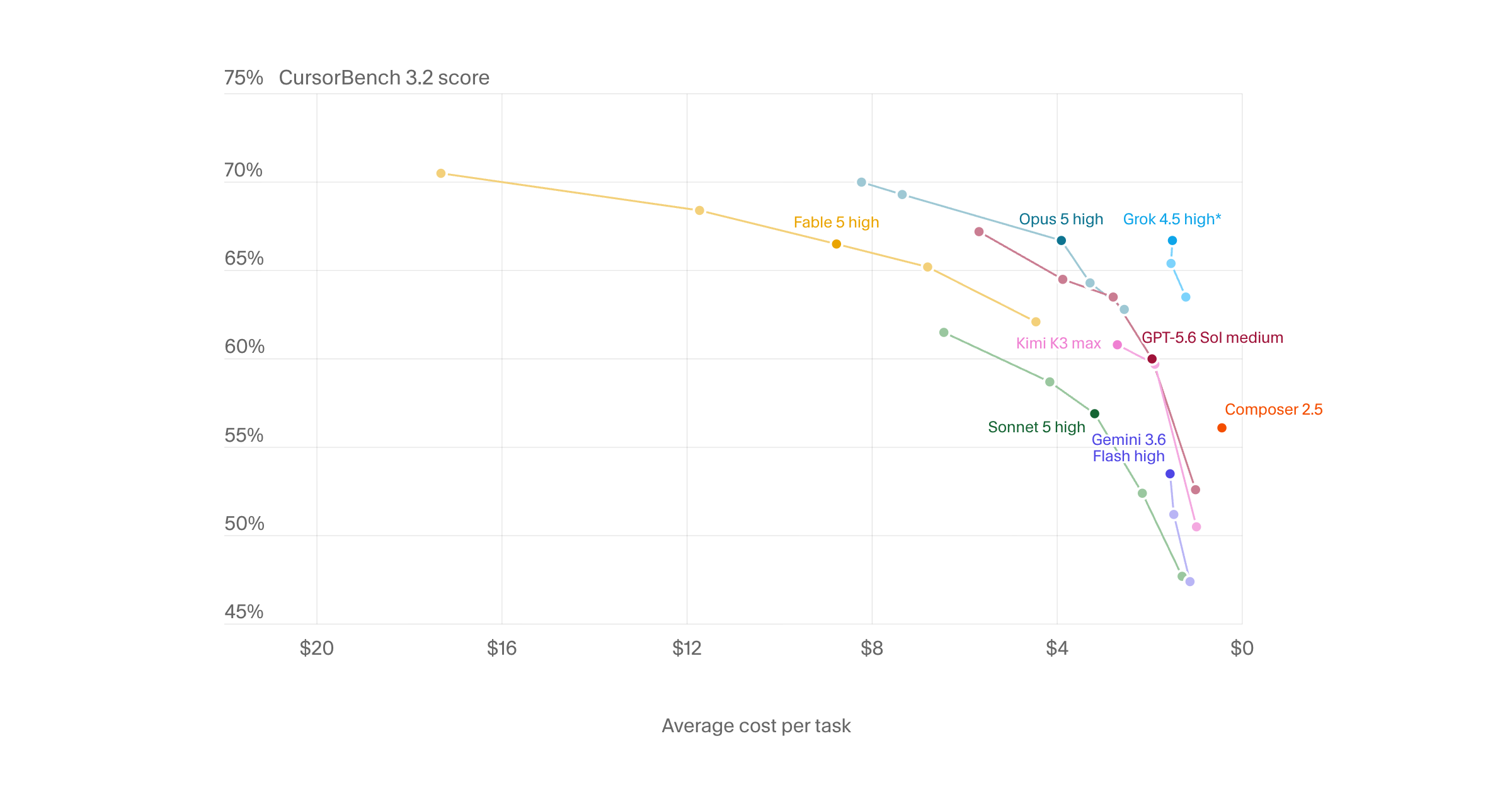
Cursor's evaluation page ranks AI models on CursorBench, its own suite of coding- tasks. Most models appear several times, once for each reasoning-effort setting, usually from Low to Max. Each row shows the score with the average cost, and steps per task. Cursor calculates cost by applying each model's published per-million-token prices, including cache reads and writes, to the tokens the model used. It also warns that results vary and small score differences may not be statistically meaningful.
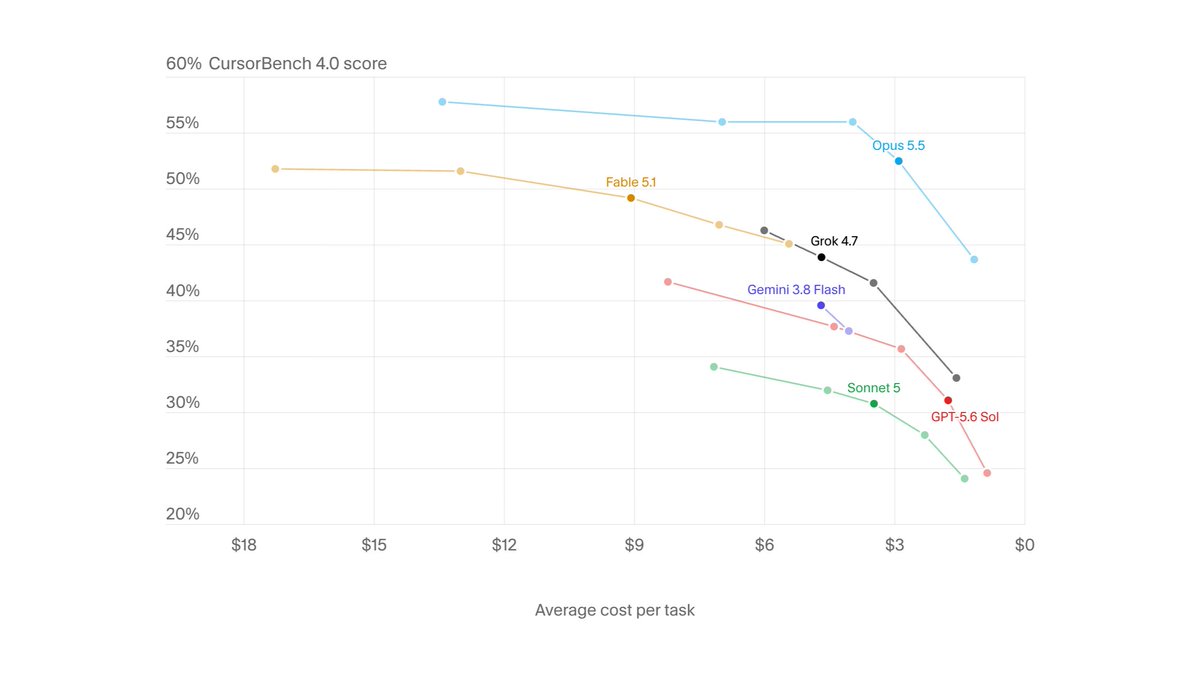
The effort columns show what extra reasoning buys. Anthropic's Opus 5.5 scores 56.0 percent at High for $3.97 per task, the same at Extra High for $6.98, and 57.8 percent at Max for $13.43. That is more than three times the High cost for 1.8 points. Further down, Haiku 5.5 at Max scores 48.4 percent for $1.12 per task, close to Fable 5.1 at Max, which scores 51.8 percent for $17.28. For a team choosing a default, the cheaper settings often give up very little.
The changelog shows the benchmark is a moving target. CursorBench 3.0 in March covered edit, refactor and bugfix problems. Versions 3.1 and 3.2 added areas such as code review and , and CursorBench 4.0 in September added long-horizon problems. Several entries also record cost updates after providers changed prices. That explains why Cursor's July post gave Opus 5 a score of 66.7 against 66.5 for Fable 5 at default effort, while the current table lists Opus 5 between 40.7 and 46.6 percent and no longer lists Fable 5. The page does not label which version the table uses. But the July figures predate CursorBench 4.0, so the drop most likely reflects the new, harder task set rather than a weaker model, though Cursor does not give that explanation itself. Scores are best compared within one version of the page.
- eval — A repeatable test for AI quality — a set of tasks plus scoring — used the way software teams use test suites, because model output is too variable to judge by eyeballing.
- AI agent — An AI system that doesn't just answer once but works toward a goal in a loop — taking actions, reading the results, and deciding what to do next.
- token — The chunk of text a model reads and writes in — roughly three-quarters of a word — and the unit AI usage is billed in.
- tool use — A model's ability to call external functions — run code, search the web, edit files — instead of only generating text.


Checking sign-in…
Loading comments…