An agent-oriented diffusion LLM that edits its own tokens mid decode
- Source
- x.com
- Date

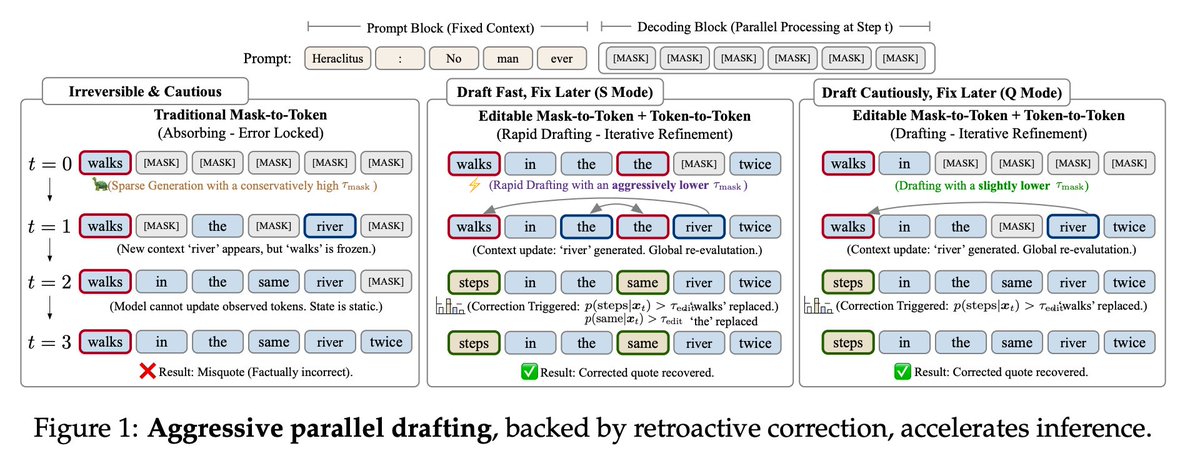
🚀 Meet LLaDA2.2-flash — the first agent-oriented MoE Diffusion LLM. Levenshtein editing—deletion, insertion, and substitution—enables self-correction during decoding. A more elegant solution to model collapse than forcing diffusion back into left-to-order generation. Performance: ⚡ 703.82 TPS on BFCL-V4 function calling 519.0 TPS on SWE-bench Verified coding ⚡ 1.64x BF16 throughput vs autoregressive models Built for high-throughput, low-latency AI agents. 🔗 GitHub: https://t.co/3TJUYNSLdT 🤗 Hugging Face: https://t.co/8OrHXBiGp2 📄 Technical Report:https://t.co/liV6nOk8YU #LLaDA #OpenSource #DiffusionLLM #AIAgents

Context
Diffusion language models generate a whole block of text at once and then refine it, rather than writing one token after another the way most chat models do; the usual tradeoff is that fixing an early mistake means restarting the block. Ant Open Source says LLaDA2.2-flash instead edits the block in place, using insertion, deletion and substitution operations borrowed from Levenshtein distance to correct itself mid-decode. The announcement reports 703.82 tokens per second on the BFCL-V4 function-calling benchmark, 519.0 tokens per second on , and a 1.64x throughput advantage over comparable autoregressive models in BF16 precision.
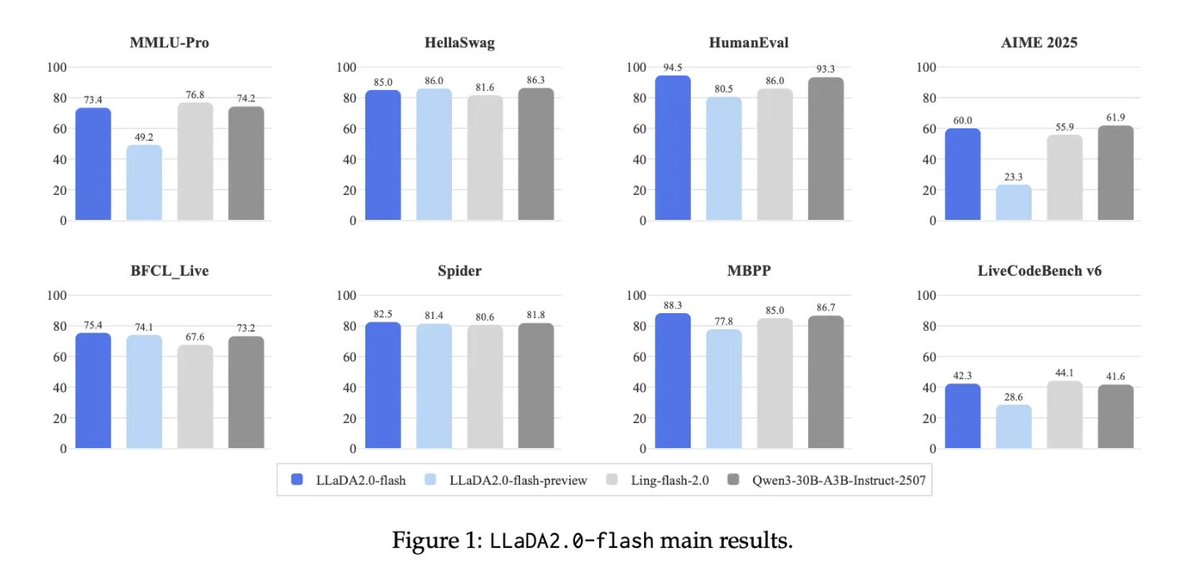
It's the latest release in Ant's LLaDA diffusion-model line, following LLaDA2.1's token-editing approach and LLaDA2.0-Uni's unified text-image model.
- SWE-bench — The standard benchmark for AI coding agents: real GitHub issues from real repositories, scored by whether the agent's patch passes the project's own tests.
- mixture-of-experts — A model built from many specialist sub-networks where only a few activate per token, giving big-model capability at small-model running cost.
- AI agent — An AI system that doesn't just answer once but works toward a goal in a loop — taking actions, reading the results, and deciding what to do next.
- tool use — A model's ability to call external functions — run code, search the web, edit files — instead of only generating text.

Checking sign-in…
Loading comments…