AgentX benchmarks inference against real coding-agent traces
- Source
- video.twimg.com
- Author
- SemiAnalysis
- Date
Context
AgentX, the agentic benchmark inside SemiAnalysis's InferenceX, is built so a reader can trace any result back to the run that produced it. In the launch video attached to its August 25 announcement, SemiAnalysis says each point on a performance chart is a single benchmark run on real hardware, with the full self-hosted GitHub Actions run linked, and that results use no private, hyper-optimized containers. Behind a point the dashboard shows server metrics such as prefix cache hit rate and KV working-set size, a timeline of the requests the server received including rollouts, and logs from servers, routers and KV transfer engines. The video's own words call it the definitive benchmark; that is SemiAnalysis's description, and the transcript available here is automatic, with the visuals not analyzed.
The traffic being replayed comes from SemiAnalysis's own staff. According to the launch article, a proxy recorded more than 8,000 Claude Code and Codex sessions, and AgentX v1.0 uses a 393-session subset. To keep the contents private, each request is cut into 64-token blocks and every block is replaced by a hash, so two requests that share a prefix still share the same hashes. At replay time the hashes are filled with synthetic coding tokens, and Nvidia's AIPerf tool resends requests on the original schedule, including which subagents must finish before the main agent continues. The median request carries 142,000 input tokens and produces 444 output tokens, and about 44% of sessions spawn subagents. Each test sweeps the number of concurrent sessions and measures for one hour after a warmup.
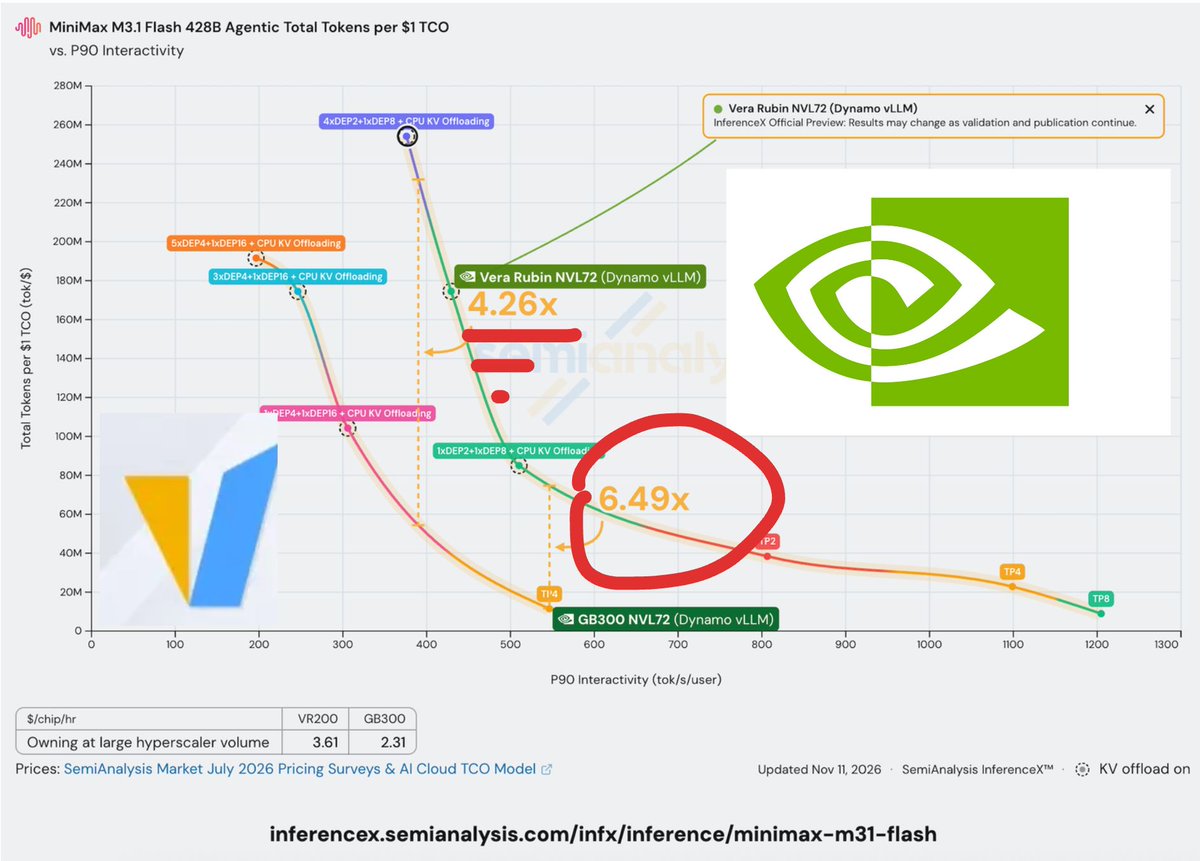
The telemetry matters because agent workloads succeed or fail on cache reuse, which a headline figure hides. The article gives an example: a B300 serving 384 concurrent sessions kept 91% of cache hits in GPU memory, while a B200 at 196 sessions managed 73% and leaned on slower CPU memory for nearly 20%, because its usable cache was roughly half the size. The dashboard is meant to make that kind of difference visible for every point. What the hardware comparisons themselves show is covered in a companion explanation.
- multi-agent — Using several AI agents on one problem — splitting work in parallel, checking each other, or filling different roles like planner and reviewer.
- throughput — How much model output a provider can generate over time, commonly measured in output tokens per second.
- subagent — A separate agent spawned by another to do one scoped piece of work in its own context, returning only the result.
- KV cache — The memory a model keeps about text it has already read, so generating each new token doesn't require reprocessing the whole conversation.

Checking sign-in…
Loading comments…