Mercury Decide update: 66k context, ZDR and lower pricing
- Source
- x.com
- Date
Mercury Decide is a diffusion-based model built for classification and verification decisions rather than open-ended chat. The update raises context from 33k to 66k tokens, adds a zero data retention tier priced at $0.02 per million input tokens, and includes 100M free tokens plus an unlimited free tier. OpenRouter added a matching ZDR endpoint the same day, with output and cached input free. Vals AI's independent evaluation against 13 systems found it tied frontier accuracy on SEC claim verification at the lowest cost measured and automated 94% of claims at a 0.8% error rate. Vals also notes latency grows with batched questions, and that the competing Jev model stays faster at scale. Teams routing yes/no or scoring decisions under privacy constraints now have a cheap production option, but should test it on their own batch shapes.

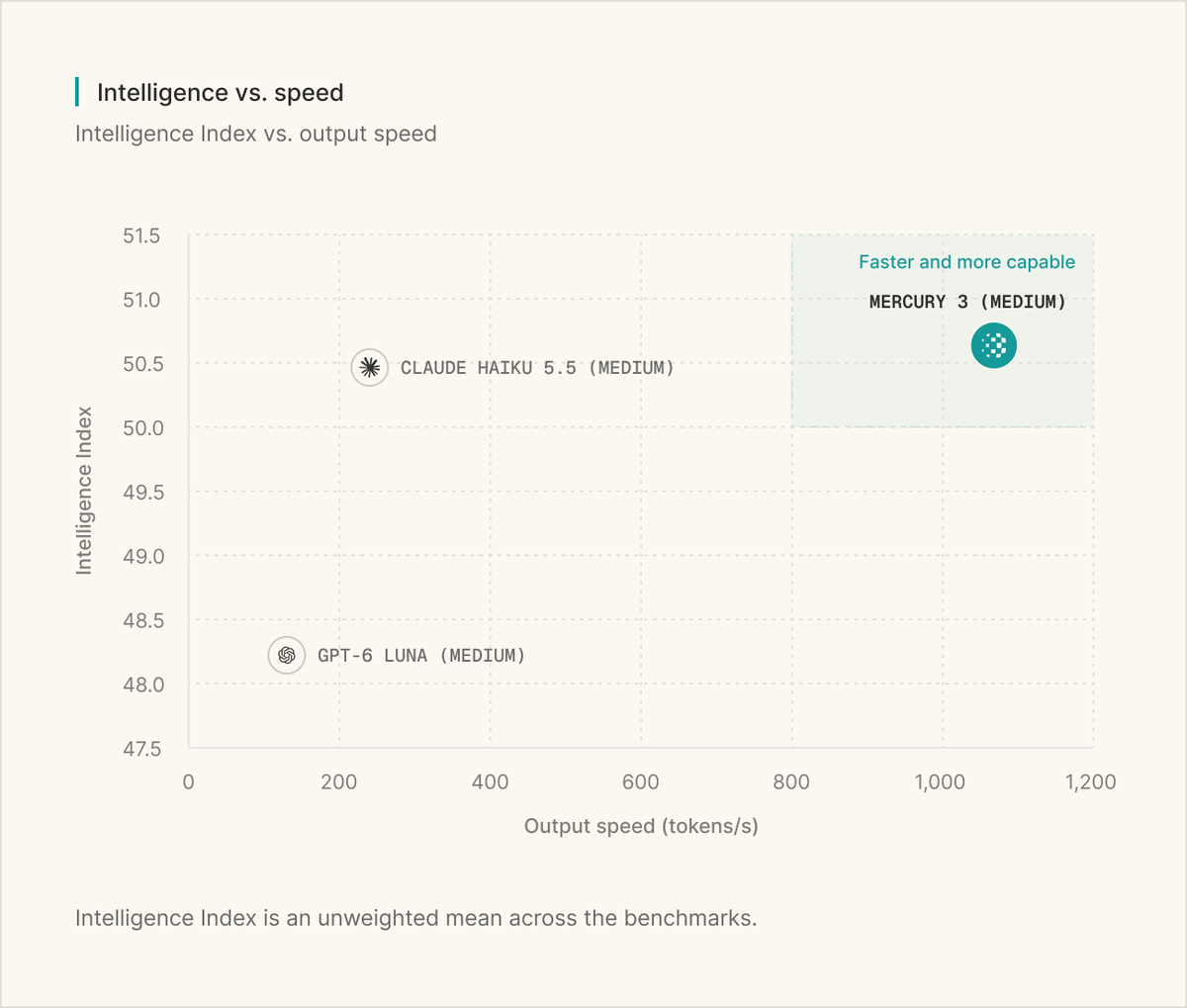
Last week, we launched Mercury Decide, a Jev-beating decision model that quickly rose to #2 on OpenRouter by number of users: https://t.co/SIySfLQBHA This week, we’re updating Mercury Decide with substantially better benchmark performance, longer context (33k → 66k), General Availability with Zero Data Retention (ZDR), and more. All that with lower pricing than Jev (ZDR for $0.02/$0 per 1M in/out, discounted at 50% from the list price of $0.04/$0, plus 100M free tokens), alongside an unlimited free tier. What have we improved? Read on to find out! [🧵1/4]

Context
Inception calls Mercury Decide, which it launched the week before October 8, 2026, a decision model. Instead of writing free text, a model of this kind takes a description of the current situation and a list of allowed answers, and returns one answer with a probability for every option in a single call, as Vals AI explains it. In a thread on X on October 8, Inception said the model had quickly risen to number two on OpenRouter by number of users, and announced an update.
The concrete changes are stated plainly. The , the amount of text the model can take in at once, doubles from 33k to 66k . The model becomes generally available with zero data retention (ZDR), an arrangement under which the provider does not keep the prompts and outputs it handles. Zero-data-retention access costs $0.02 per million input tokens and nothing for output, half the $0.04 list price, with 100M free tokens, and the unlimited free tier stays. OpenRouter's post about the new endpoint gives the same price and 66K context. In the video attached to the thread, Inception adds that the model is compatible, so moving to it from another decision model means switching the endpoint.
The thread also claims substantially better benchmark performance and calls Mercury Decide "Jev-beating", a reference to TypeSafe AI's decision model Jev. The first post names no benchmark or score, and the later posts that promised to explain the improvements were not available here. An independent evaluation by Vals AI, published the same day, gives a more mixed picture. On 400 claim-verification items the two models could not be told apart (0.978 against 0.975), and Mercury Decide cost about a quarter as much as Jev per claim. It was ahead on a set of LegalBench legal subtasks (0.869 against 0.740 accuracy). Jev was faster, and when many questions are asked about the same document in one call, Vals found that Jev's speed and cost scale better. Vals priced Mercury Decide at its launch rate and notes that the model has no version pin, describing it as of October 8, so its results do not show whether they reflect this update.
- Context and context window — Context is the information available for a generation; the context window is the capacity available to hold it.
- Token — A piece of text, such as a word, part of a word or a punctuation mark, that a language model represents as numbers and handles as a unit.
- API — Application programming interface: the agreed set of operations, inputs and outputs through which one piece of software uses another.
- eval — A repeatable test for AI quality — a set of tasks plus scoring — used the way software teams use test suites, because model output is too variable to judge by eyeballing.





Checking sign-in…
Loading comments…