Today, we’re introducing Mercury 2.5, the most capable diffusion LLM on the…
- Source
- x.com
- Date
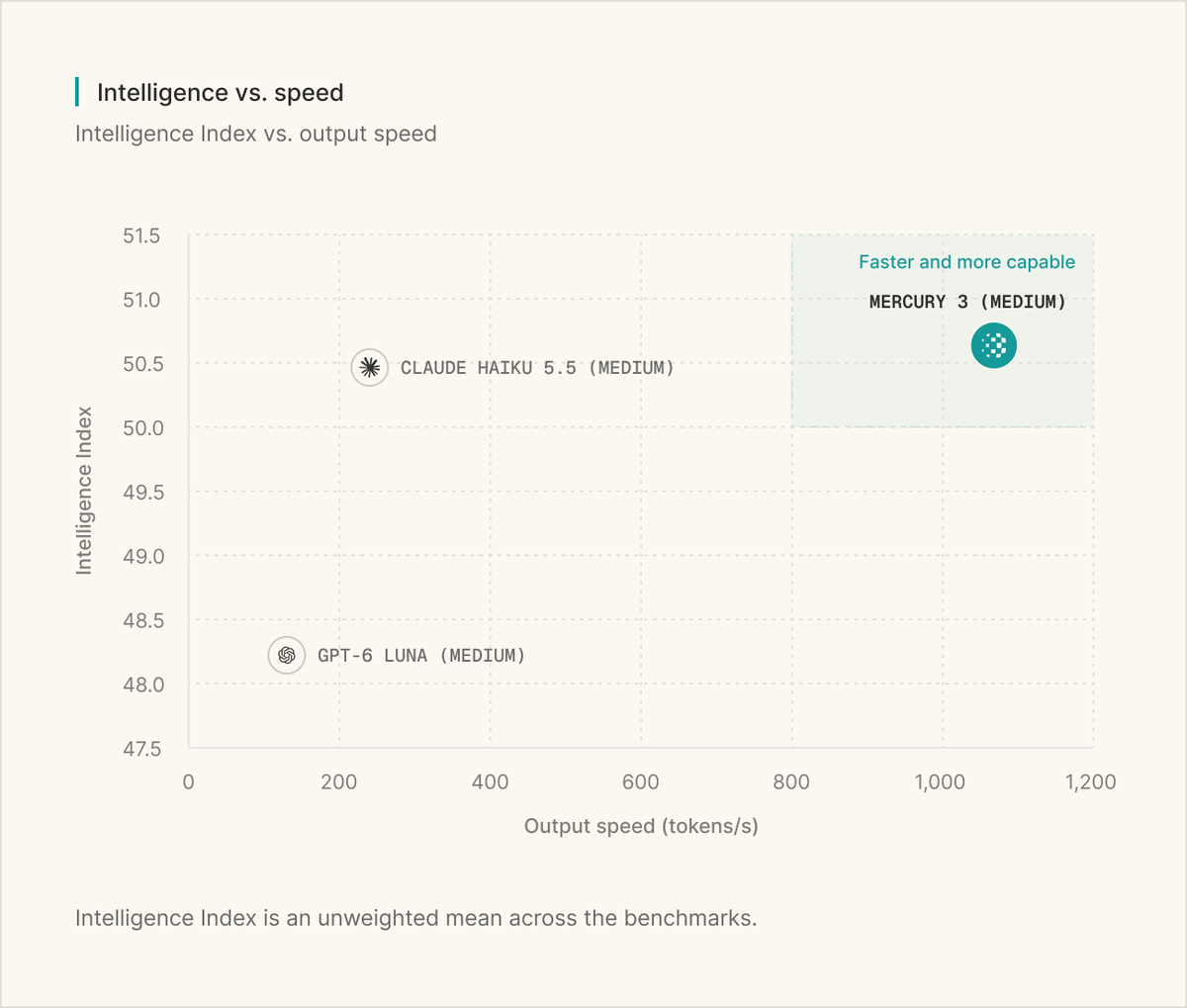
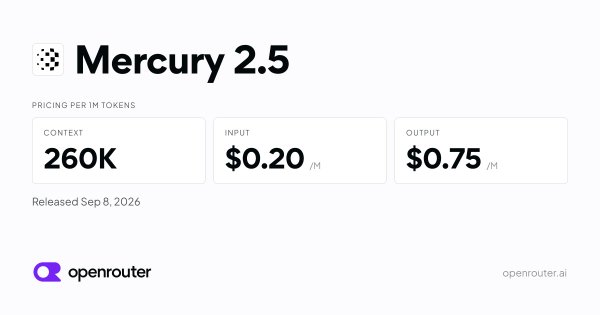
Inception has released Mercury 2.5, a language model that uses diffusion-style decoding to generate parts of a response in parallel instead of producing every token strictly one after another. The company reports throughput above 1,100 tokens per second on widely available Nvidia GPUs and a 40% intelligence gain over Mercury 2. Those are vendor claims, not independent measurements in the cited announcement. OpenRouter, which now offers the model generally, says Mercury 2.5 leads its speed ranking among models that do not require specialized hardware and sees its largest gains on code-heavy prompts. That combination makes the release relevant to agent systems where supporting calls for routing, context compression, or tool selection can dominate latency. Availability through Inception, OpenRouter, and Baseten means teams can compare the model against their current stack without changing hardware. The useful test is workload-specific: measure answer quality, total task time, and cost together, because raw token throughput does not establish that an agent finishes real work faster.

Today, we’re introducing Mercury 2.5, the most capable diffusion LLM on the market. It offers a 40% jump in intelligence over Mercury 2, and runs over 1,100 tokens/sec on widely-available @NVIDIAAI GPUs. It’s available today on our API, @OpenRouter, and @Baseten. Contact us to evaluate Mercury 2.5 for production:

Context
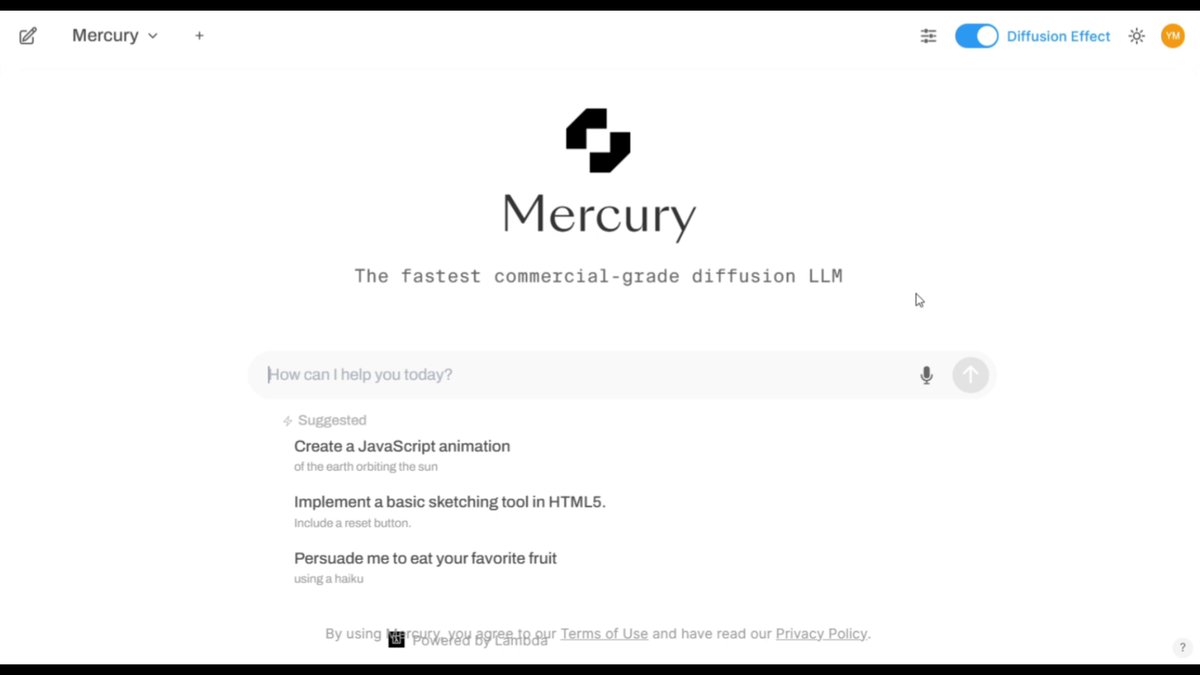
Most large language models generate text one at a time, in sequence. Inception's Mercury models instead use a diffusion process, converging on a full response through parallel refinement rather than producing it token by token, which is what lets them report much higher raw throughput on the same hardware. Mercury 2.5 is the latest version, claiming a 40% improvement in measured intelligence over the prior Mercury 2 and speeds over 1,100 tokens per second on widely available NVIDIA GPUs; it is available now through Inception's own API as well as OpenRouter and Baseten.
Mercury 2, the version it replaces, was already running in production on Baseten and Azure Foundry, where Inception said it ran at similarly high speeds and cut costs for at least one customer. Those production figures describe the older model, not Mercury 2.5, and neither the 40% intelligence gain nor the new throughput figure comes with a named or independent measurement in this announcement.
- token — The chunk of text a model reads and writes in — roughly three-quarters of a word — and the unit AI usage is billed in.
- benchmark — A standard public test set for comparing AI models — the shared scoreboards behind every "model X beats model Y" claim.
- LLM — A large language model — the neural network behind tools like Claude and ChatGPT, trained on huge amounts of text to predict what comes next.

Checking sign-in…
Loading comments…