Mercury 3: a diffusion LLM at 1,000+ tokens per second
- Source
- x.com
- Date

Mercury 3 is live: the most capable diffusion LLM released to date. It outperforms GPT-6 Luna and Claude Haiku 5.5 across a range of benchmarks while running at over 1,000 tokens per second. More than 40x the size of Mercury 1, 3x more intelligent across standard benchmarks, and just as fast, with a 1M-token context window. Available today on the Inception API, @baseten, and @OpenRouter .

Context
Inception has released Mercury 3, which it calls the most capable diffusion released so far (Inception on X). Most language models write a response one at a time, each step waiting on the last; Inception's diffusion models instead refine the whole output in parallel, as the company has described its earlier Mercury models. Inception credits that approach for the speed it advertises: over 1,000 tokens per second, which the launch blog puts at 1,068 tokens per second on NVIDIA GPUs (Inception blog).
The release is pitched as evidence that the approach scales. Inception says Mercury 3 has more than 40 times the parameters of Mercury 1 and scores three times higher across standard benchmarks by its own measure while running just as fast, and the grows to 1M tokens from 260K in Mercury 2.5. List pricing is $0.20 per million input tokens and $0.70 per million output tokens, halved during a launch discount, and the model is available through Inception's API, Baseten, OpenRouter and Vercel.
The headline comparison, that Mercury 3 outperforms OpenAI's GPT-6 Luna and Anthropic's Claude Haiku 5.5 across a range of benchmarks, is Inception's own claim, presented in the company's own chart rather than in an independent evaluation. The nearest independent reference is Vals AI's run of the previous Mercury 2.5, which found it extremely fast but lower-scoring across its benchmark suite, so whether the new model closes that gap remains to be measured.
- LLM — A large language model — the neural network behind tools like Claude and ChatGPT, trained on huge amounts of text to predict what comes next.
- token — The chunk of text a model reads and writes in — roughly three-quarters of a word — and the unit AI usage is billed in.
- context window — The maximum amount of text a model can consider at once — its working memory for the current conversation or task.
- benchmark — A standard public test set for comparing AI models — the shared scoreboards behind every "model X beats model Y" claim.
 postInception ships Mercury Decide update with ZDR and 66k context
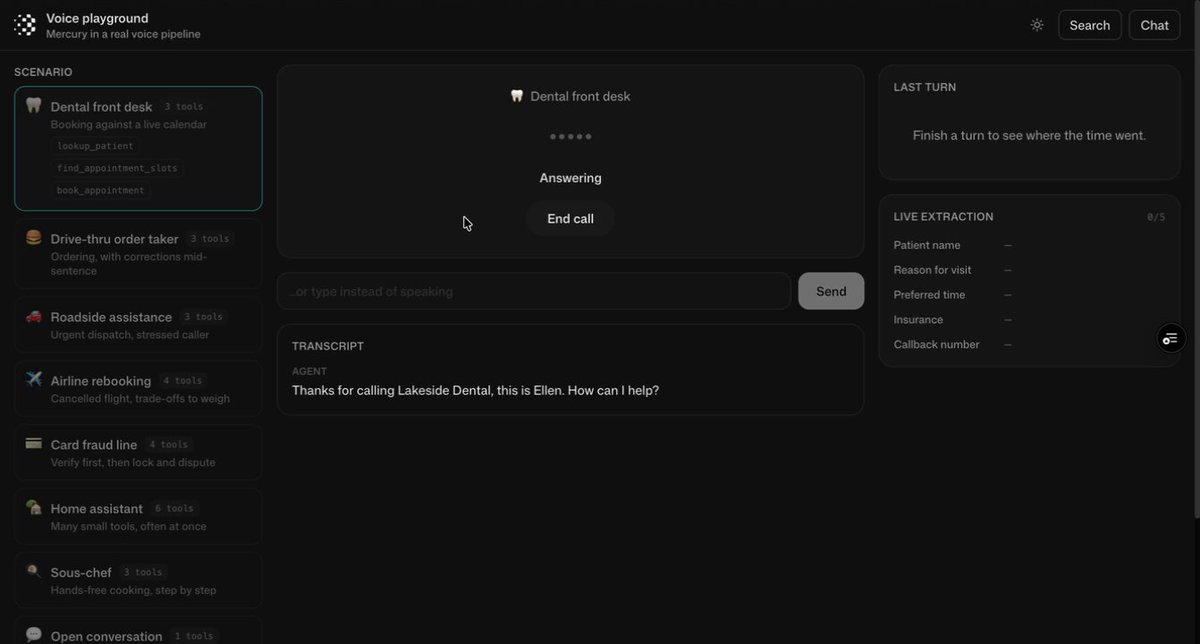 postInception launches Mercury Voice, a diffusion LLM for low-latency voice agents
 postToday, we’re introducing Mercury 2.5, the most capable diffusion LLM on the…
 postInception ships Mercury 2.5 Preview at roughly 1,100 tokens per second
Checking sign-in…
Loading comments…