A 2-bit 1.8B model in 600MB, tuned for Arm SME2 silicon
- Source
- x.com
- Date

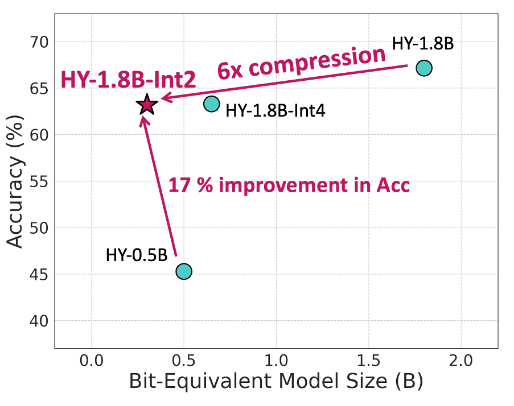
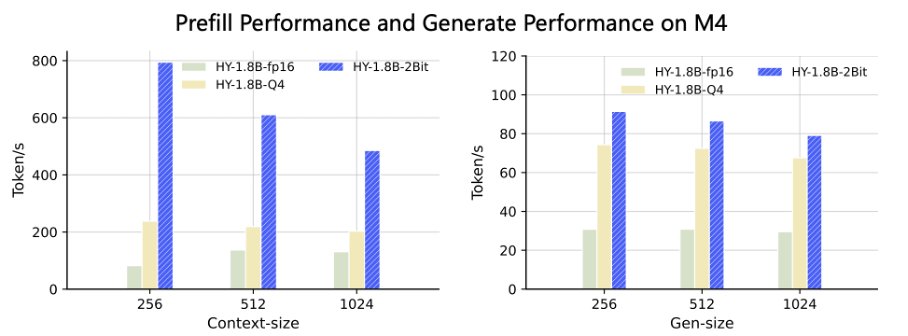
We have open-sourced HY-1.8B-2Bit, a high-efficiency 2-bit LLM built for on-device deployment. This model scales the 1.8B base down to an effective 0.3B parameter footprint, requiring only 600MB of storage, making it smaller than many mobile apps. 🔹 Ultra-Low-Bit Strategy: Uses QAT (Quantization-Aware Training) to reach a 2-bit representation (0.3B bit-equivalent size). 🔹 Dual-CoT Reasoning: Retains sophisticated Dual Chain-of-Thought capabilities despite radical precision reduction. 🔹 Performance: 3-8x faster prefill on Apple M4 and MediaTek Dimensity 9500; 2-3x faster token generation on-device. 🔹 Benchmark Gains: Achieves a 17% average accuracy lead over models of equivalent size. 🔹 Hardware Synergy: Optimized for Arm SME2 and modern consumer silicon. HY-1.8B-2Bit is available now in GGUF format for seamless integration into edge-based inference engines. Project Page: https://t.co/pFp6vgpooa Weights: https://t.co/Pvua0eec3L GGUF Version: https://t.co/wdRIsUqwFb Technical Report:


Context
Tencent's HY-1.8B-2Bit compresses a with 1.8 billion parameters into a release advertised as requiring 600 MB of storage. The smaller footprint comes from representing weights at reduced precision, rather than replacing the model with one containing only 300 million parameters. The announcement's smaller equivalent-size figure describes that compression.
The model card says the model was trained with taken into account, helping it adapt to the reduced numerical precision. This addresses the storage constraint of local language-model deployment; actual execution speed still depends on the device and implementation.
- LLM — A large language model — the neural network behind tools like Claude and ChatGPT, trained on huge amounts of text to predict what comes next.
- quantization — Shrinking a model by storing its numbers less precisely — like rounding — so it runs faster and fits on smaller hardware, at a small quality cost.
- inference — Running a trained model to get answers — the phase where AI is actually used, as opposed to trained.
- chain-of-thought — Having a model write out intermediate reasoning steps before its answer, which markedly improves performance on hard problems.
 articleExplorationBench: Feedback and Self-Designed Probes Drive Agent Discovery
 postHy Image3.5 preview is live. 🚀 Professional-grade image generation, +30% win…
 postTencent Hunyuan's EvolveScaler trips up frontier models on evolving facts
 postTencent Hunyuan open-sources AuK, a unified speech generation and editing model
Checking sign-in…
Loading comments…