SemiAnalysis: AMD MI355X Out-Earns GB200 NVL72 on Kimi K3 Inference
- Source
- x.com
- Date

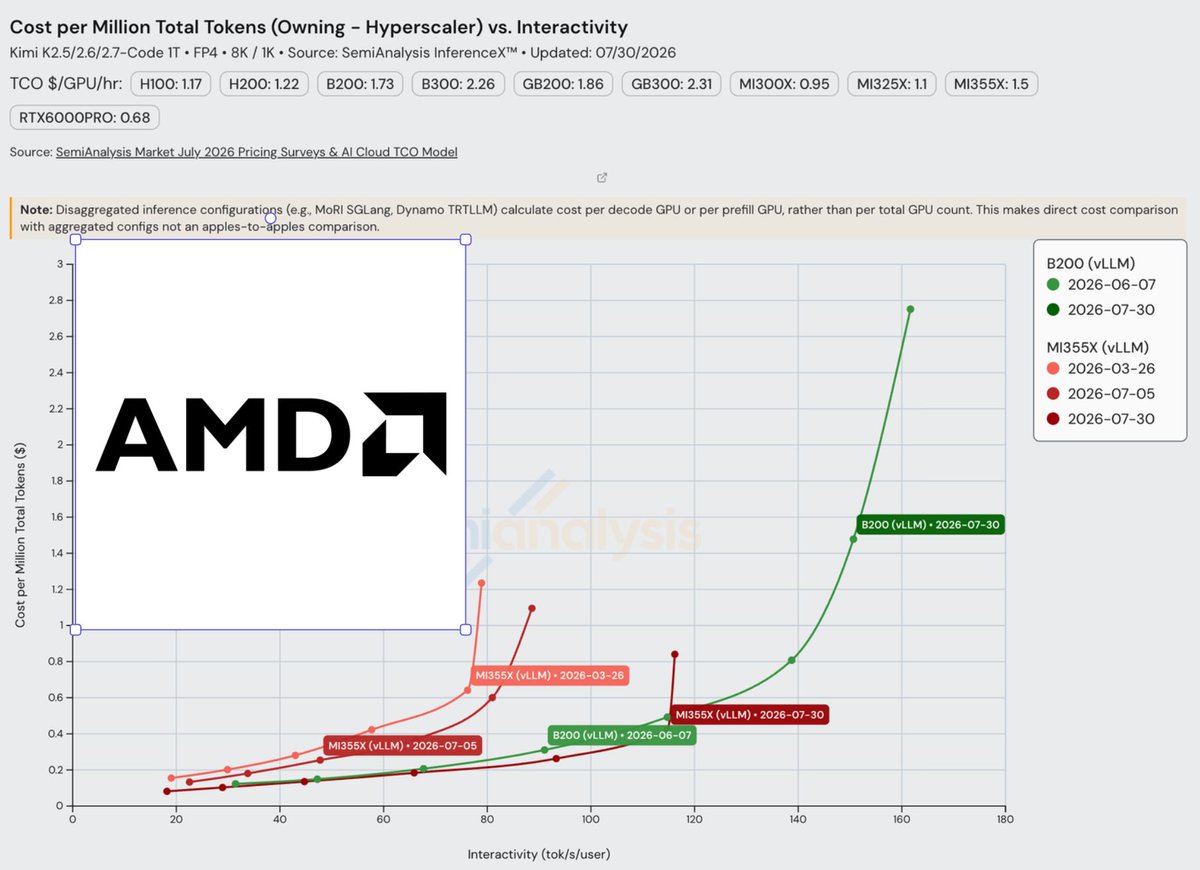
AMD ALERT🚨🚨: On Kimi K3 2.8T, AMD has even better profit margins per gigawatt compared to B300, GB200 NVL72, and B200. This is due to AMD's lower TCO and better performance, leading to better profit margins of 53.6% on Mi355X compared to 44.3% on GB200 NVL72. This is from our open-source Agentic Inference benchmark, AgentX. Shoutout to @roaner & @EmadBarsoumPi 10x engineers for optimizing this 2.8T model!

Context
SemiAnalysis is making a claim about the business of serving a model, not only about speed. In a post on X, it says that when serving Moonshot AI's Kimi K3, a 2.8-trillion-parameter model, AMD's MI355X earns a 53.6% profit margin against 44.3% for Nvidia's GB200 NVL72, and that AMD also beats Nvidia's B300 and B200 on the same measure. The figures come from AgentX, SemiAnalysis's open-source for agentic , the work of running a trained model to answer AI agents. SemiAnalysis's earlier write-up on AgentX describes the benchmark itself.
SemiAnalysis gives two reasons for the gap: AMD's lower total cost of ownership, meaning the full cost of buying and running the hardware, and better performance on this workload. A margin of this kind folds both into one number, because it depends on how much a system can serve and on what that output costs to produce. A system can win on margin by being cheaper as well as by being faster, and SemiAnalysis says AMD did both here.
The post frames the comparison per gigawatt of capacity, but its text does not give the assumptions that turn benchmark throughput into a margin, such as the price charged per or the hardware and power costs used, and the text gives no margin figures for B300 or B200. SemiAnalysis also credits two engineers with optimizing the 2.8-trillion-parameter model, so the result reflects tuned software on one model and one workload. Read it as SemiAnalysis's modeled economics for serving Kimi K3, which favor MI355X under assumptions its text does not state, rather than as evidence that AMD hardware out-earns Nvidia across models.
- benchmark — A standard public test set for comparing AI models — the shared scoreboards behind every "model X beats model Y" claim.
- inference — Running a trained model to get answers — the phase where AI is actually used, as opposed to trained.
- token — The chunk of text a model reads and writes in — roughly three-quarters of a word — and the unit AI usage is billed in.
Checking sign-in…
Loading comments…