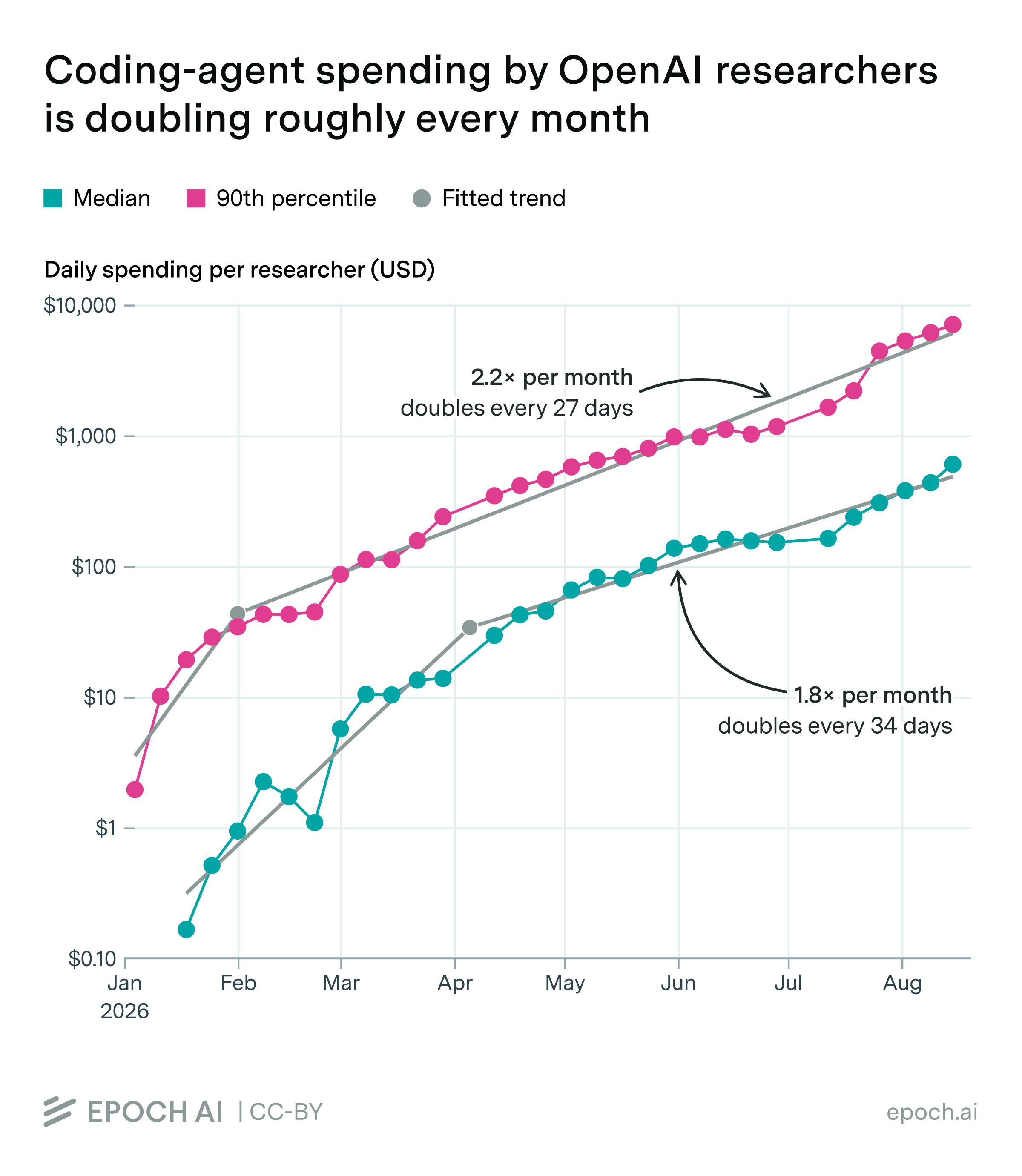
Shows how fast heavy coding-AI agentAn AI system that doesn't just answer once but works toward a goal in a loop — taking actions, reading the results, and deciding what to do next.Full definition → usage scales in cost per engineer, with numbers for budgeting tokenThe chunk of text a model reads and writes in — roughly three-quarters of a word — and the unit AI usage is billed in.Full definition → spend and inference demand.
Key takeaways · AI-distilled
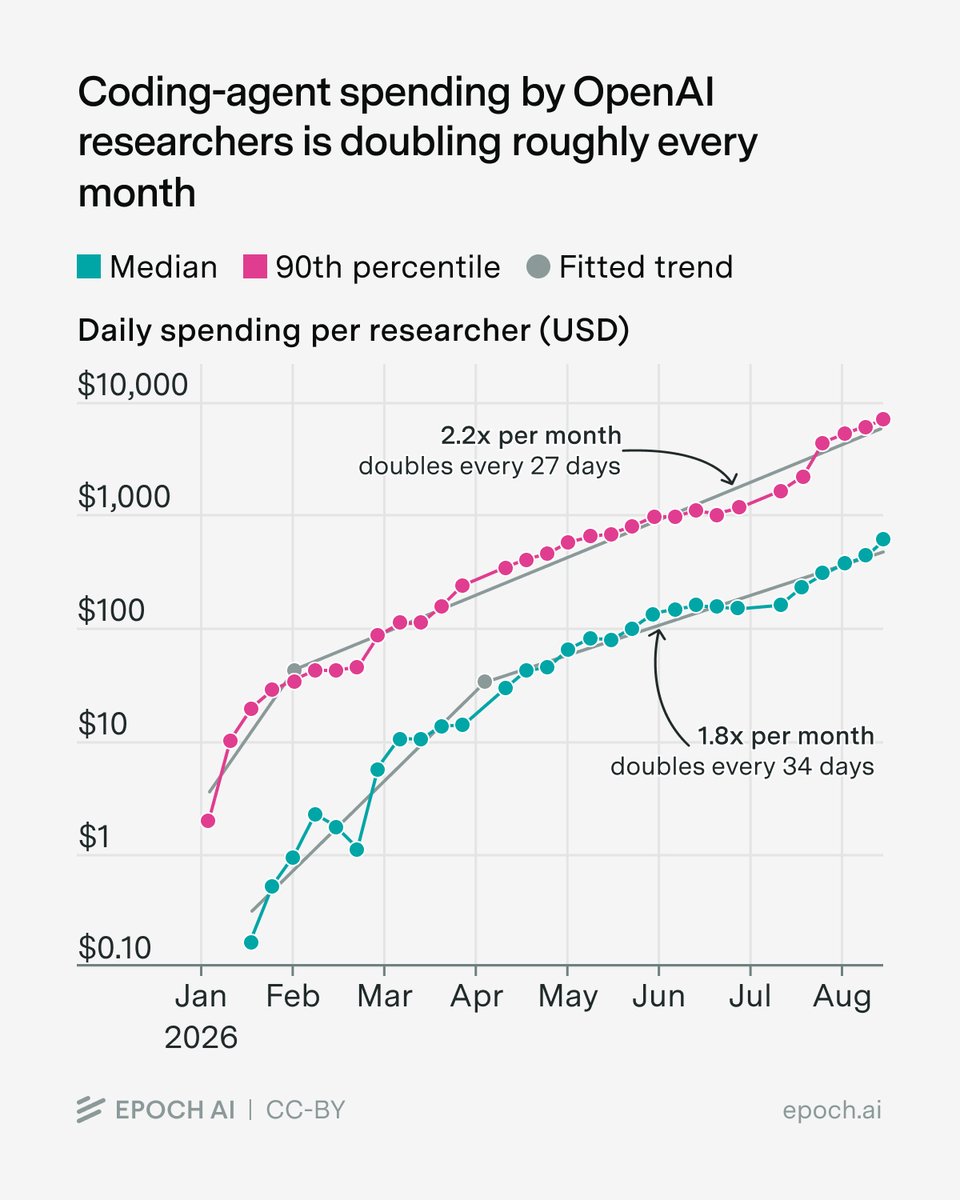
Epoch's preferred fit is an exponential with one slope breakpoint; in recent months the median grew about 1.8x per month and the 90th percentile about 2.2x, doubling times of 34 and 27 days.
The figures use OpenAI's API list prices rather than internal cost, so Epoch notes they do not measure OpenAI's actual spending, only how fast usage grew and its scale.
Epoch calculates that $7,000 of inferenceRunning a trained model to get answers — the phase where AI is actually used, as opposed to trained.Full definition → per working day would come to around $2 million per year, comparable to or greater than the cost of employing a researcher.
The 90th percentile accelerated sharply in summer, rising from about $1,169 per day in late June to about $4,413 by late July, and both series grew several thousandfold from their first positive January values.
Epoch extracted the data from charts in OpenAI's post; each weekly point averages daily percentiles, and the fit includes all positive weeks, including a partial final week.
Terms in this piece · Glossary
AI agent — An AI system that doesn't just answer once but works toward a goal in a loop — taking actions, reading the results, and deciding what to do next.
token — The chunk of text a model reads and writes in — roughly three-quarters of a word — and the unit AI usage is billed in.
inference — Running a trained model to get answers — the phase where AI is actually used, as opposed to trained.