Gemini 4 Hydrogen benchmarked: near-frontier intelligence, weaker terminal work
- Source
- x.com
- Date

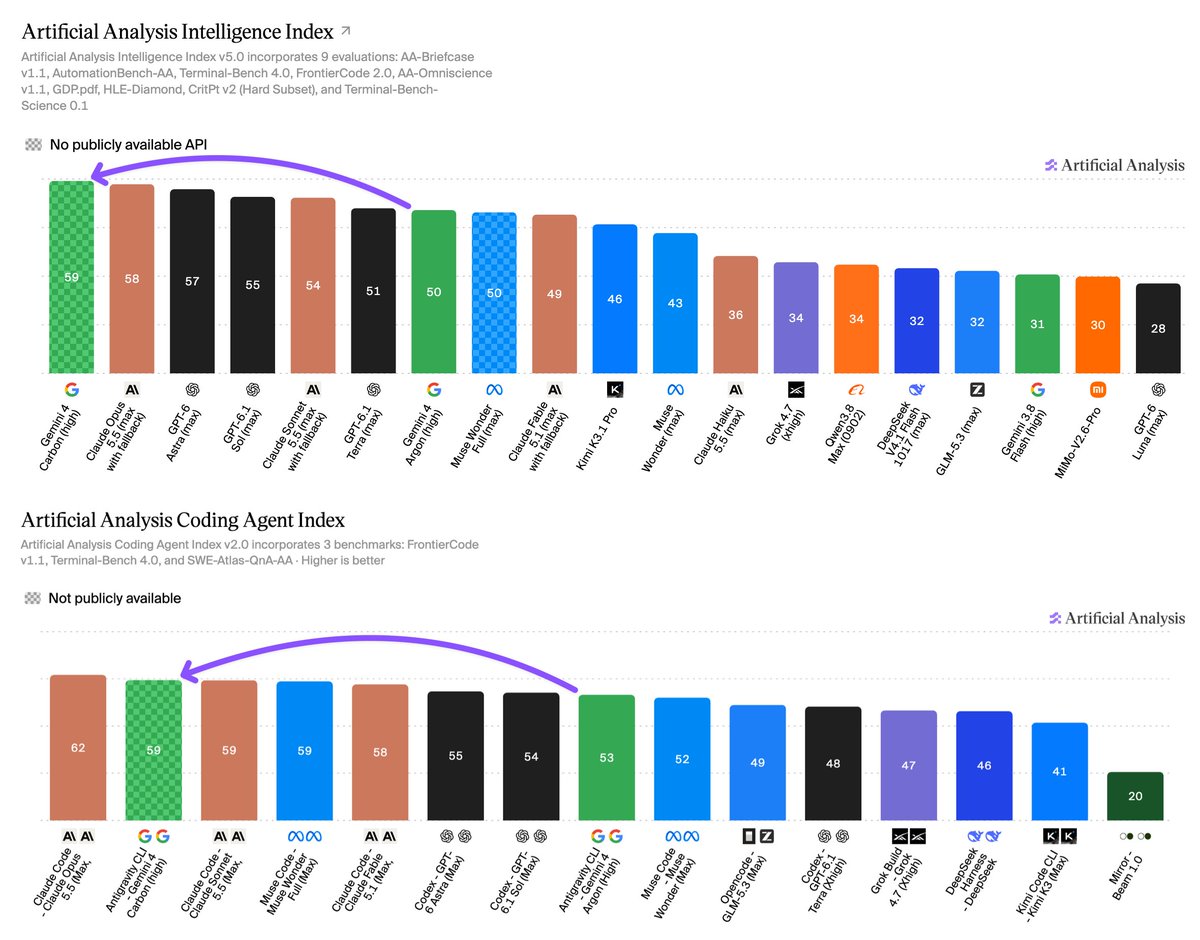
Google's new Gemini 4 Hydrogen has Intelligence just below Claude Sonnet 5.5 and GPT-6.1 Sol, at a third of Sonnet’s cost but ~2.5x that of GPT-6.1 Sol @GoogleDeepMind has released their third new model in six weeks. Gemini 4 Hydrogen introduces an xhigh reasoning level and scores 54 on the Artificial Analysis Intelligence Index, with strengths in visual reasoning and non-hallucination. This places it 1 point behind Claude Sonnet 5.5 (max) and GPT-6.1 Sol (max), at ~32% of Sonnet’s cost but ~2.5x that of GPT-6.1 Sol. With high reasoning, Gemini 4 Hydrogen matches the Intelligence of Gemini 4 Argon for ~19% of the Cost per Task Key takeaways: ➤ The new xhigh reasoning level scores 54 on the Intelligence Index: xhigh is the first reasoning level above high on a Gemini model, and puts Hydrogen 1 point below Claude Sonnet 5.5 (max) and GPT-6.1 Sol (max), and 4 points ahead of Gemini 4 Argon (high). With default (high) reasoning, Gemini 4 Hydrogen scores 51, just behind GPT-6.1 Sol (xhigh, 52) and Claude Opus 5.5 (high, 52) ➤ Strong visual reasoning, presentation and non-hallucination: On GDP.pdf, a visual reasoning benchmark over long documents, it scores 33% all-pass on medium…

Context
Artificial Analysis's numbers make Gemini 4 Hydrogen a nearly frontier-level general model, low-priced for its score, whose weakest results come in the kind of work Google is promoting it for. Google DeepMind launched Hydrogen as its fast model for "everyday coding and agentic workflows" (Google's announcement). At its new xhigh reasoning level, the first setting above high on a Gemini model, it scores 54 on the Artificial Analysis Intelligence Index, 1 point behind Claude Sonnet 5.5 (max) and GPT-6.1 Sol (max) and 4 ahead of Gemini 4 Argon (high). At the default high setting it scores 51 (Artificial Analysis on X).
Agentic work in the terminal is where it falls behind. Hydrogen scores 54% on Terminal-Bench 4.0, a test of agentic coding in the terminal, against 64% for Claude Sonnet 5.5 and 56% for GPT-6.1 Sol, and 50% on Terminal-Bench-Science, which covers scientific research workflows, against 53% and 58%. The extra reasoning of xhigh lifts the science score from 41% to 50% but leaves Terminal-Bench 4.0 unchanged at 54%. Its strengths lie elsewhere: an 8% rate on AA-Omniscience, one of the lowest Artificial Analysis has recorded, compared with 43% for Claude Sonnet 5.5 and 52% for GPT-6.1 Sol, and a tied-first 33% all-pass score on GDP.pdf, a visual reasoning test over long documents, at medium reasoning.
The price is $1.50 per million input and $7.50 per million output tokens. At xhigh a task costs $3.16, about 32% of what Claude Sonnet 5.5 costs for nearly the same score but about 2.5 times GPT-6.1 Sol's cost. xhigh nearly doubles output tokens compared with high for a 3-point gain, and high costs $1.87 per task, matching Gemini 4 Argon's intelligence for about 19% of its cost per task. Medium ($0.80) and low ($0.29) are cheaper still but score 41 and 27. At high, medium and low, Hydrogen sits on the time-per-task frontier, meaning no tested model is both more intelligent and faster. In these figures, moving from high to xhigh raises cost per task by about 70% for 3 Intelligence Index points, and on the two terminal tests that extra reasoning added 9 points on the science tasks and none on Terminal-Bench 4.0.
- hallucination — When a model states something false with full confidence — inventing facts, citations, or APIs that don't exist.
- token — The chunk of text a model reads and writes in — roughly three-quarters of a word — and the unit AI usage is billed in.

Checking sign-in…
Loading comments…