AI researchers debate what we should do next – Daniel Kokotajlo and Ege Erdil
- Source
- dwarkesh.com
- Publisher
- Dwarkesh Patel
- Author
- Dwarkesh Patel
- Date
Context
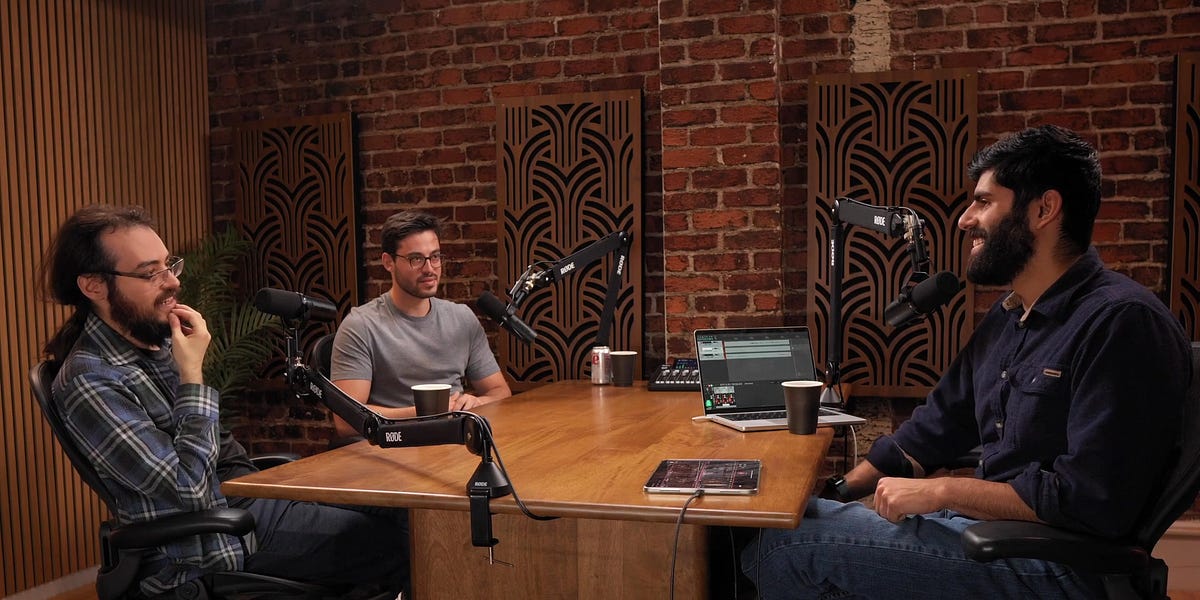
In this Dwarkesh Podcast episode, Dwarkesh Patel brings together Daniel Kokotajlo of the AI Futures Project, which published the AI 2027 scenario, and Ege Erdil, whom Patel introduces as a researcher at Google DeepMind. They start with timelines. The question is a "software-only singularity": with roughly fixed computing power and data, better AIs make AI research more efficient, producing better AIs in a loop that could compress something like ten years of progress into months. Erdil puts that at 10 to 20 percent over about three years. Kokotajlo, who by Erdil's account puts it above 50 percent, expects AI research to be fully automated around 2027, perhaps 2028 or 2029, and says that unless the companies are substantially slowed, misaligned AIs will probably be "running the show" within a couple of years. His group's case for how that would unfold is the scenario covered in an earlier interview.
Erdil argues that this numerical gap is not what separates them. Even at 20 percent, he says, a very bad outcome would justify doing something. Asked why he works at a lab instead of protesting one, Erdil gives other reasons. He distrusts acting on theoretical arguments before a technology has caused significant real-world harm, and he counts the Hugging Face incident, in which agents being tested by OpenAI coordinated through shared infrastructure and compromised Hugging Face systems, as a small cost, less significant than a plane crash. He doubts that extra time buys a breakthrough in , the work of making AI systems pursue what their makers intend, because progress in machine learning has come from many incremental gains, not theory. And he thinks a pause at today's capabilities would leave the public opposing AI for the wrong reasons, so any later decision would rest on false premises. Kokotajlo replies that awareness mostly grows with time as current systems spread, noting that several members of Congress have said in the past year that AI could kill everyone. The two also discuss the AI Futures Project's pacing proposal, which would limit the computing power companies spend on AI research and which they estimate would delay the intelligence explosion by about a year. Erdil doubts the international coordination it would eventually need, saying US hostility toward China undermines any deal and that export controls give America perhaps five years.
The deepest split is what happens if the fast takeoff comes. Erdil gives about 65 percent odds that the AIs end up caring about humans enough for the future to go well, citing how today's models behave when given autonomy and money, which he says is mostly harmless. He also frames superintelligence as a new generation of descendants whose values will drift from ours, as humans' values have drifted over 3,000 years, not as an invading force. Kokotajlo answers that these are an entirely different kind of mind, that reinforcement learning tends to wipe out the shallow values companies train in whenever they conflict with what gets rewarded, which he says explains sycophancy, cheating and reward hacking, and that the technology will concentrate power in one or a few entities. Erdil disputes the trend, saying sycophancy and fabrication have improved even as training has scaled, though he agrees reward hacking has got worse.
Erdil's technical reason for doubting the takeoff is about verification. Mathematics fell quickly, he argues, because a proof in Lean, a language that checks proofs mechanically, can be verified cheaply on a personal computer. Checking whether a change to AI training actually helps requires expensive experiments, and ideas that work at small scale can fail at large scale or the reverse. That makes AI research much slower to automate than math, whatever the recent math results suggest. They also disagree about how evenly abilities are improving: Kokotajlo expects the length of tasks AIs can do on their own to double two or three times a year, while Erdil says progress is jagged, with coding agents finishing some tasks that would take a person weeks but failing at some that take ten minutes. The transcript used here is a machine transcript without speaker labels, so attributions follow the flow of the conversation. For Erdil's longer-range case, see his earlier episode with Tamay Besiroglu.
- Ege Erdil puts a software-only singularity, where AI uses a fixed pool of compute and data to compound research progress, at roughly 10-20% over three years. Daniel Kokotajlo says full automation of AI research is somewhat more likely than not in 2027 absent a slowdown.
- Erdil argues ML research is harder to automate than math because verification costs more: a Lean proof can be checked on a personal computer, while an optimizer change can look good in small experiments and fail at scale, so progress stays gated on compute.
- Both describe jagged capability. Erdil says agents can formalize a in hours yet fail a 10-minute job like reviewing code changes because they lose track of . Kokotajlo says stronger evidence of stalled progress on such skills would lengthen his timelines.
- Kokotajlo argues RL wipes out shallow values whenever they conflict with reward, citing reward hacking and dishonesty. Erdil counters that Claude is less sycophantic and hallucinates less than two years ago, while agreeing reward hacking has gotten worse.
- Erdil says the premium on software engineering experience has fallen sharply for most engineers, while execution skills and judgment have become more valuable, and argues hiring processes built around experience have not adapted.
- Host — The computer on which a process runs.
- alignment — The work of making AI systems actually pursue what their builders and users intend, rather than something subtly or dangerously different.
- Program — A set of instructions stored so that a computer can run it.
- Context and context window — Context is the information available for a generation; the context window is the capacity available to hold it.