Limite 1B - Violetto: Technical Report
- Source
- arxiv.org
- Author
- Mario Prignano, Gabriele Cirillo, Alessio Morosini, Luca Cerovaz, Alessandro Bartolocci, Emanuele Rodol\`a, Giulio Starace, Francesco Pappone
- Date

Context
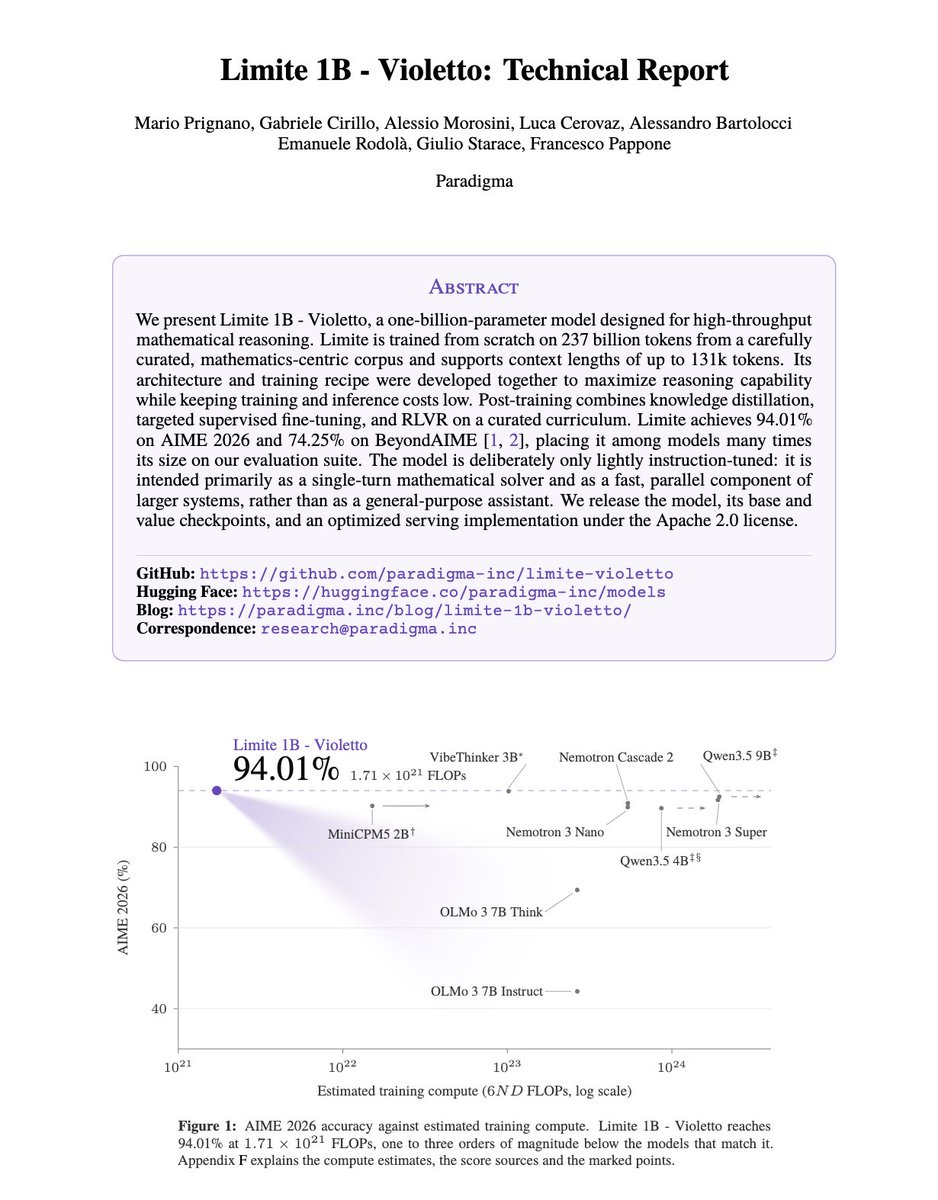
Strong math reasoning has mostly come from large models, which are costly to sample many times. Paradigma's technical report on Limite 1B - Violetto shows that a one-billion-parameter model trained only for math can score close to models many times its size on answer-checked competition benchmarks, including 94.01% on AIME 2026. Paradigma presents it as a fast solver to run in parallel inside larger systems, not as a general assistant. The release itself was covered earlier on Intel; the report explains how the model was built and measured.
Limite was trained from scratch on about 237 billion tokens drawn from a math-heavy corpus of problem-solution pairs, synthetic material and filtered technical web text. Its 48 layers make it unusually deep for its size, on the authors' hypothesis that hard reasoning benefits from more sequential steps. Three of every four layers attend only to nearby text, which keeps memory costs down across contexts of up to 131,000 tokens. After , the team solutions from other models, then alternated targeted fine-tuning with reinforcement learning on problems whose answers can be checked automatically, adding a learned value model in the last stage to help assign credit across long solutions. The report estimates total training compute at 1.71 x 10^21 operations.
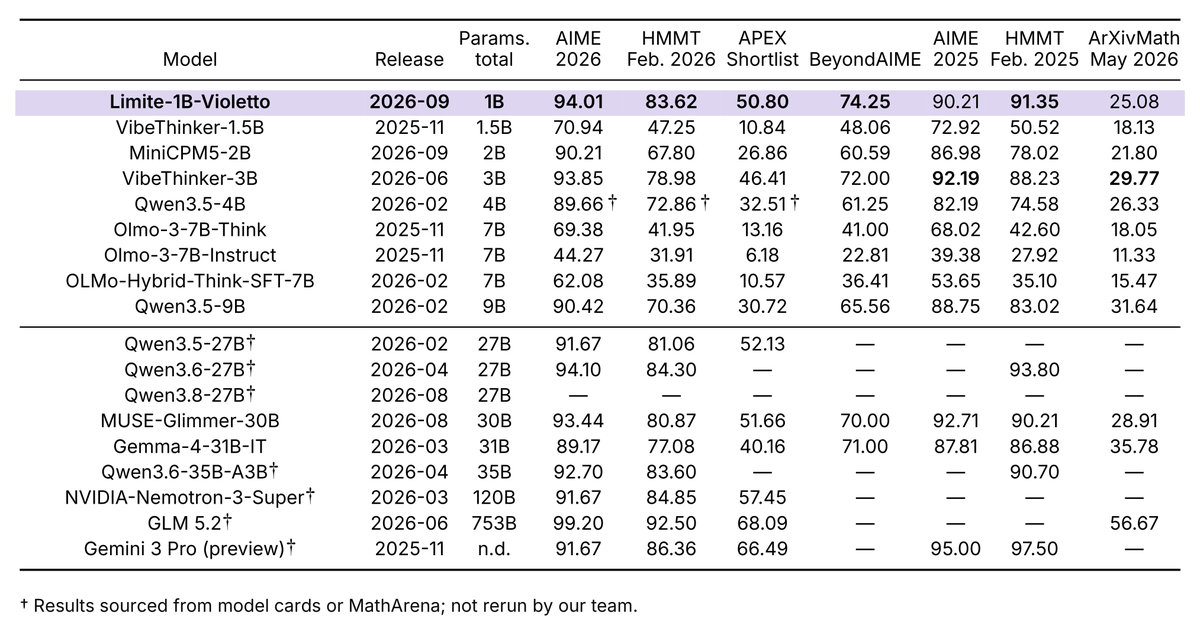
The scores are pass@1 averaged over 32 samples per problem, mostly from the team's own runs using MathArena's grader. Against models of up to 9 billion parameters, Limite led on most benchmarks, including 83.62% on HMMT February 2026 and 74.25% on BeyondAIME, though VibeThinker-3B came close on AIME 2026 at 93.85%. Among larger reference models, Qwen3.6-27B is reported at 94.10% on AIME 2026. The pattern changes on ArXivMath, which uses research-level problems from recent papers: Limite scored 25.08%, below both VibeThinker-3B at 29.77% and Qwen3.5-9B at 31.64%. The team says it removed benchmark overlap from its training data, both by matching text and by semantic similarity.
The specialization is also the main limitation. The authors say the model is only lightly instruction-tuned, may misread non-math requests as math problems, is weaker on knowledge of the literature and formal theorem proving, and is not yet optimized for decoding speed, which its depth can limit. Competition benchmarks of this kind check final answers rather than whole proofs. For teams building pipelines that try many candidate solutions and pick among them, an openly licensed 1B solver with this accuracy makes each attempt cheap. The model, its base and value checkpoints, and the serving code are released under Apache 2.0.
- Limite 1B was trained from scratch on 237 billion tokens of a mathematics-centric corpus, then post-trained with knowledge distillation, targeted supervised fine-tuning and RLVR on a curated curriculum, according to the technical report.
- The model is deliberately only lightly instruction-tuned: the authors position it as a single-turn math solver and a fast parallel component inside larger systems, not as a general-purpose assistant.
- The AIME 2026 and BeyondAIME scores come from the authors' own evaluation suite, where they say Limite places among models many times its size. The abstract does not name the comparison models.
- pretraining — The first, biggest phase of building a model: training it on enormous amounts of text so it learns language, facts, and reasoning in general.
- distillation — Training a small, cheap model to imitate a big one's outputs, keeping much of the capability at a fraction of the cost.
- reasoning model — A model trained to think — generating extended internal reasoning before answering — trading time and tokens for accuracy on hard problems.
- context window — The maximum amount of text a model can consider at once — its working memory for the current conversation or task.

Checking sign-in…
Loading comments…