Jev is the fastest-adopted model in AI Gateway history
Source
Amelia Charles
Author
Amelia Charles
Date
Key takeaways · AI-distilled
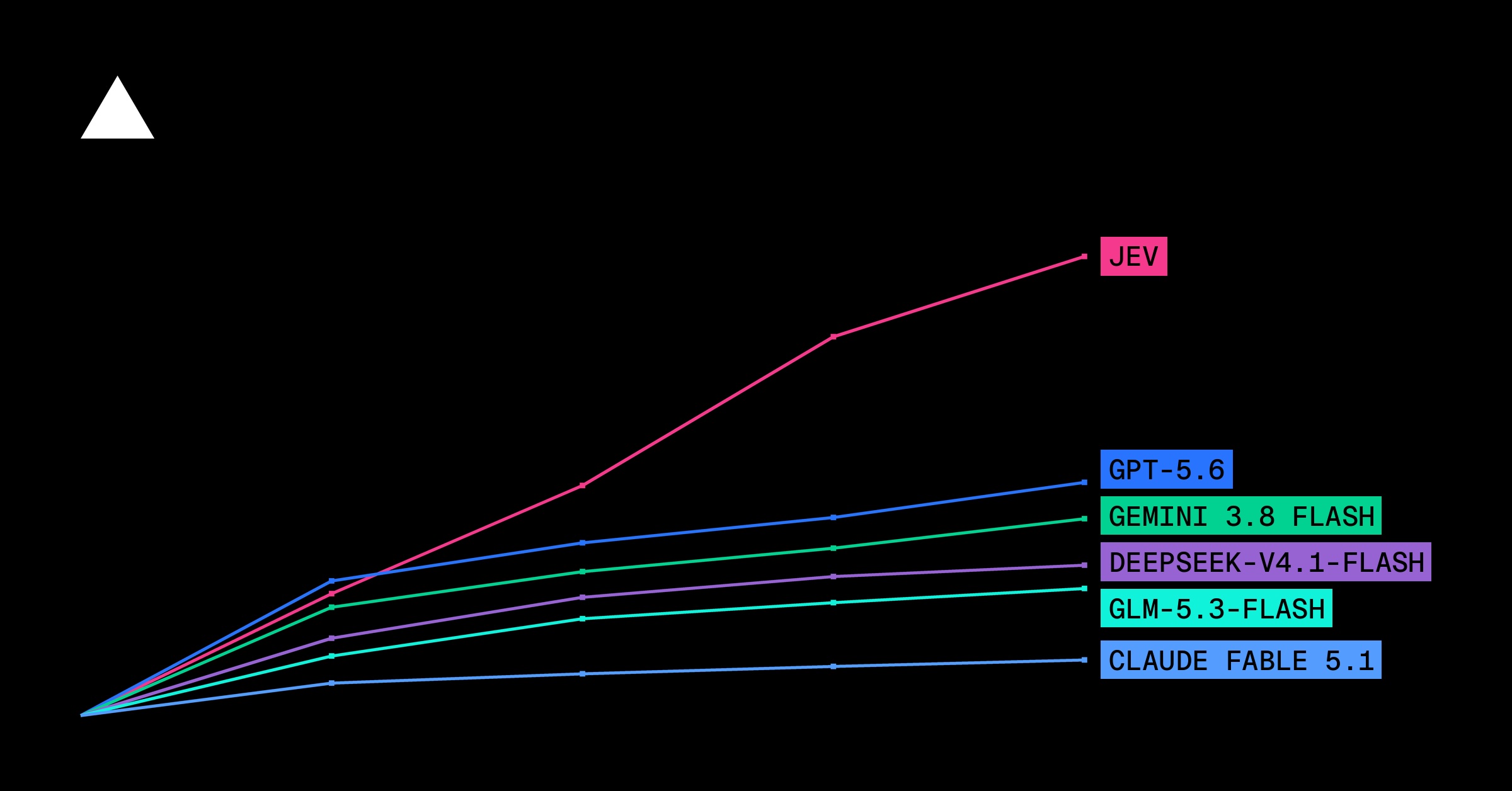
Within 24 hours of launch, Jev reached about 13% of paid AI Gateway teams -- 2x the adoption of the GPT-5.6 family and over 6x that of Fable 5.1 at the same mark.
Jev is a probabilistic decision model, not a text generator: it evaluates a set of questions in parallel and returns typed choices, scores, or true/false answers with probabilities attached.
Typical uses include picking an AI agentAn AI system that doesn't just answer once but works toward a goal in a loop — taking actions, reading the results, and deciding what to do next.Full definition →'s next tool or multi-agentUsing several AI agents on one problem — splitting work in parallel, checking each other, or filling different roles like planner and reviewer.Full definition →, deciding whether a workflow should continue or retry, and scoring risk before an action executes.
TypeSafe AI reports Jev ran up to 194x faster and 445x cheaper than general-purpose language models in its own workflow evaluations.
Terms in this piece · Glossary
AI agent — An AI system that doesn't just answer once but works toward a goal in a loop — taking actions, reading the results, and deciding what to do next.
guardrails — The checks around a model that block bad inputs and outputs — filters, validators, and permission rules the model itself can't override.
multi-agent — Using several AI agents on one problem — splitting work in parallel, checking each other, or filling different roles like planner and reviewer.
Why it matters
Jev is a decision-specific model that returns typed choices and probabilities instead of prose, aimed at agent tool-routing, workflow control, and guardrail checks, and claims large speed/cost advantages over general-purpose models for that narrow job.