Kimi K3.1 Pro now has more ZDR providers on AI Gateway
- Source
- vercel.com
- Author
- Jerilyn Zheng
- Date
Context
Vercel says Kimi K3.1 Pro and its faster variant, Kimi K3.1 Pro Highspeed, are now available from more Zero Data Retention providers on its AI Gateway. Until this change, Moonshot AI, which makes the model, was the only provider serving either version there. AI Gateway is a single API that sits in front of many model providers and chooses which one handles each request, with retries and failover to another provider. When Zero Data Retention (ZDR) is required, the gateway sends a request only to providers with which Vercel has a ZDR agreement, and Vercel's ZDR documentation says all of those providers also disallow training on prompts.
The number of providers matters because of how ZDR is enforced. A team can require it for one request by setting zeroDataRetention in the gateway options, or for every request, including those from coding agents, with a switch in the dashboard. Either way, the gateway routes only to providers with a ZDR agreement, applies the same rule to fallback providers, and fails the request if none is available rather than sending it to a provider without one. While Moonshot AI was the only provider, a ZDR request for K3.1 Pro had exactly one possible route. With more ZDR providers, the gateway can spread and fail over such requests while keeping the requirement. Per the documentation, the per-request setting costs nothing extra, team-wide ZDR costs $0.10 per 1,000 requests, and both need a paid account.
The changelog does not say which providers were added or how many. The documentation also warns that tools a provider runs on its own side, such as a provider's web search, may send data to a separate service that processes and retains it under its own terms, and that the gateway does not block those calls when ZDR is on.
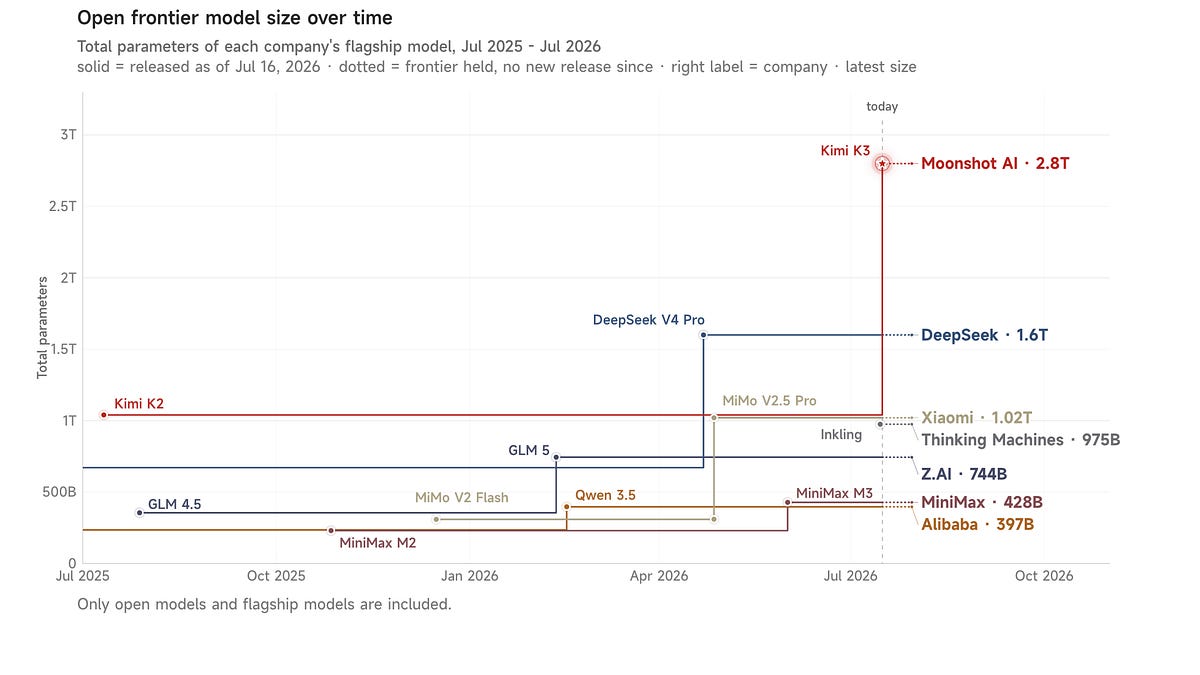
The model's weights are also public: Moonshot published them on Hugging Face the same day, describing a model with 2.8 trillion total parameters, 104 billion active per token and a 1-million-token . Vercel says both versions accept image input, describes K3.1 Pro as improving on earlier Kimi models in coding, 3D modeling and financial analysis, and suggests Highspeed for interactive work such as coding agents. The changelog gives no benchmarks for those claims. Vercel took a similar step for the previous generation in July, when it added US-based providers including Baseten and Fireworks, along with ZDR, for Kimi K3.
- Zero data retention is enforced by failing rather than falling back: with ZDR required per request or team-wide, a request fails if no provider with a ZDR agreement is available for that model instead of routing to one without.
- Vercel positions the two variants differently: Highspeed is for interactive work such as coding agents where response time matters, while K3.1 Pro is pitched for long runs, from a small fix to a full project.
- Coding agents reach the models by installing the latest Vercel CLI and running vercel ai-gateway coding-agents setup, then selecting moonshotai/kimi-k3.1-pro or the highspeed id inside the agent.
- Vercel states AI Gateway passes through provider pricing with no markup and charges no platform fee on , including Bring Your Own Key requests.
- mixture-of-experts — A model built from many specialist sub-networks where only a few activate per token, giving big-model capability at small-model running cost.
- context window — The maximum amount of text a model can consider at once — its working memory for the current conversation or task.
- AI agent — An AI system that doesn't just answer once but works toward a goal in a loop — taking actions, reading the results, and deciding what to do next.
- inference — Running a trained model to get answers — the phase where AI is actually used, as opposed to trained.

Checking sign-in…
Loading comments…