Long Context Latency Scaling Gpt Vs Claude
- Source
- epoch.ai
- Author
- Epoch AI publications
- Date
Context
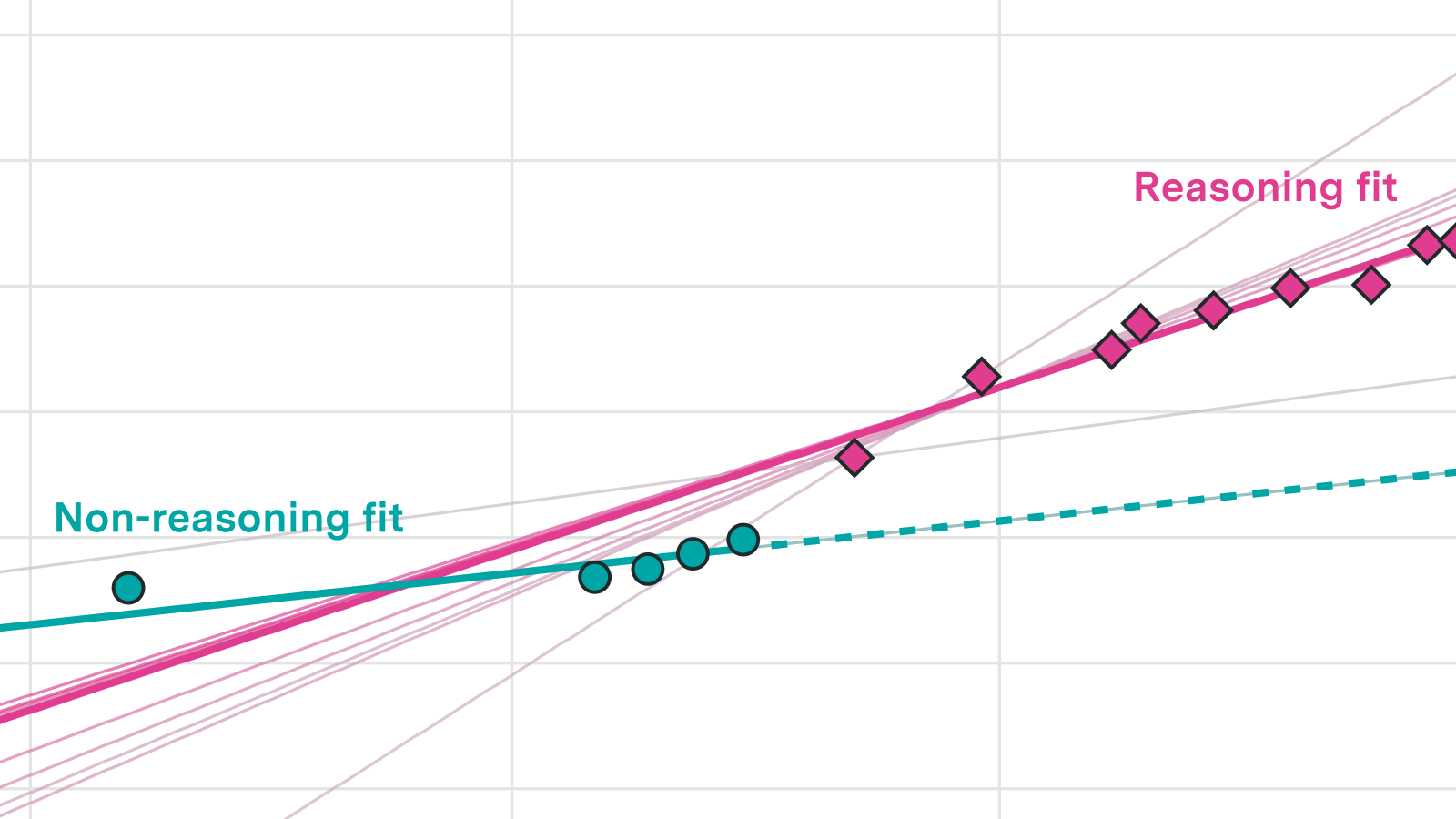
Epoch AI researcher Jason Li timed how long four frontier models take to return the first token of a reply as prompts grew from about 50,000 to roughly 900,000 tokens, and found that the two model families slow down in different shapes (epoch.ai). For OpenAI's GPT-5.6 Terra and Sol, each extra block of adds more waiting time than the block before it, a curve consistent with a significant quadratic component. For Anthropic's Claude Sonnet 5 the added delay stays close to constant, so latency rises in a nearly straight line, and Claude Opus 5 is noisier but still consistent with linear scaling. Li reads the gap as a sign that the two labs made very different architectural choices about how their models process long prompts.
Time to first token is a useful window because it is dominated, at long lengths, by prefill: the phase in which the model reads the entire prompt before it writes anything. In a classic every layer uses full , where each token looks back at every earlier token, so the work of reading a prompt grows with the square of its length. Many open models now cut that cost. Hybrids such as Kimi K3 and Qwen3.5 interleave cheaper linear-attention layers with full attention at a 3:1 ratio, others swap in sparse attention, and OpenAI's open gpt-oss models used sliding-window attention, which looks only at a fixed stretch of recent tokens. Claude's near-linear curve suggests that full attention contributes much less to its long-context processing than it does for GPT-5.6; the post infers this from timing, not from disclosed model details.
API timings are noisy, partly from queueing and routing, so Li fit the data three ways with different assumptions about that noise. All three recovered similar upward curvature for both GPT models. Sonnet stayed at or near zero curvature, while the Opus result is described as inconclusive rather than proven linear. In concrete terms, adding 10,000 tokens costs GPT-5.6 Terra about 0.071 seconds at a 100,000-token context and about 0.216 seconds at one million, while Sonnet 5 adds about 0.129 seconds at both. Li connects this to product defaults: Claude 5 models in Claude Code support a one-million-token window by default, while Codex autocompacts before 272,000 tokens even though GPT-5.6 supports 1.05 million, and OpenAI charges double the input price above 272,000 tokens where Anthropic keeps one price regardless of length.
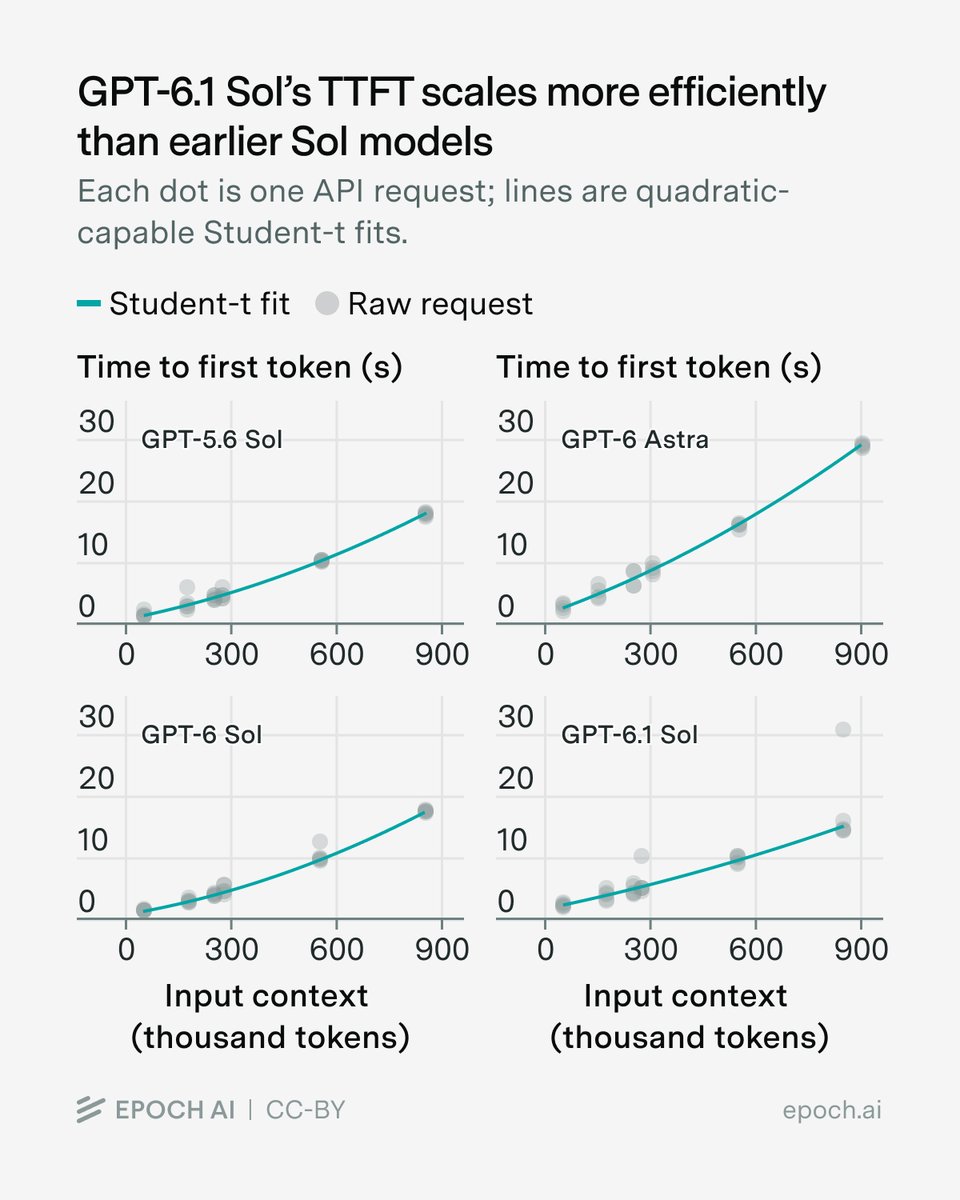
The post also extrapolates the fitted curves to ten million tokens, explicitly as a stress test rather than a forecast, since the measurements stop near one million. On those curves the GPT models' marginal delay per added token would be roughly 7 to 8 times what it is at one million, which Li argues would push long-running agents on quadratic models toward external memory and aggressive , while near-linear models could keep more history in context. An appendix extends the measurements to newer OpenAI models: GPT-6 Astra still shows a significant quadratic component, and GPT-6.1 Sol has a fitted quadratic coefficient 59% lower than GPT-6 Sol, starting slower at about 50,000 tokens but finishing faster at about 850,000.
- Measuring time to first token with reasoning off up to about 1M tokens, Epoch found GPT-5.6 Terra and Sol curve upward, consistent with a large quadratic term, while Claude Sonnet 5 stayed near-linear and Opus 5 was noisier but similar.
- The gap held across three estimators with different assumptions about API latency noise, all recovering similar curvature for GPT-5.6 and near-linear fits for Claude.
- Epoch reads this as different architectures: full attention, whose compute scales quadratically with context, appears to contribute much less to long-context processing in Claude than in GPT.
- Pricing diverges the same way: OpenAI charges double input and 1.5x output prices above 272,000 input tokens, while Claude keeps a fixed price at any length, though Epoch notes price need not reflect cost.
- context window — The maximum amount of text a model can consider at once — its working memory for the current conversation or task.
- transformer — The neural network architecture behind modern AI models, built on attention — letting every word directly consider every other word in parallel.
- attention — The mechanism that lets a model weigh which earlier words matter for the word it's currently processing — the core operation of a transformer.
- context compaction — Summarizing an agent's earlier conversation to free room in the context window so a long session can keep going.
Checking sign-in…
Loading comments…