Inference Economics Of Language Models
- Source
- epoch.ai
- Author
- Epoch AI publications
- Date
Context
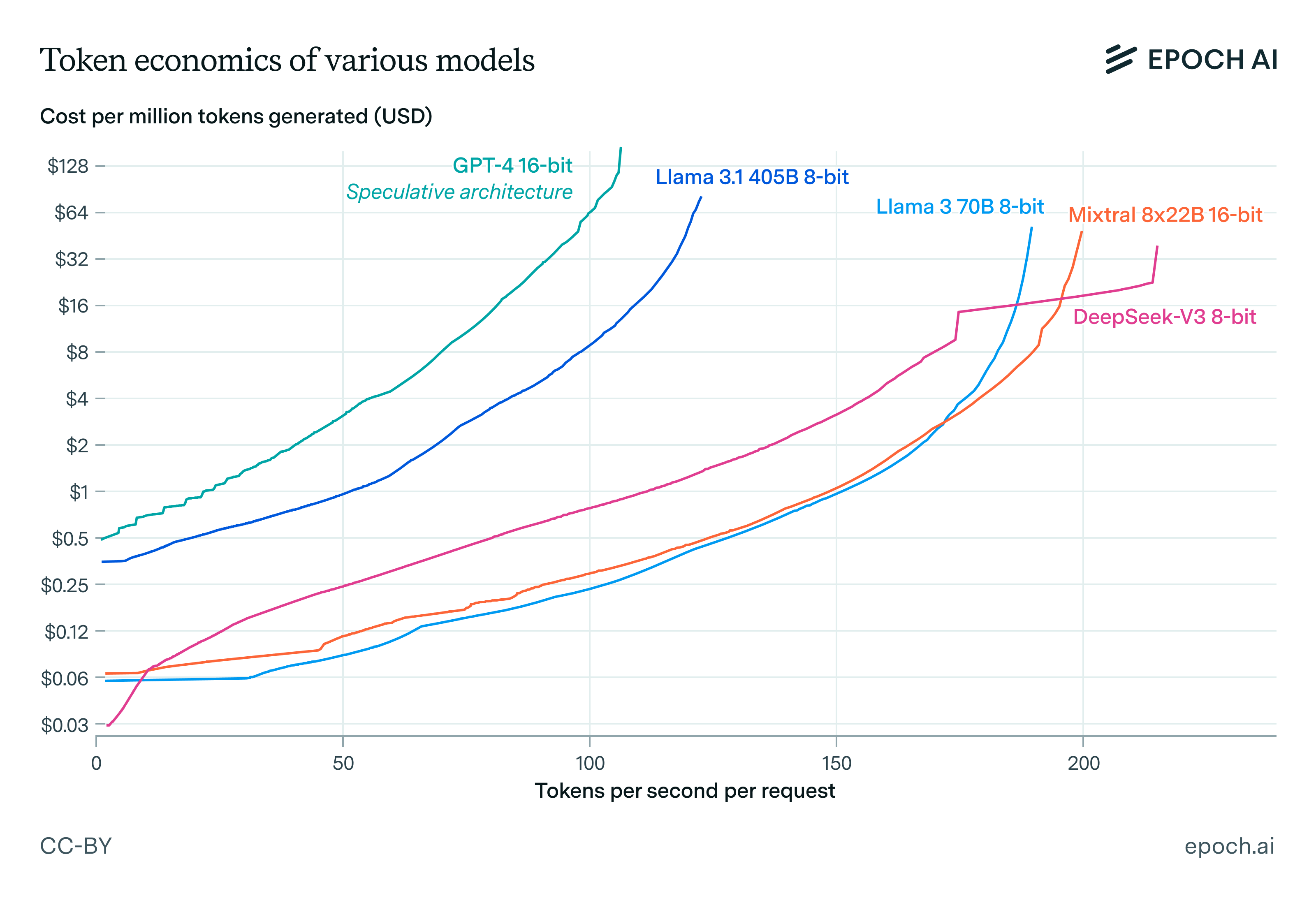
Language models are not served much faster than they are, even for customers willing to pay more per token, mainly because of fixed communication delays between GPUs, according to a model of inference economics by Ege Erdil, published by Epoch AI in 2025 with an accompanying arXiv paper (epoch.ai). The model splits each forward pass of a into four costs: arithmetic on the GPU cores, moving data from high-bandwidth memory into those cores, sending data between GPUs over the network, and latency, the fixed overhead of steps such as kernel launches and collective operations that does not shrink with message size. Erdil gives the example that one NVIDIA all-reduce protocol on a DGX H100 has a base latency of 30 microseconds even for a one-byte tensor. Searching over ways to split a model across GPUs then traces the best achievable speed at each price.
The key finding is about which of those costs binds. Network bandwidth gets more , but Erdil argues it only dominates for transfers above about 10 MB, which would need per-GPU batch sizes of 500 or more, far larger than anyone would use when serving for speed. In fast inference the network cost is therefore mostly latency. Without that constraint, spreading a forward pass across more GPUs could keep quadrupling speed for each doubling of cost per token, a point the post credits to Steinhardt (2022). Because latency does bind, that path runs out. As rough order-of-magnitude rules, the model finds a dense transformer's token speed scales with the inverse square root of its parameter count and the cube root of the GPUs' memory bandwidth.
The same accounting explains why , where a cheap draft proposes several tokens and the large model checks them in a single pass (background), pays off so well. It does nothing for arithmetic or network bandwidth, but in fast decoding those are not the limits; memory bandwidth and network latency are, and both get spread across several tokens per pass. Erdil reports the effect can be as large as doubling generation speed at fixed cost. The model also implies pipeline parallelism, splitting a model's layers across GPUs in sequence, is mainly worth using when a model would not otherwise fit in GPU memory, which on an H100 means speeds below roughly 42 tokens per second.
- Epoch's model breaks each Transformer forward pass into arithmetic time, HBM read-write time, network send-receive time, and fixed latency such as kernel launches and collectives.
- Fixed latency matters even for tiny transfers: NCCL's LL128 all-reduce has a 30-microsecond base latency on a DGX H100 even for a one-byte tensor.
- Because some components overlap, the model applies overlap assumptions and grid-searches parallelism setups to find the best setup, and finds latency scales with the square root of model size and cube root of memory bandwidth.
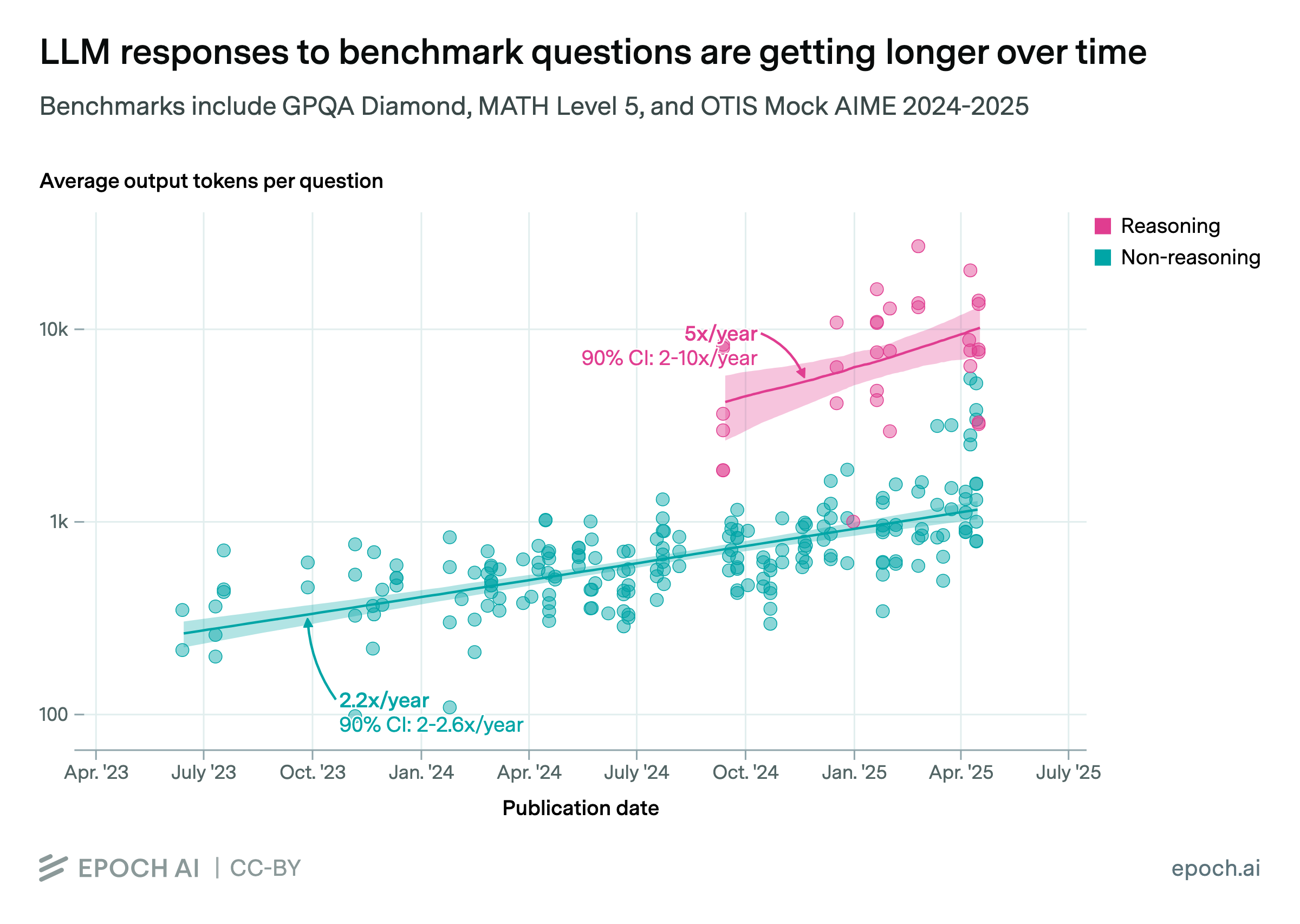
- Ege Erdil argues 10 tokens per second at human reading speed is an obsolete bar: long reasoning and loops make faster serving more valuable, while inference revenue at OpenAI and Anthropic grows 3x or more a year.
- transformer — The neural network architecture behind modern AI models, built on attention — letting every word directly consider every other word in parallel.
- attention — The mechanism that lets a model weigh which earlier words matter for the word it's currently processing — the core operation of a transformer.
- speculative decoding — A speed trick where a small model drafts several tokens ahead and the big model verifies them in one pass, often doubling generation speed.
- AI agent — An AI system that doesn't just answer once but works toward a goal in a loop — taking actions, reading the results, and deciding what to do next.

Checking sign-in…
Loading comments…