Lower-Scoring LLM Endpoints Produce Fewer Output Tokens
- Source
- x.com
- Date

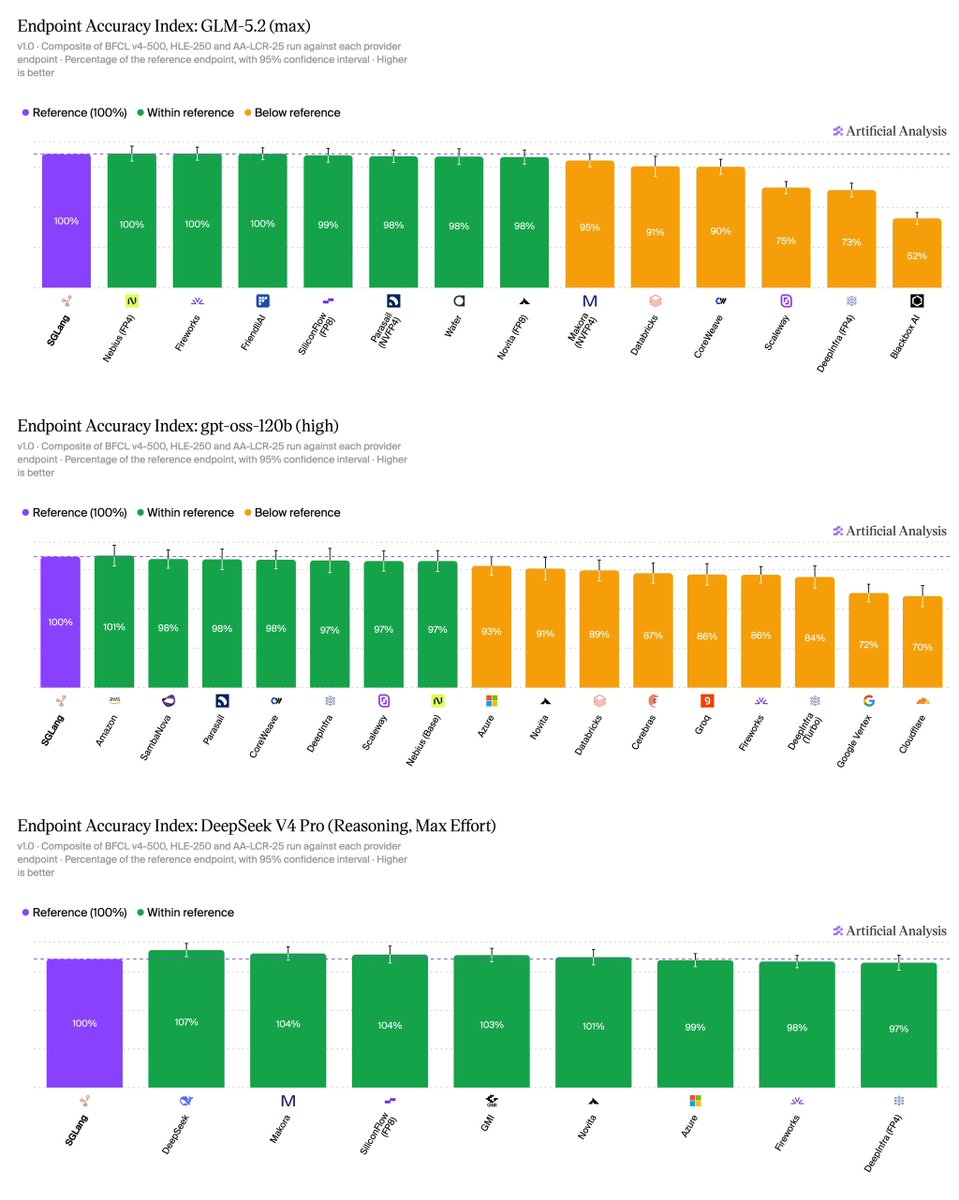
Announcing the Artificial Analysis Endpoint Accuracy Index, measuring how much of an open weights model's accuracy each serverless API endpoint preserves. We are initiating coverage with GLM-5.2, gpt-oss-120b and DeepSeek V4 Pro, with Kimi K3 coming soon Providers trade off accuracy to optimize for speed and cost. They quantize weights, write custom kernels and tune their inference stacks, and sometimes they simply ship bugs. We are bringing the rigor of our Artificial Analysis Intelligence Index to measuring endpoints, so developers can pick providers on accuracy, not just price and speed We benchmark each serverless endpoint against our own self-hosted reference deployment of the official weights, where 100% represents matching the reference. An endpoint is at reference parity when its result falls within the 95% confidence interval of the reference. Coverage is live for GLM-5.2, gpt-oss-120b and DeepSeek V4 Pro, with Kimi K3 accuracy coverage launching soon Key elements of the Endpoint Accuracy Index: ➤ Three areas, equally weighted: tool calling (BFCL-500, 500 questions, 3 repeats), scientific reasoning (HLE-250, 250 questions, 10 repeats) and long context recall (AA-LCR-25, 25 questions, 10 repeats). Each subset separates endpoints on the serving choices that drive accuracy differences, with repeats sized for tight confidence intervals ➤ Reference deployment: we self-host the official weights at the lab's recommended precision, following the lab's serving recipe, and publish the complete commands for each reference ➤ Inference parameters: we run the model's highest supported reasoning mode and each endpoint's highest supported output length and context window ➤ Confidence intervals: the parity test accounts for uncertainty in both the endpoint's runs and the reference's runs ➤ Rotating coverage: models enter once sufficient number of providers serve them and exit when a newer version in the same family supersedes them. We benchmark new endpoints as providers launch them and refresh all listed endpoints periodically ➤ Point in time: each result carries the date it was measured, with multi-day benchmarks dated to their final day Key results for GLM-5.2 ➤ Output token limits restrict accuracy. Restrictive limits cut responses off before the model finishes reasoning, and the most restrictive endpoints score half the reference or less on HLE-250 Key results for gpt-oss-120b ➤ Tool call handling separates endpoints. Providers parse and format tool calls differently, and some endpoints score 22% on BFCL-500 against 37% for the reference ➤ Serving configuration changes what the model does at the same requested settings. Some endpoints produce far fewer reasoning tokens at the same configured level, and restricted context windows truncate long context tasks Key results for DeepSeek V4 Pro ➤ DeepSeek V4 Pro endpoints are more in line with the reference. Majority of the endpoints are at reference parity, and DeepSeek's own first-party endpoint scores slightly above the reference

Endpoints that score below the reference generally produce fewer output tokens per task. Output limits and reduced reasoning effort show up directly in token usage, and the lowest-scoring endpoints on both models produce roughly half the reference's output tokens

Context
The same open-weights model can score very differently depending on which company serves it, and Artificial Analysis built its Endpoint Accuracy Index to measure that gap. Because anyone can run an open-weights model, many providers sell access to the same model through their own serverless endpoints. Artificial Analysis says providers trade accuracy for speed and cost: they quantize weights (store the model's numbers at lower precision), write custom kernels (the low-level code that runs the model's math on the chips), tune their serving software, and sometimes ship bugs. The index scores each endpoint against the firm's own deployment of the official weights, run at the lab's recommended precision and following the lab's serving recipe, with 100% meaning the endpoint matches that reference.
The test covers three equally weighted areas with repeated runs: on 500 BFCL questions, scientific reasoning on 250 questions from Humanity's Last Exam (HLE-250), and long- recall on 25 questions (AA-LCR-25). Each endpoint runs at the model's highest supported reasoning mode and at its own highest supported output length and context window. An endpoint counts as at reference parity when its result falls within the 95% confidence interval of the reference, a test that accounts for run-to-run variation on both sides. Each result carries the date it was measured, and listed endpoints are refreshed periodically.
The announcement thread ties lower scores to shorter work. Endpoints that score below the reference generally produce fewer output per task, and the lowest-scoring endpoints on both models in that comparison produce roughly half the reference's output tokens. The firm attributes this to output limits and reduced . For GLM-5.2, restrictive output limits cut responses off before the model finishes reasoning, and the most restrictive endpoints score half the reference or less on HLE-250. For gpt-oss-120b, some endpoints produce far fewer reasoning tokens at the same configured reasoning level, restricted context windows truncate long-context tasks, and differences in how providers parse and format tool calls leave some endpoints at 22% on BFCL-500 against 37% for the reference. DeepSeek V4 Pro endpoints track the reference more closely: most are at parity, and DeepSeek's own endpoint scores slightly above it.
For a developer, this means a model name and a price do not settle what an endpoint delivers; its output cap, reasoning setting and tool-call handling can change the result. Output token count works as a visible warning sign, though the thread presents it as a pattern alongside lower scores rather than a per-endpoint diagnosis. Apart from DeepSeek's own endpoint, the thread text does not name the providers, and it gives few per-endpoint scores and does not say which two models the token comparison covers; those details are in charts that were not read.
- tool use — A model's ability to call external functions — run code, search the web, edit files — instead of only generating text.
- Context and context window — Context is the information available for a generation; the context window is the capacity available to hold it.
- Token — A piece of text, such as a word, part of a word or a punctuation mark, that a language model represents as numbers and handles as a unit.
- Reasoning effort — The inference-time budget a reasoning model spends before answering.

Checking sign-in…
Loading comments…