Ring-2.6-1T Ships With a Reasoning-Effort Dial for Agent Workloads
- Source
- x.com
- Date

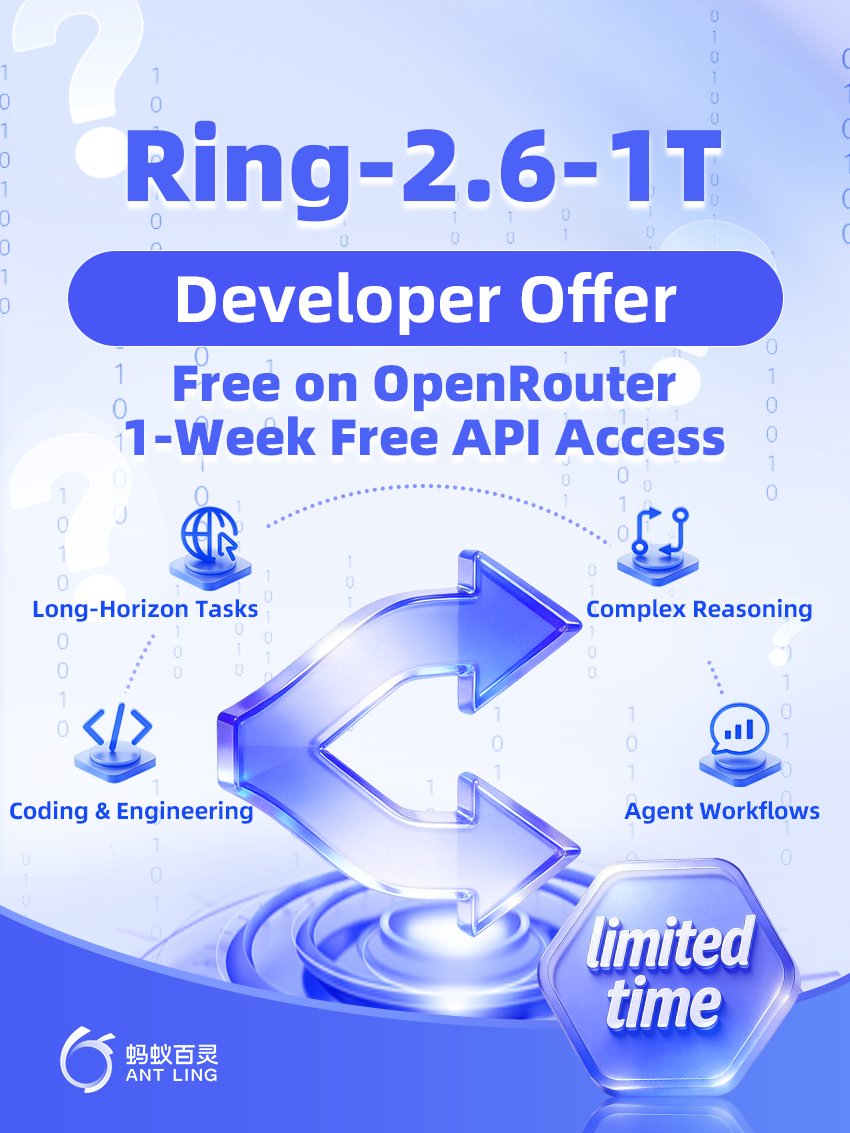
We are launching Ring-2.6-1T, a trillion-parameter flagship thinking model engineered for real-world complex tasks and production env: 🚀 - Adjustable Thinking Effort: dynamic compute mechanism to flexibly balance cognitive depth, token cost, and execution speed; - Agent-Optimized: Built for high-frequency workflows, delivering rapid multi-step execution and tool orchestration with SOTA stability; - Deep Thinking: Unlocks the model's maximum capability ceiling for rigorous mathematical logic and scientific research;

Context
A that always thinks at full depth can spend as many tokens on a routine step as on a hard proof. Ant Ling launched Ring-2.6-1T on May 8 as a trillion-parameter reasoning model with what it calls adjustable thinking effort, a mechanism Ant says lets a user trade depth of reasoning against token cost and speed. The launch post pitches one end for fast, high-frequency work such as multi-step , and a deep-thinking end for rigorous math and scientific research.
The model card that inclusionAI published with the six days later names the two settings high and xhigh and gives Ant's own scores for each: 87.60 on PinchBench and 95.32 on Tau2-Bench Telecom, both agent benchmarks, at high, and 95.83 on AIME 26 math and 88.27 on GPQA Diamond science questions at xhigh. Those are self-reported runs, and the card does not say how much extra compute xhigh spends or which setting a developer passes to pick a level, so any token or cost saving from choosing high remains Ant's claim rather than a measured figure.
- reasoning model — A model trained to think — generating extended internal reasoning before answering — trading time and tokens for accuracy on hard problems.
- AI agent — An AI system that doesn't just answer once but works toward a goal in a loop — taking actions, reading the results, and deciding what to do next.
- tool use — A model's ability to call external functions — run code, search the web, edit files — instead of only generating text.
- open weights — A model whose trained parameters are published for anyone to download and run — unlike API-only models you can access but never possess.



Checking sign-in…
Loading comments…