DeepSeek: DeepSeek v4.1 Flash 1017
- Source
- openrouter.ai
- Author
- theanonymousone
- Date
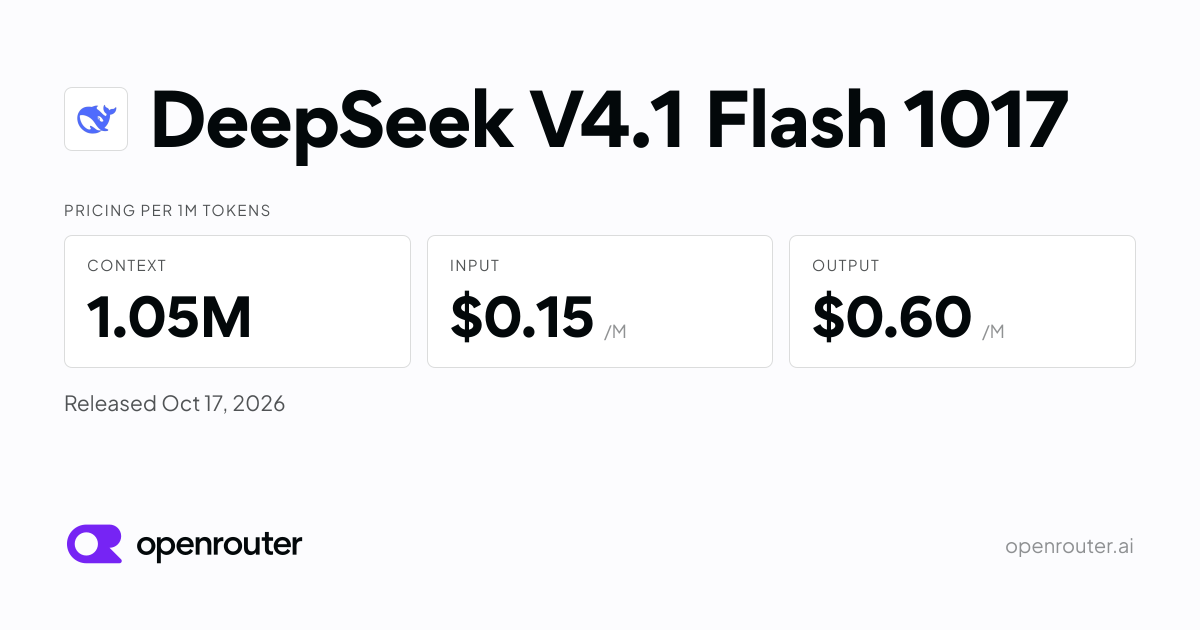
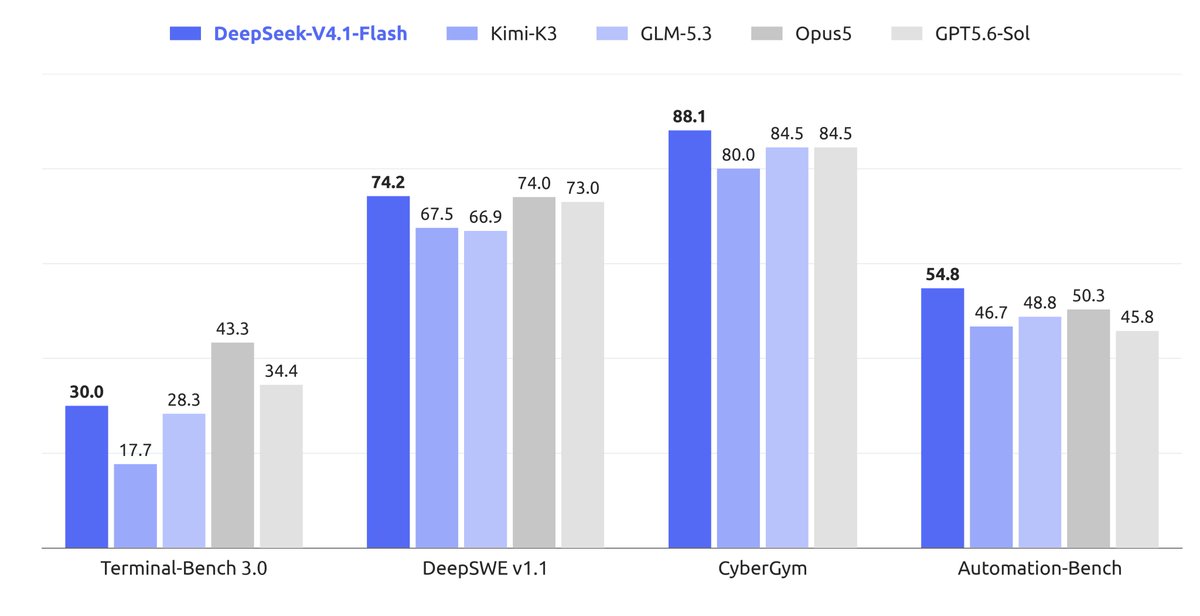
DeepSeek V4.1 Flash 1017 is a sparse mixture-of-experts model with native vision and a context window of one million tokens, listed on OpenRouter at $0.10 per million input tokens and $0.50 per million output tokens. DeepSeek aims it at coding, terminal and computer-use agents and claims it outperforms its own V4 Pro. Vercel, which added the model to AI Gateway the same day, describes it as a minor update to V4.1 Flash with gains in terminal work, building and editing whole repositories, multi-step automation and chart reading when the model can call tools. Vercel also reports that it finishes tasks faster and with shorter outputs than the previous snapshot. For agent workloads that matters as much as the list price, because output tokens are the expensive side of the meter and long runs produce many of them. The model is reachable through OpenRouter and through AI Gateway as deepseek/deepseek-v4.1-flash-1017, including from Claude Code, Codex and Cursor via the Vercel CLI setup command. The performance claims come from DeepSeek and its distributors, not from an independent benchmark, so the comparison against V4 Pro is the vendor's own.
Context
DeepSeek V4.1 Flash 1017 is a dated refresh of DeepSeek's existing V4.1 Flash model rather than a new architecture. OpenRouter's model page describes it as the October 17, 2026 snapshot of V4.1 Flash, served by DeepSeek under its deepseek-flash API model name (openrouter.ai). The underlying design is unchanged from the V4.1 Flash launch: a sparse model, meaning only a fraction of its parameters run for each token, built on DeepSeek's Causal Encoder-Decoder architecture. It activates 8B parameters when reading input and 16B when generating output from a 552B-parameter total, which keeps per-token compute low for a model of that size. Image understanding is built in from , and compressed cuts the memory used to hold earlier context to roughly a quarter of the previous Flash generation.
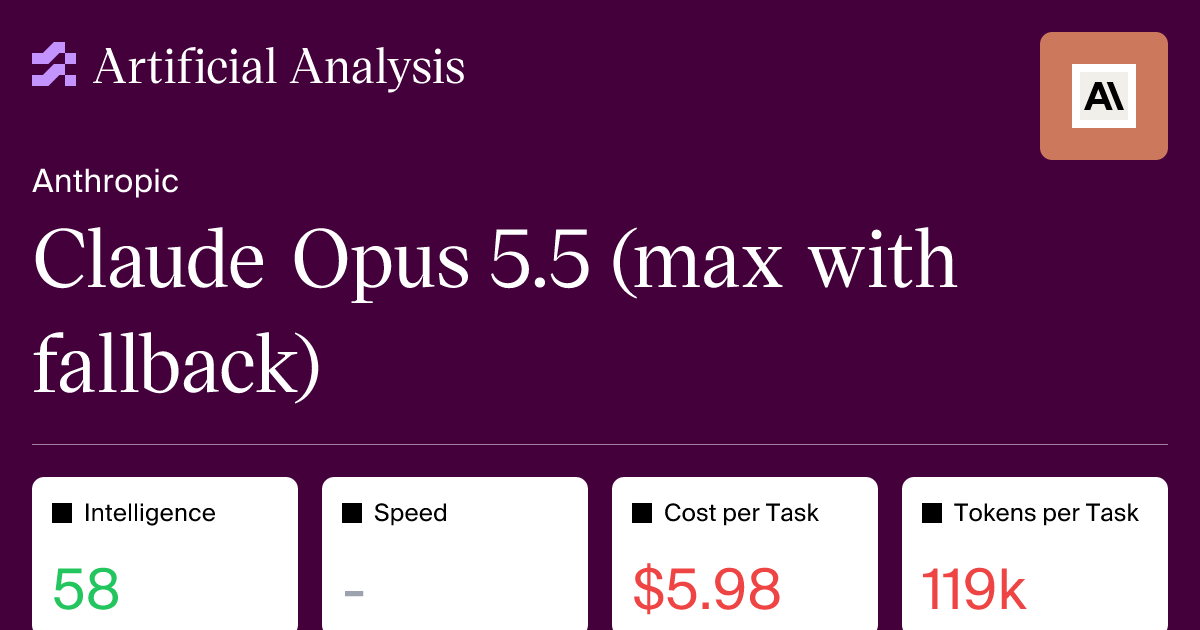
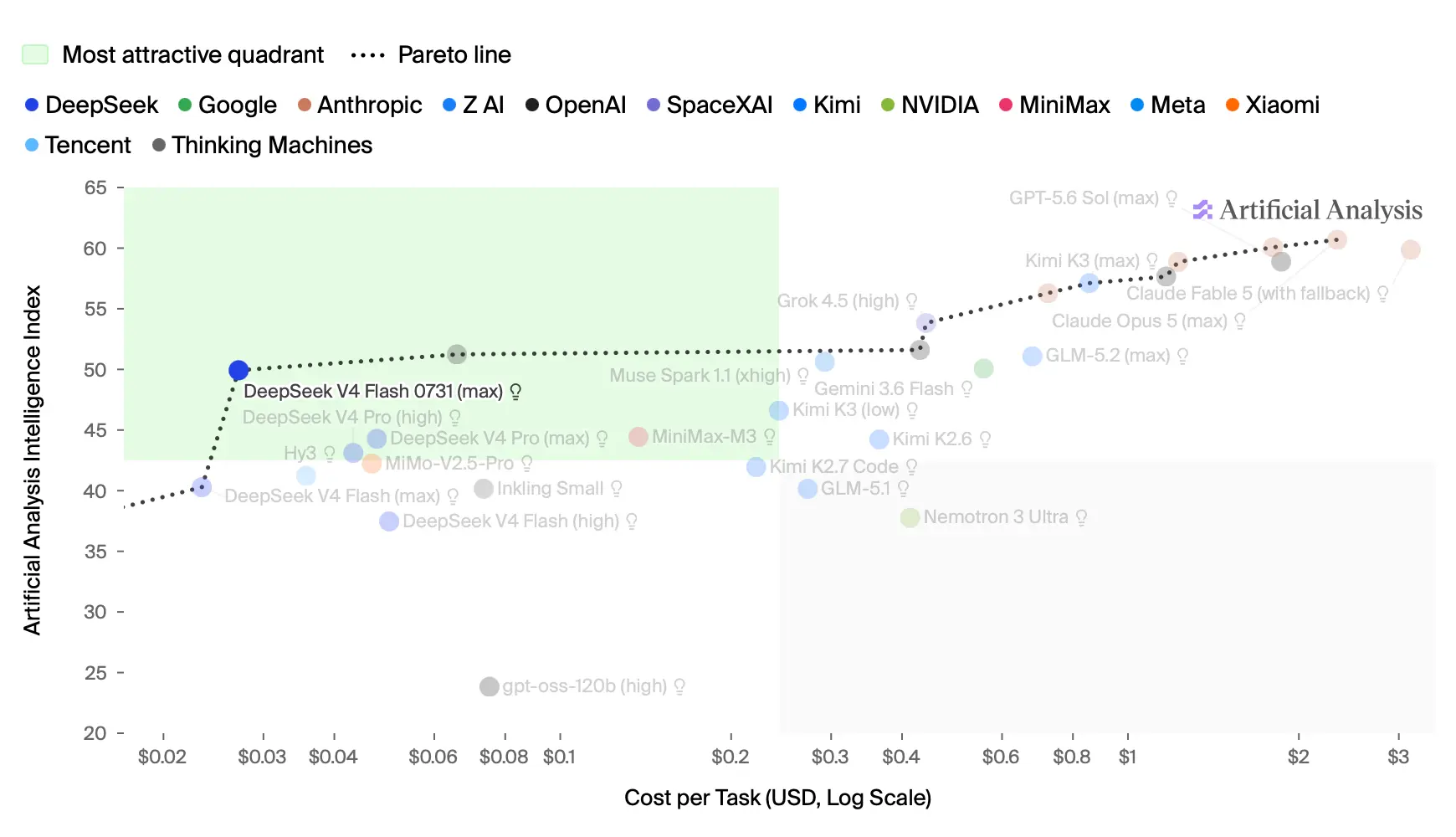
What changed is post-training. DeepSeek's release note claims stronger benchmark performance, faster task completion and shorter outputs than the previous version, and says reinforcement learning with self-feedback was used to improve end-to-end project development. The Hugging Face model card calls it a minor update and reports DeepSeek's own comparisons against the original V4.1 Flash, for example 42.3 versus 31.2 on Terminal-Bench 4.0. Those are vendor-reported figures. The Artificial Analysis scores shown on OpenRouter's page are labeled for V4.1 Flash (Max), not specifically for the 1017 snapshot, so they do not measure this update.
On OpenRouter, the model lists a 1,048,576-token context window, up to 131,072 output tokens, text and image input, and structured outputs. Its headline price is $0.10 per million input tokens and $0.50 per million output tokens, with cache reads at $0.002 per million. At the time of the snapshot it was served by four providers: inference.net, Cloudflare, DeepInfra and DeepSeek itself, whose own endpoint was listed at $0.15 input and $0.60 output. The page lists agent tools, led by Hermes Agent and Claude Code, as the apps sending it the most traffic, which fits DeepSeek's positioning of the model for coding, terminal and long-running agent work.
- mixture-of-experts — A model built from many specialist sub-networks where only a few activate per token, giving big-model capability at small-model running cost.
- pretraining — The first, biggest phase of building a model: training it on enormous amounts of text so it learns language, facts, and reasoning in general.
- KV cache — The memory a model keeps about text it has already read, so generating each new token doesn't require reprocessing the whole conversation.
- tool use — A model's ability to call external functions — run code, search the web, edit files — instead of only generating text.



Checking sign-in…
Loading comments…