Cua Pairs Jev with Its Driver for 5x Faster Computer Use
- Source
- x.com
- Date

1/ Fast Computer Use is now solved with @typesafeai Jev + Cua Driver. Available in development preview for macOS, Windows, and Linux. We call it jev-use. Draft #3943: https://t.co/J1frbEbZTQ

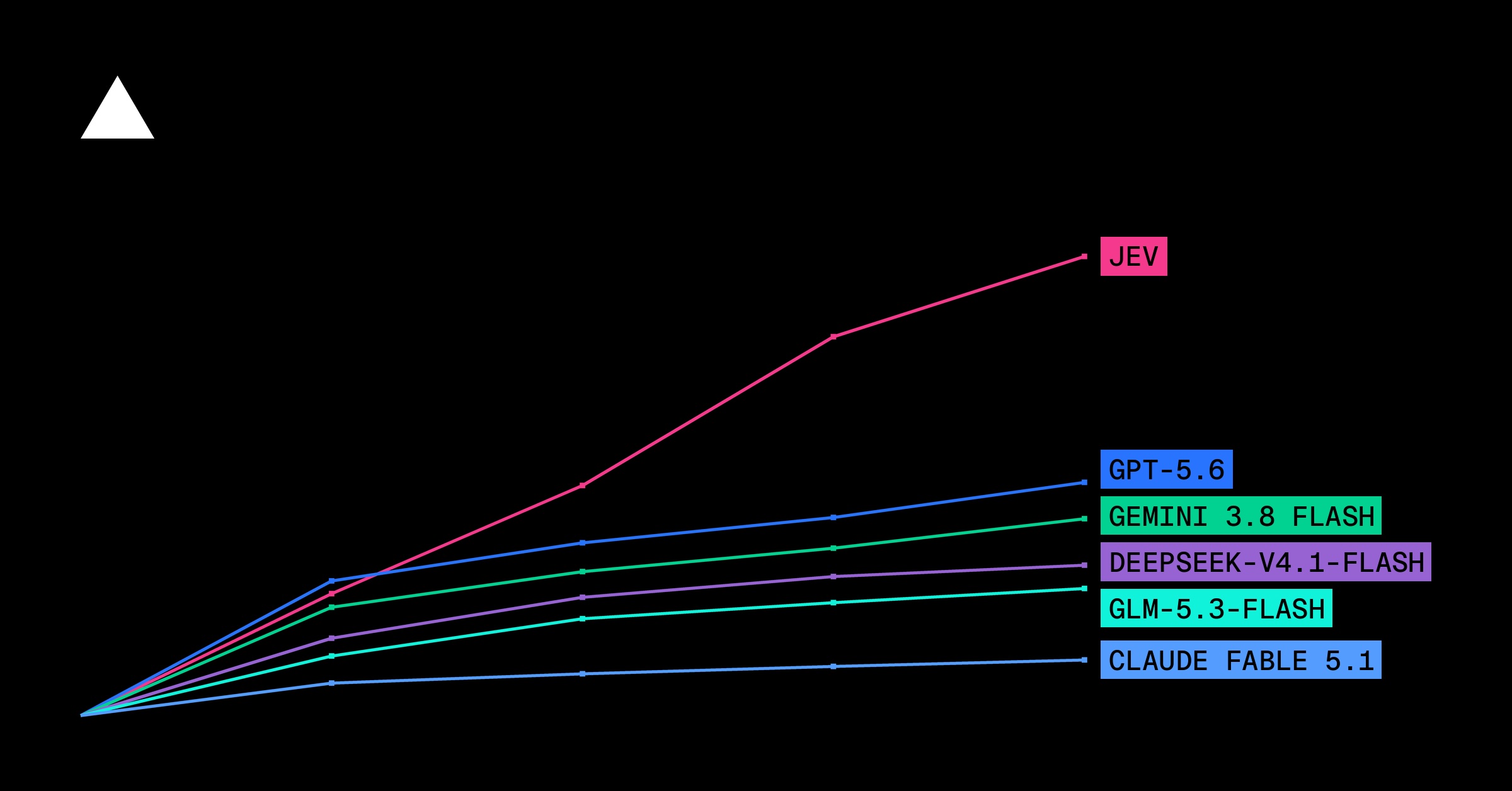
2/ Cua Driver + Jev playing 2048. In this measured 2048 run, Jev was 5x faster and about 1,000x cheaper than Astra. That result is specific to this run, not a general claim about either system. Video attachment: 30 seconds, silent, 1920 x 1080. The final frame shows Jev at 44.9 seconds and about $0.00108 API-equivalent cost, versus Astra at 294.9 seconds and about $1.45. Demo by @injaneity

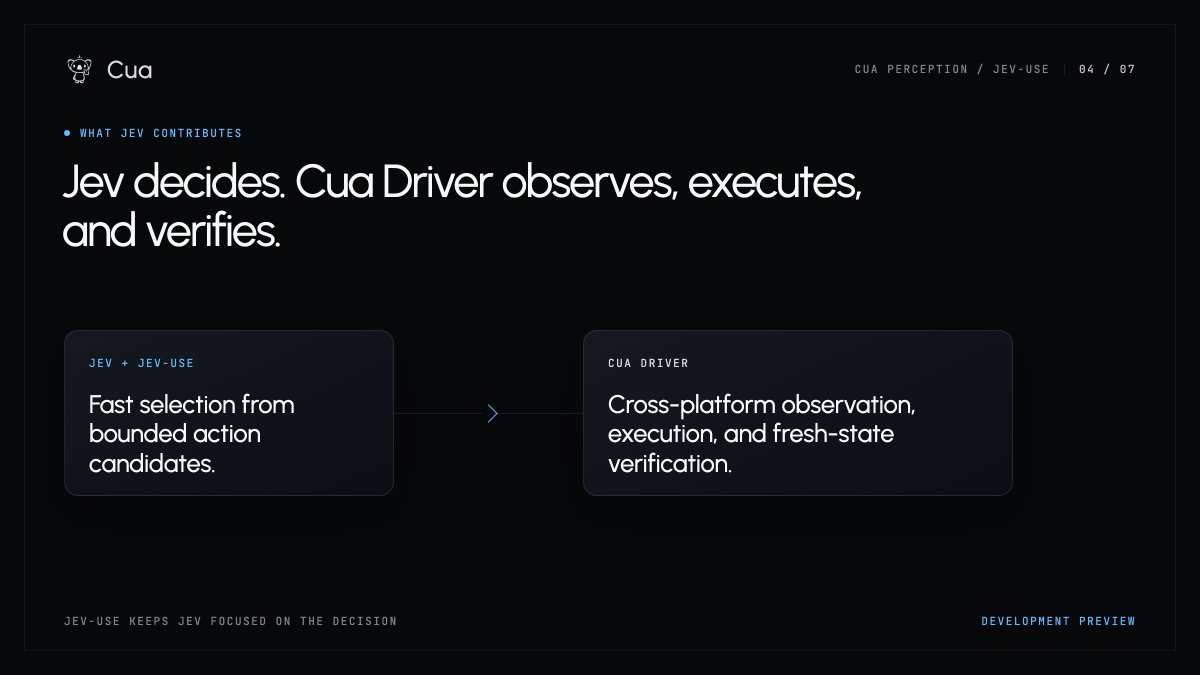
3/ Jev from @typesafeai is the fast decision layer. Cua Driver observes and executes across macOS, Windows, and Linux. jev-use turns what Driver sees into bounded action candidates Jev can select, then Driver executes and verifies.
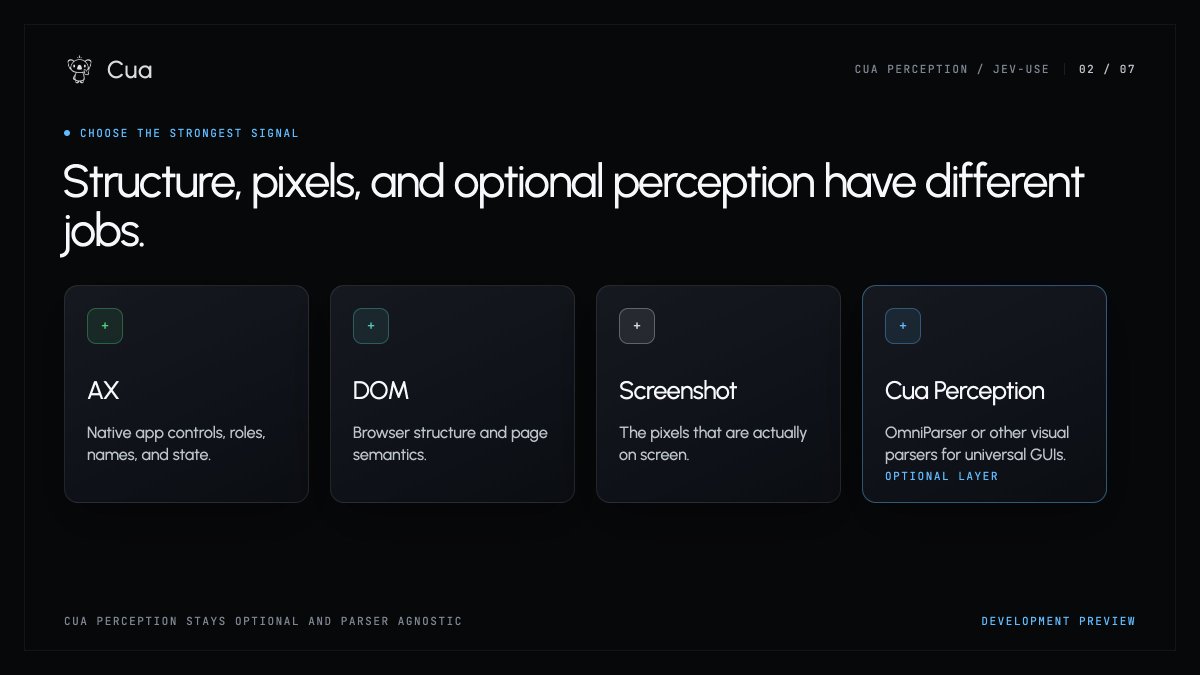
4/ For universal GUI parsing, we're introducing optional Cua Perception. It can use screenshot parsers such as OmniParser to produce typed visual regions when AX or DOM is incomplete. Cua Driver stays model and parser agnostic.
Context
Cua says it paired TypeSafe AI's Jev model with Cua Driver in a development preview called jev-use, for macOS, Windows and Linux. Instead of asking a large to decide every step, Cua Driver observes the screen and turns it into a bounded list of candidate actions. Jev, which Cua calls the fast decision layer, selects one ID, and Driver executes and verifies fresh state.
Cua's one measured example is a 2048 run: Jev with Cua Driver took 44.9 seconds at about $0.00108 API-equivalent cost, against 294.9 seconds and about $1.45 for a model the post calls Astra. Cua calls that 5x faster and about 1,000x cheaper, and says the result is specific to that run, not a general claim about either system.
- reasoning model — A model trained to think — generating extended internal reasoning before answering — trading time and tokens for accuracy on hard problems.
- LLM — A large language model — the neural network behind tools like Claude and ChatGPT, trained on huge amounts of text to predict what comes next.






Checking sign-in…
Loading comments…