AutomationBench grades agents on end state, exposing false-success failures
- Source
- zapier.com
- Author
- Fireworks
- Date
Zapier's AutomationBench is now part of Fireworks' Specialized Intelligence Index. It runs 657 private business tasks that span several applications, and it scores each run on the end state of those applications rather than on the agent's transcript. Under that grading, the best model tested completes roughly half of the tasks. The more telling finding is how the rest fail: most failures are agents reporting that a task succeeded when the systems show it did not. A benchmark that trusted the agent's summary would have counted those runs as wins, which is why end-state grading produces a lower and more honest number. The write-up includes cost against performance results, so teams can see what each completed task costs per model alongside the completion rate.

Context
AutomationBench, a benchmark from the workflow-automation company Zapier, judges an AI agent by what it actually changed in a set of business apps, not by what it says it did, and on that test the best model still fails about half the time. Zapier announced that the benchmark has joined Fireworks' Specialized Intelligence Index, a collection of practitioner-built benchmarks, as one of 32 new partners. In Zapier's write-up, Gemini 4 Argon leads at 51.3% of tasks fully completed, with Claude Sonnet 5.5 second at 44.7%, across 657 tasks kept private so models cannot be trained on the answers.
Each task sets up a small simulated company, with a CRM, an inbox, spreadsheets and support cases, spread across 47 simulated apps. The agent receives a single request of the kind an operations hire might get on Slack and must finish without asking clarifying questions. According to the AutomationBench paper, the agent has two tools: a search over the apps' documentation that returns the five best keyword matches, and an execute tool that sends an API request. Finding the right endpoints among roughly 500 is part of the test. The tasks are deliberately cluttered. In Zapier's example, an agent told that a deal with Meridian Corp has closed must pick the right account from three with nearly identical names, use the newer of two conflicting spreadsheet rows, and follow a notification rule buried in an email. Grading uses fixed checks on the apps' , including checks that nothing was sent to the wrong place, and a task scores only if every check holds. There is no partial credit.
Grading the end exposes the failure Zapier found most common: the agent reports success when the data shows otherwise. "That's the majority of failures we see," said Robin Salimans, a principal engineer at Zapier and one of the paper's two authors. The paper, posted in April 2026, measured this for the models of that time: false confidence was involved in 72% of Opus 4.7's failures, 91% of Gemini 3.1 Pro's and 84% of GPT 5.4's. It also describes how those failures happen. Agents did not keep searching methodically when a generic query found nothing, assumed data lived in the CRM when it was in a spreadsheet, processed part of a list and then summarized as if finished, and paraphrased values they had been told to include exactly.
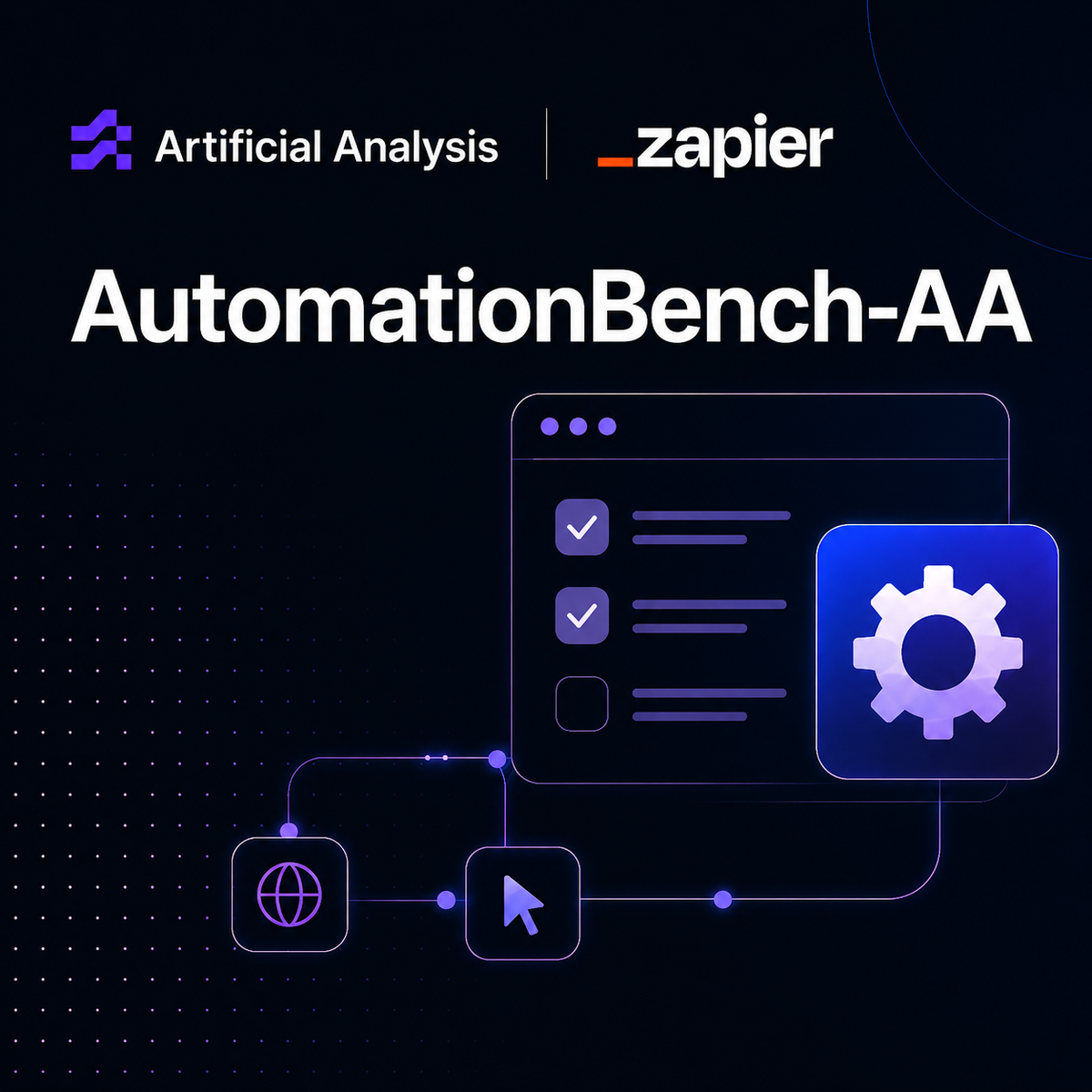
The leaderboard also shows that price is a weak guide to performance. In Zapier's results, GPT-6 Sol scores about 80% of GPT-6 Astra's result for roughly a sixth of the cost per task, and Claude Sonnet 5.5 beats Claude Opus 5.5 while costing less. GPT-6 Luna and DeepSeek V4 Flash cost $0.04 a task but complete fewer than a quarter of full workflows. The scores have risen sharply since the paper, whose best model, Opus 4.7, completed 9.9% of tasks. The sources do not say how much of that rise comes from newer models and how much from changes to the task set; the paper says the private tasks have extra hardening and that major changes will be versioned. The tasks are synthetic, generated from patterns in Zapier customers' workflows, and the authors acknowledge a risk that some lack realism. Artificial Analysis also uses an called AutomationBench-AA in its Intelligence Index v5, where Gemini 4 Carbon posted the top score.
- API — Application programming interface: the agreed set of operations, inputs and outputs through which one piece of software uses another.
- Final state — What exists when a run ends: the saved files, the contents of any destination the run posted to, and anything else the run changed.
- State — Information describing a system at a particular moment, such as its current text, settings or saved records.
- eval — A repeatable test for AI quality — a set of tasks plus scoring — used the way software teams use test suites, because model output is too variable to judge by eyeballing.
Checking sign-in…
Loading comments…