AA-Robotics v0.1: frontier LLMs drive a robot arm, slowly and expensively
- Source
- artificialanalysis.ai
- Author
- Artificial Analysis
- Date
Context
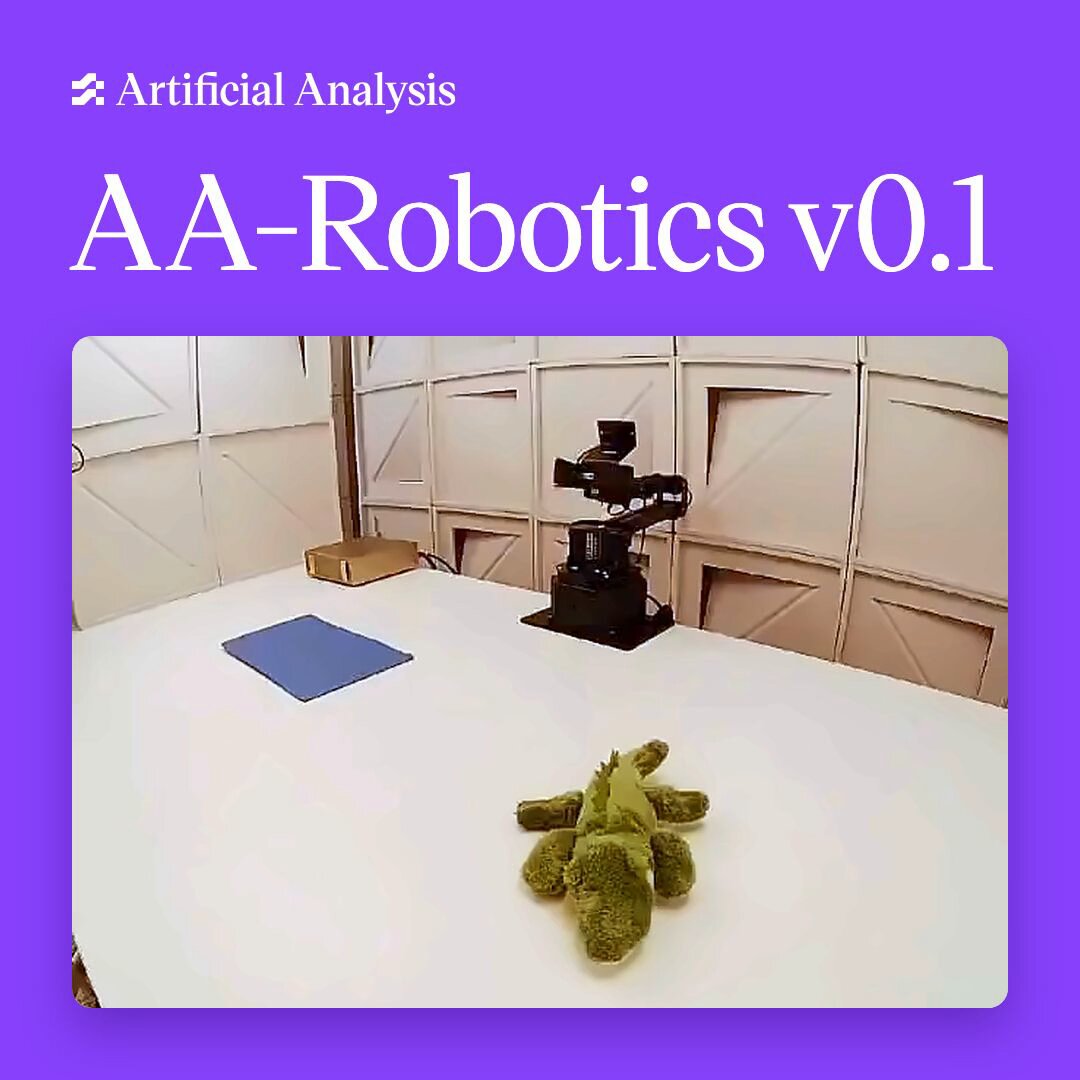
Artificial Analysis has launched AA-Robotics v0.1, a research preview that tests whether general language models can control a physical robot arm. The models are not robotics systems. Each runs inside its usual coding (GPT models in Codex, Claude models in Claude Code, Gemini 4 Argon in Antigravity, all at high effort) in an isolated container. The arm has six axes, five joints plus a gripper, but the model gets only brief instructions: how to reach it through a simple HTTP API, that it is a Hiwonder NexArm, with no further specifications, and how to submit an attempt. It sees the table through four cameras and has to write and run its own code to work out the arm and send movements. Each attempt is zero-shot, and the end state is graded against the task's pass criteria: a pass scores 100 and an incomplete attempt earns partial credit.
The eight tasks range from pressing a button to pouring a drink, packing blocks into a box with the lid on, writing hello world with a marker, building the tallest freestanding foam tower and measuring a box to within 2 mm. All five models passed the button press and the task of placing a toy crocodile inside a rectangle. No model passed the measuring task, where the best result was 17 points. OpenAI's GPT-6 Astra scored highest overall at 69.4, followed by GPT-6.1 Sol at 64.6, Google's Gemini 4 Argon at 55.3, and Anthropic's Claude Opus 5.5 at 48.8 and Claude Fable 5.1 at 46.3.
The bigger gap is time. Artificial Analysis says the models took about half an hour per task, against a human average of 20 seconds, which makes them roughly 100 times slower; four of the five averaged about 30 minutes, and Gemini 4 Argon averaged 52. Its activity breakdown shows where the time goes. Early in each run the models calibrate the arm and study the scene before acting at all, and Gemini 4 Argon spent an average of 21 minutes on this. After that, most of the time goes on planning, with short, precise arm movements between long planning steps, and the arm itself is moving for only a small share of the run. Cost is a smaller gap. GPT-6.1 Sol averaged $1.93 per task and GPT-6 Astra $16.36, and the most cost-effective model cost about ten times as much as a person paid the average US hourly wage of $37.81. About 70% of the spend goes on input, largely because the models have to process so much visual information.
The failures are physical as well as cognitive. Only 28% to 45% of each model's grasp attempts held the intended object, and the clips show blocks knocked off towers, bottles slipping and a cup pushed aside by the pour. Models also misjudged when they had finished. One kept adjusting a crocodile that was already inside the rectangle until it pushed it back over the edge, and GPT-6.1 Sol built a passing tower after about 17 minutes and then went on to fail the task. Artificial Analysis concludes that these models are far too slow and expensive for production robotics today, and says it expects that to change quickly.
- Each model drives a Hiwonder NexArm through a simple HTTP API with four camera views and no further arm specs, attempting eight tabletop tasks zero-shot, from pressing a button to pouring a drink and measuring a box within 2 mm.
- GPT-6 Astra leads at 69.4, then GPT-6.1 Sol 64.6, Gemini 4 Argon 55.3, Claude Opus 5.5 48.8 and Claude Fable 5.1 46.3; every model pressed the button and placed the toy, but none fully completed the box-measuring task.
- GPT-6.1 Sol costs $1.93 per task against GPT-6 Astra's $16.36 for a score four points lower, and about 70% of spend goes to input because models must process heavy visual information about an unfamiliar arm and scene.
- Grasping remains the weak link: only 28% to 45% of grasp attempts held the intended object through a lift or carry, with GPT-6 Astra and Claude Fable 5.1 best at about 45% and GPT-6.1 Sol worst at 28%.
- Models often keep refining after reaching a passing state and then undo it: GPT-6.1 Sol built a passing tower after about 17 minutes and still failed the task, and one run pushed a placed toy back over the edge three times.
- AI agent — An AI system that doesn't just answer once but works toward a goal in a loop — taking actions, reading the results, and deciding what to do next.
- context window — The maximum amount of text a model can consider at once — its working memory for the current conversation or task.
Checking sign-in…
Loading comments…