Do The Returns To Software Rnd Point Towards A Singularity
- Source
- epoch.ai
- Author
- Epoch AI publications
- Date
Context
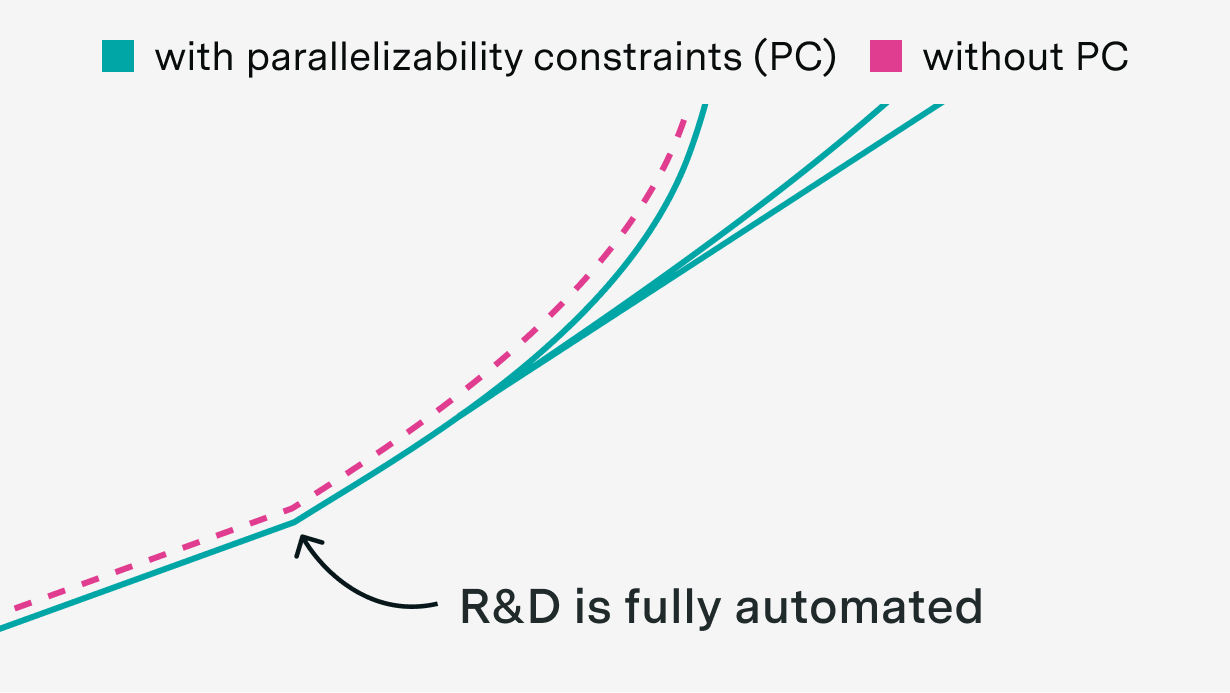
A software singularity is a scenario in which AI systems doing AI research improve AI software, which then does that research better, so that progress keeps accelerating even with a fixed stock of computing hardware. Whether that happens turns on what economists call the returns to research effort: if a proportional increase in research input yields a greater-than-proportional improvement, a value above one, growth in a simple model becomes hyperbolic and diverges in finite time; below one, it slows. This May 2024 summary from Epoch AI, of a paper by Tamay Besiroglu, Ege Erdil and Anson Ho, tries to measure that quantity for software (epoch.ai).
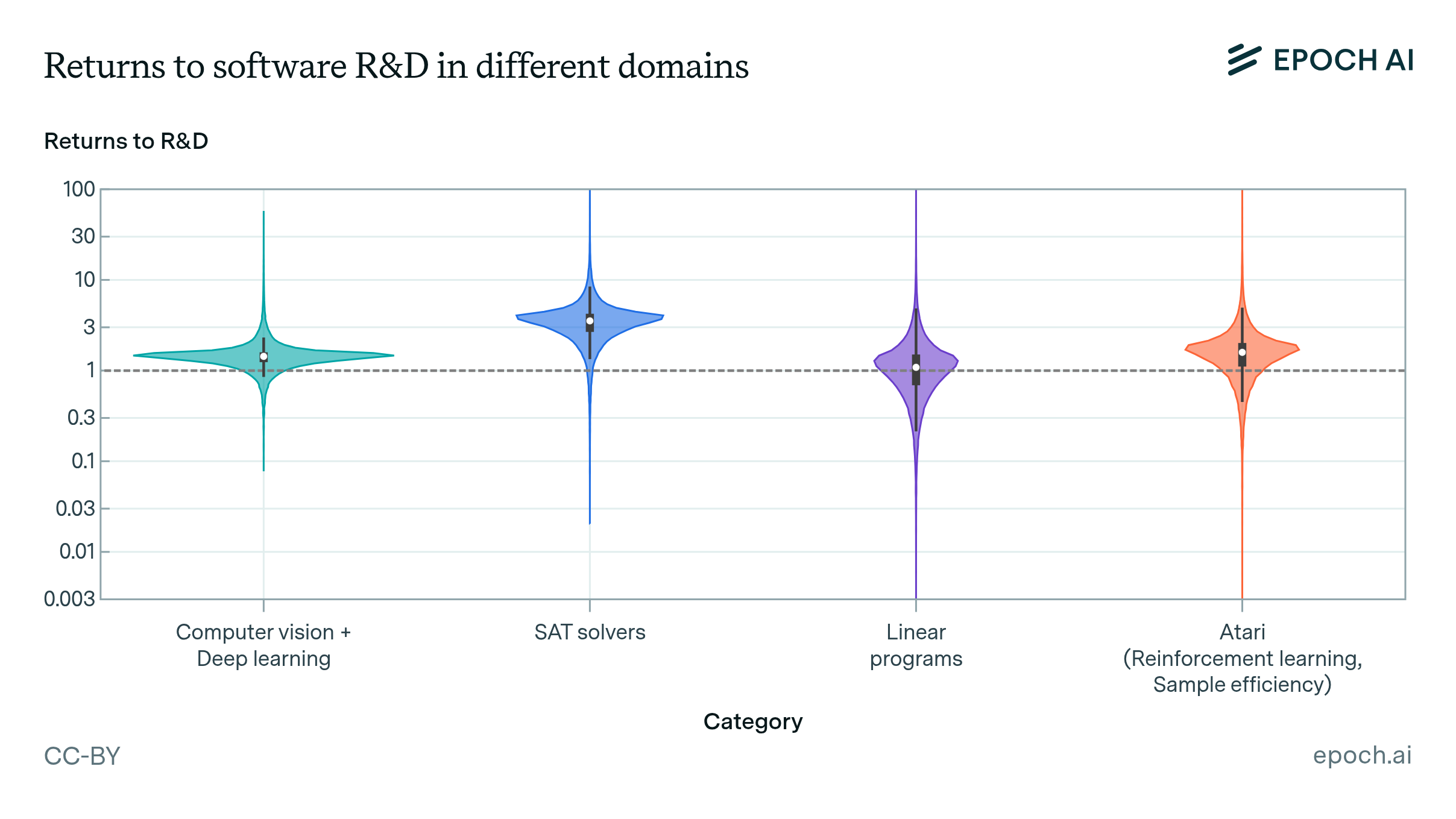
The best data come from the open-source Stockfish chess engine, where each proposed change is tested and its strength gain measured, and the number of tests run gives a measure of research input. There the central estimate is about 0.83, with a standard error of 0.15: just under the threshold, without ruling out a value above it. For computer vision, SAT solvers, linear programming and reinforcement learning, the authors had only an overall growth rate in efficiency plus counts of publishing authors, effectively one data point each, and used Bayesian estimation. Those median estimates all exceed one, but none is statistically significant, and some measure training or sample efficiency rather than the kind of improvement the singularity model assumes. For contrast, their replication of an estimate for the whole US economy gives about 0.25.
The authors' own conclusion is cautious. They write that the returns to software R&D might be high enough to drive hyperbolic growth from software alone, but that the evidence is not conclusive. Hardware and software have historically improved at similar rates, which suggests new algorithms partly depend on new hardware, and the simple model may overstate the case if experiments need computing power that software progress does not reduce. So they do not treat the data as strong evidence for a software singularity, while noting that hyperbolic growth from software and hardware improving together requires considerably weaker conditions.


Checking sign-in…
Loading comments…