Ling-3.1-flash open-sourced: 560B MoE, 1M context, 4-GPU serving
- Source
- x.com
- Date

Ling-3.1-flash is now open source: ~560B total parameters, ~25B active per token and up to 1M context. Built for real work, it can turn a rough brief into a page, mobile UI or interactive prototype teams can review and refine. See the demo.

For local serving, MXFP4 experts and block-FP8 dense layers cut weights from ~534GB to ~292GB; a tested Hopper setup moved from 8 GPUs to 4. In separate tests, 8 GPUs averaged 604ms to first token and 4 GPUs reached ~1.36 QPS. Workloads differed.
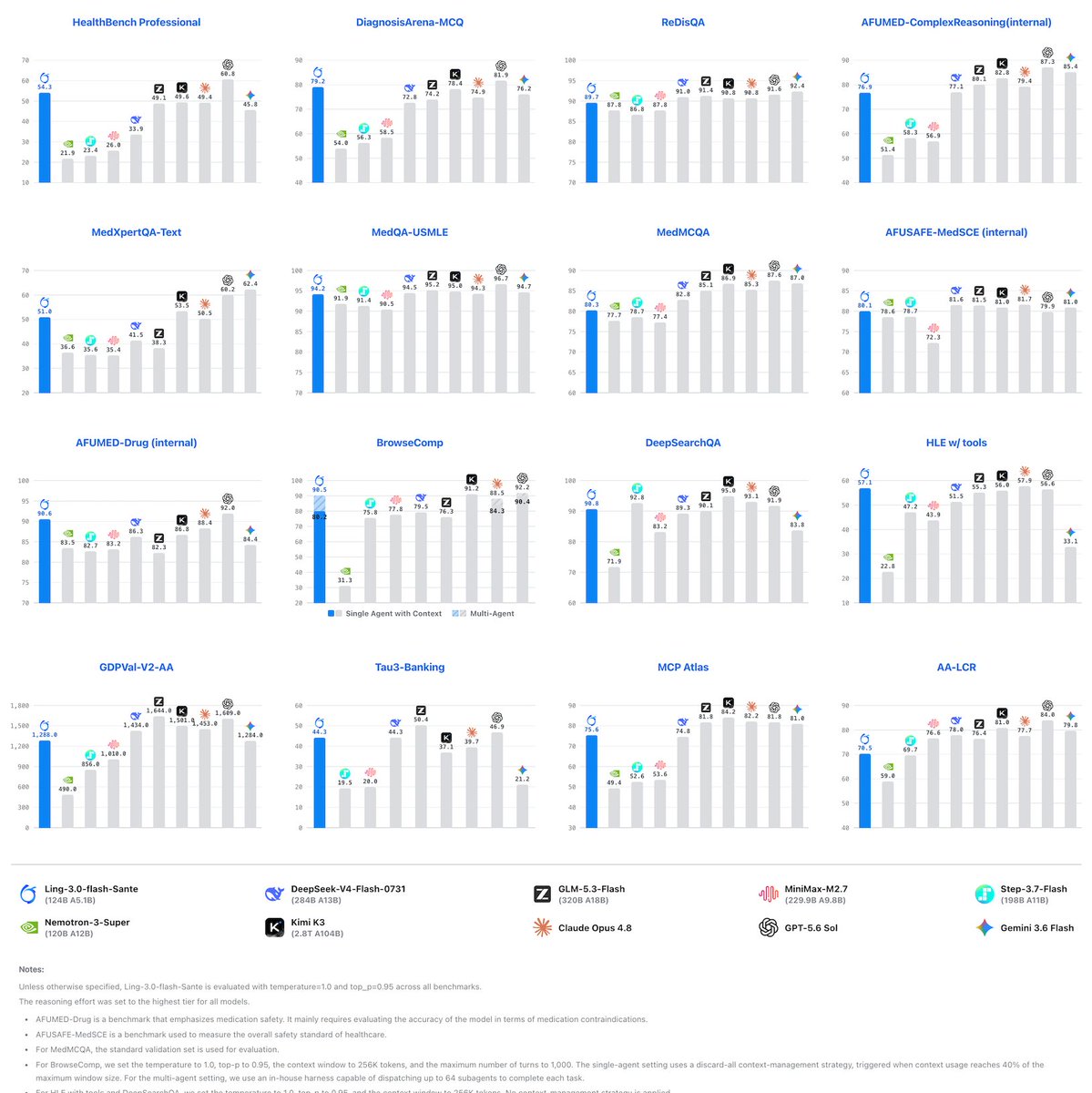
For a business assistant, capability matters alongside response speed. On the Artificial Analysis leaderboard, Ling-3.1-flash pairs an Intelligence Index of 41 with ~210 output tokens/s. This helps teams assess both dimensions for frequent use.

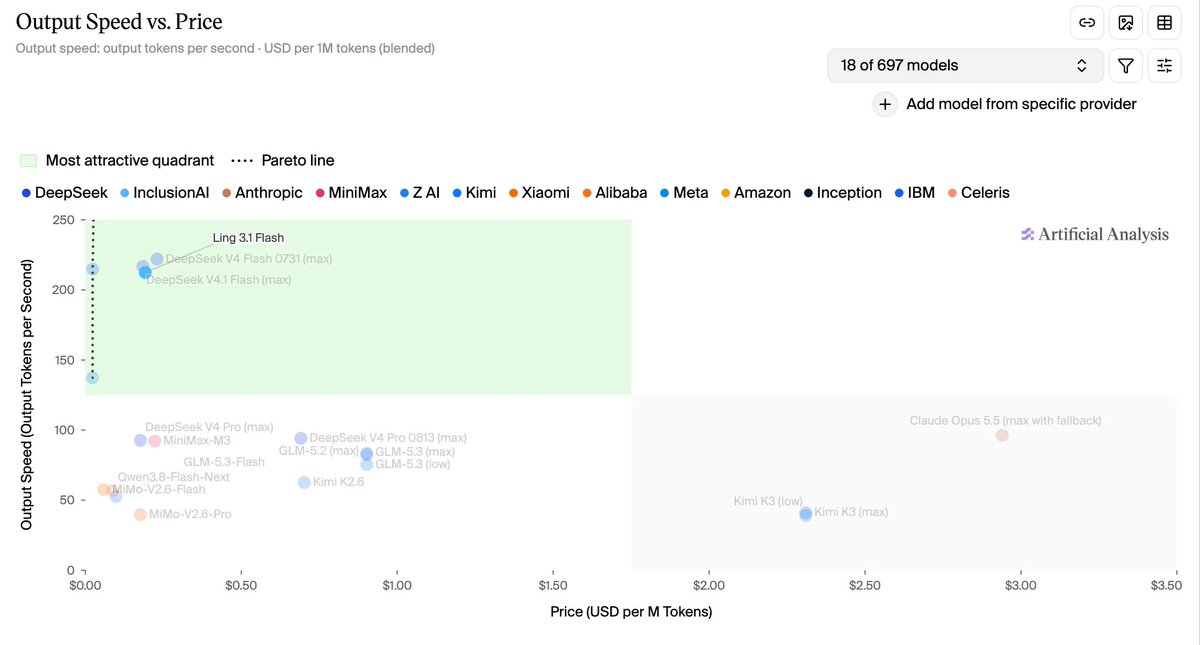
High-frequency use also has a budget constraint. A second Artificial Analysis view plots output speed against blended price: Ling-3.1-flash sits at ~210 tokens/s and ~$0.19 per 1M tokens. Provider prices may differ from this benchmark measure.
Context
Ant Group's Ling team, publishing as inclusionAI, has released for Ling-3.1-flash under the MIT license. The model was announced two weeks earlier with a promise to open-source it soon. Its model card describes about 560 billion parameters in total, about 25 billion active for each token, and a of up to 1 million tokens. It is a model: its expert layers hold 512 small expert networks, and a router sends each token through 8 of them plus 1 shared expert. Each token therefore touches only a small slice of the network, but the whole network still has to sit in GPU memory to serve it, which is why the headline size matters for hardware.
The four-GPU claim in the title is about shrinking that memory footprint. In the release thread, Ant Ling says storing the expert weights in MXFP4, a 4-bit number format, and the dense layers in block-FP8, an 8-bit one, cuts the weights from about 534GB to about 292GB, and that a tested setup on Nvidia Hopper GPUs went from 8 GPUs to 4. It also gives two performance figures: 8 GPUs averaged 604 milliseconds to the first token, and 4 GPUs reached about 1.36 queries per second. Ant Ling notes that these came from separate tests with different workloads, so they are not a like-for-like pair. The model card's own quickstart recipe uses 8 H200 GPUs, or 4 of Nvidia's newer GB300s, and does not itself describe the compressed build, so the four-Hopper result rests on the thread.
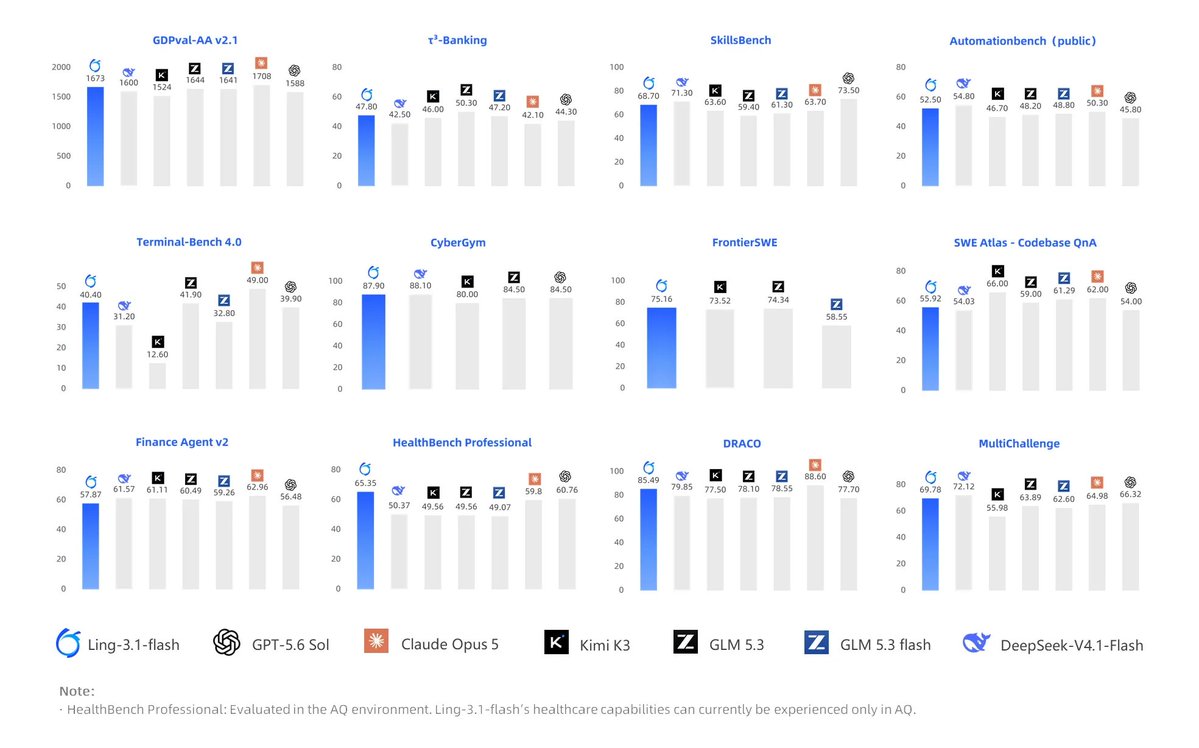
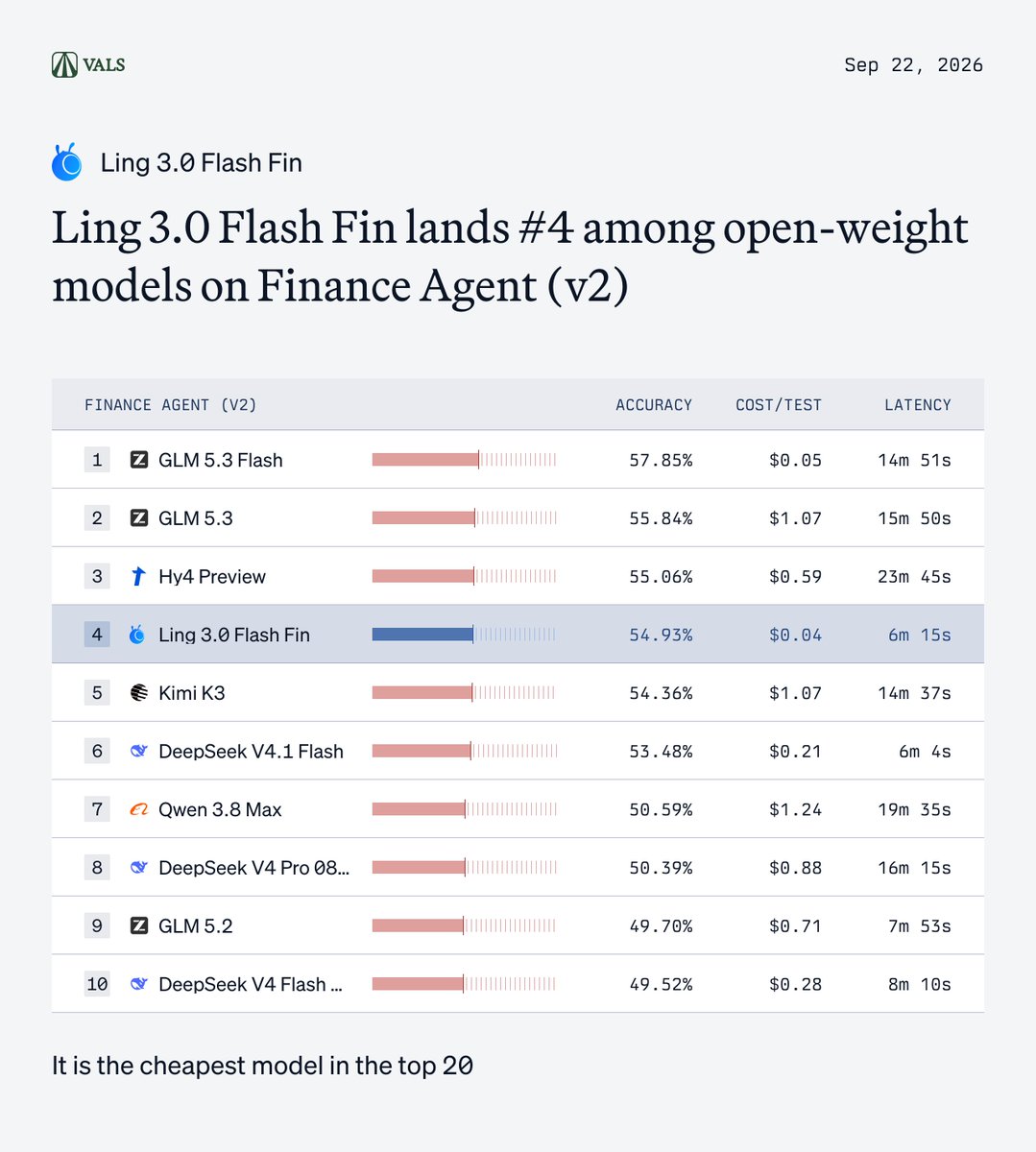
The rest of the thread positions the model for frequent business use. Ant Ling cites a score of 41 on the Artificial Analysis Intelligence Index, which Artificial Analysis reported as up from 20 for Ling 3.0 Flash, along with about 210 output tokens per second and a blended price of about $0.19 per million tokens on that benchmark's measure, noting that provider prices may differ. For generated front-end work, it says the model ranks third among open-weight models on Design Arena for React Native screens and 3D, fourth for SVG and fifth for websites. The SGLang and vLLM serving projects support the model.
- open weights — A model whose trained parameters are published for anyone to download and run — unlike API-only models you can access but never possess.
- context window — The maximum amount of text a model can consider at once — its working memory for the current conversation or task.
- mixture-of-experts — A model built from many specialist sub-networks where only a few activate per token, giving big-model capability at small-model running cost.
- quantization — Shrinking a model by storing its numbers less precisely — like rounding — so it runs faster and fits on smaller hardware, at a small quality cost.
Checking sign-in…
Loading comments…