AA-Robotics v0.1 benchmarks frontier LLMs on robot arms
- Source
- x.com
- Date

Welcome to the era of embodied AI. We are launching AA-Robotics v0.1, our research preview that measures frontier language model performance on understanding, planning, and acting in the physical world. In v0.1, each model is given control of a 6-axis robot arm (5 joints and a gripper) and a simple objective. We’re releasing results for our first eight tasks today. We find that frontier language models in coding agent harnesses have recently become capable of directly manipulating robot arms for simple tasks. Today, they are far too slow and expensive for any kind of production usage - nearly two orders of magnitude worse than human baselines. We expect this to change quickly. GPT-6 Astra places first in AA-Robotics v0.1, followed by GPT-6.1 Sol, Gemini 4 Argon and Claude Opus 5.5. AA-Robotics v0.1 details: ➤ Our first eight tasks test a range of capabilities: control and dexterity (precise grasping and object handling), spatial reasoning (how objects interact with one another) and adaptability (how models respond to the unexpected) ➤ Models get only brief instructions: how to connect to the robot arm (via a simple HTTP API), the arm's name and how to submit an attempt. They…

Frontier models in coding harnesses can now operate a robot arm for simple tasks, but run far too slowly and expensively for production. The gives a baseline for tracking when that changes.
- In AA-Robotics v0.1, each model controls a 6-axis arm through a simple HTTP API, sees the scene through four cameras, and writes code to plan moves. Attempts are zero-shot and graded on the end state, with partial credit for incomplete attempts.
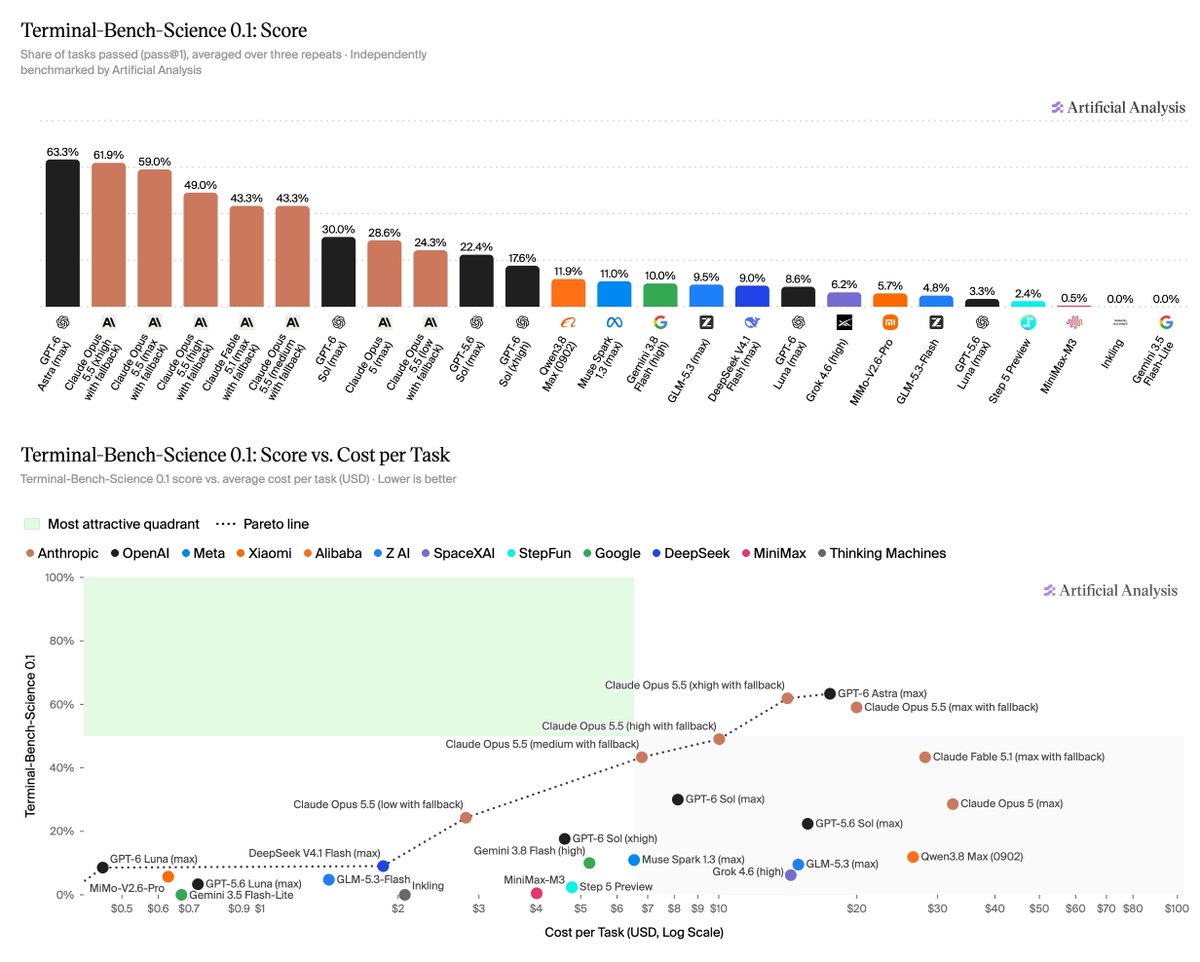
- Across the first eight tasks, GPT-6 Astra leads at 69, ahead of GPT-6.1 Sol at 65, Gemini 4 Argon at 55, Claude Opus 5.5 at 49 and Claude Fable 5.1 at 46.
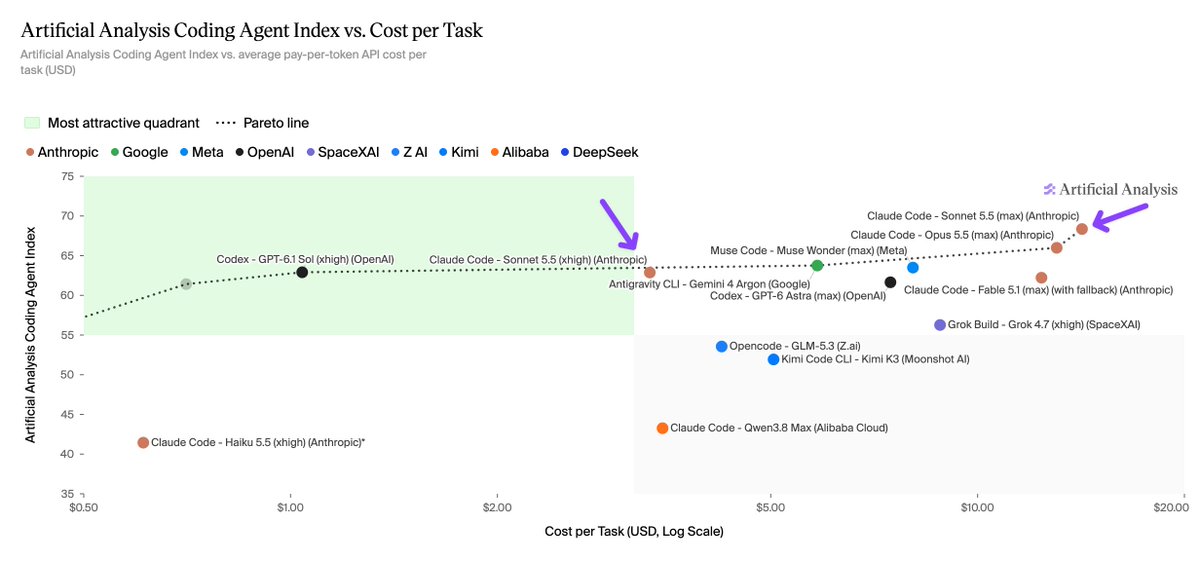
- Models take about 30 minutes per tabletop task on average. Cost ranges from $1.93 per task for GPT-6.1 Sol to $16.36 for GPT-6 Astra, more than eight times as much.
- Artificial Analysis estimates the best models are about 100x slower and 10x more expensive than a human, far from production use, though it expects that gap to close quickly.

Checking sign-in…
Loading comments…